
Phryganea sayi
This record describes Phryganea sayi (species). Recorded family: Phryganeidae. Recorded order: Trichoptera.
Identification and Appearance
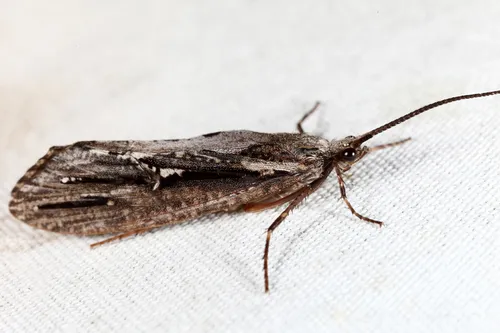
Adult: forewing brownish-gray with indistinct longitudinal streaking; black line (broken in middle) runs from near base almost to outer margin; small white spots present at both ends and middle of this line; a shorter black line closer to costa in distal half of wing has white spot at anterior end; slender whitish or pale gray patch at base of wing next to thorax; black line on side of head runs through eye; antennae thick, about two-thirds as long as forewing; legs with conspicuous short spines [description of genus copied from genus page ] no information on how to visually distinguish P. sayi from cinerea (the only other species in this genus) but cinerea has not been recorded south of Connecticut, according to the source listed in Internet References section below
Wikipedia reference for Phryganea sayi: https://en.wikipedia.org/wiki/Phryganea_sayi.
Classification
- Kingdom
- Animalia
- Phylum
- Arthropoda
- Class
- Insecta
- Order
- Trichoptera (Caddisflies)
- Suborder
- Integripalpia
- Superfamily
- Phryganeoidea
- Family
- Phryganeidae (Giant Casemaker Caddisflies)
- Genus
- Phryganea
Imported taxonomy record. Source availability varies; see the source references and editorial policy below.
Habitat and Range
Habitat
larvae live in ponds and marshes; adults found on nearby vegetation and are attracted to light
Geographic Range
south-central Canada (Quebec, Ontario, Saskatchewan) and northeastern United States, south to South Carolina, west to Arkansas, Kansas, and North Dakota; the only Phryganea species recorded in New Jersey, Delaware, Maryland, District of Columbia, Virginia, North Carolina, Tennessee, Kentucky, and West Virginia as of July 2008; absent from the west coast and gulf coast states
Seasonal Activity
adults fly in summer
Additional species information
Species notes from the sources
Etymology: Phryganea sayi Milne, 1931
About Caddisflies: the wider group
Order-level background for Trichoptera, the group containing Phryganea sayi. Species-specific details appear above.
Group overview
Trichoptera (caddisflies) includes ~14,500 described species worldwide. Larvae are aquatic and build protective cases from silk, sand, pebbles, and plant material - each species creates a distinctive case design.
Ecological role of the group
Caddisfly larvae are critical food sources for trout and other freshwater fish, making them essential to recreational fishing industries worth billions annually. Their silk is being researched as an underwater adhesive for medical applications.
Economic and practical significance of the group
Caddisfly larvae are among the most important biological indicators of water quality. Their presence or absence in streams is used by the EPA and state agencies to assess pollution levels and ecosystem health.
Recorded sources for this group: EPA, freshwater ecology research. Imported estimates may describe particular regions or reporting periods.
Frequently Asked Questions About Phryganea sayi
What is Phryganea sayi?
Phryganea sayi is a species in the family Phryganeidae, within the order Trichoptera.
How big is Phryganea sayi?
adult body length 14-25 mm
How do you identify Phryganea sayi?
Adult: forewing brownish-gray with indistinct longitudinal streaking; black line (broken in middle) runs from near base almost to outer margin; small white spots present at both ends and middle of this line; a shorter black line closer to costa in distal half of wing has white spot at anterior end; slender whitish or pale gray patch at base of wing next to thorax; black line on side of head runs through eye; antennae thick, about two-thirds as long as forewing; legs with conspicuous short spines [description of genus copied from genus page ] no information on how to visually distinguish P. sayi from cinerea (the only other species in this genus) but cinerea has not been recorded south of Connecticut, according to the source listed in Internet References section below
Where is Phryganea sayi found?
| Feature | Details |
|---|---|
| Habitat | larvae live in ponds and marshes; adults found on nearby vegetation and are attracted to light |
| Range | south-central Canada (Quebec, Ontario, Saskatchewan) and northeastern United States, south to South Carolina, west to Arkansas, Kansas, and North Dakota; the only Phryganea species recorded in New Jersey, Delaware, Maryland, District of Columbia, Virginia, North Carolina, Tennessee, Kentucky, and West Virginia as of July 2008; absent from the west coast and gulf coast states |
When is Phryganea sayi active?
Phryganea sayi: seasonal activity - adults fly in summer.