
Photinus indictus
This record describes Photinus indictus (species). Recorded family: Lampyridae. Recorded order: Coleoptera.
Identification and Appearance
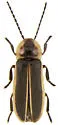
| Feature | Description |
|---|---|
| Additional details | MALE, Form similar to P. consanguineus . |
| Pronotum | Pronotum with median dark vitta attaining base and sometimes nearly apex, one-third to two-fifths as wide as convex disk, slightly narrowing posteriorly, sometimes abruptly expanding near base. Scutellum and mesonotal areas dark piceous. |
| Elytra | Elytra piceous black, sutural bead flavate usually to scutellum, lateral pale border wider, slightly exceeding width of explanate margin, continuous around apex, pale borders well defined. Ventral segments dark piceous, segments 6 to 8 often irregularly paler; pygidium with sides and apex broadly pale. |
| Eyes | Eyes small , separated medially above by more than diameter of eye. Disk of pronotum finely and sparsely punctulate, median longitudinal line not impressed. Epipleurae narrow except at base. Ventral segments 6 and 7 each subequal in length to segment 5, light organs lacking ; pygidium broadly truncate. Aedeagus similar to P. consanguineus . FEMALE. Alate (winged), similar to male. |
| Eyes | Eyes slightly smaller. Ventral segments uniformly piceous black or brownish, varying with distal segments irregularly more or less pale, light organs lacking; pygidium narrowly rounded at apex. |
Classification
- Kingdom
- Animalia
- Phylum
- Arthropoda
- Class
- Insecta
- Order
- Coleoptera (Beetles)
- Suborder
- Polyphaga
- Superfamily
- Elateroidea
- Family
- Lampyridae (Fireflies)
- Subfamily
- Lampyrinae
- Tribe
- Lucidotini
- Genus
- Photinus
Imported taxonomy record. Source availability varies; see the source references and editorial policy below.
Habitat and Range
Geographic Range
Appalachia to Great Plains
About Primitive Winged Insects: the wider group
Order-level background for Coleoptera, the group containing Photinus indictus. Species-specific details appear above.
Group overview
Coleoptera is the largest order of insects with over 400,000 described species, representing ~25% of all known animal species and ~40% of all insects. In the U.S. alone, nearly 30,000 beetle species have been identified.
Ecological role of the group
Beetles are prominent decomposers, especially in forests, breaking down dead wood and recycling nutrients. As predators, they reduce populations of pest insects. Many species are also important pollinators of flowering plants.
Economic and practical significance of the group
Beetles have major economic significance: leaf beetles (Chrysomelidae) and weevils (Curculionoidea) are among the most destructive agricultural pests globally, costing billions annually, while predatory species like ladybugs provide natural pest control.
Recorded sources for this group: Britannica, Smithsonian, NCSU Entomology. Imported estimates may describe particular regions or reporting periods.
Photos of Photinus indictus (5)
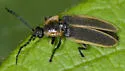
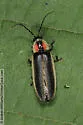
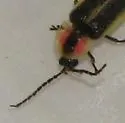
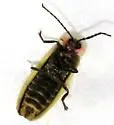
Photo credits: Contributed by Nicolas Gompel; Additional contributions by Mike Quinn , Stephen Luk , v belov
Frequently Asked Questions About Photinus indictus
What is Photinus indictus?
Photinus indictus is a species in the family Lampyridae, within the order Coleoptera.
How big is Photinus indictus?
Both sexes, 6.5-8 mm
How do you identify Photinus indictus?
| Feature | Description |
|---|---|
| Additional details | MALE, Form similar to P. consanguineus . |
| Pronotum | Pronotum with median dark vitta attaining base and sometimes nearly apex, one-third to two-fifths as wide as convex disk, slightly narrowing posteriorly, sometimes abruptly expanding near base. Scutellum and mesonotal areas dark piceous. |
| Elytra | Elytra piceous black, sutural bead flavate usually to scutellum, lateral pale border wider, slightly exceeding width of explanate margin, continuous around apex, pale borders well defined. Ventral segments dark piceous, segments 6 to 8 often irregularly paler; pygidium with sides and apex broadly pale. |
| Eyes | Eyes small , separated medially above by more than diameter of eye. Disk of pronotum finely and sparsely punctulate, median longitudinal line not impressed. Epipleurae narrow except at base. Ventral segments 6 and 7 each subequal in length to segment 5, light organs lacking ; pygidium broadly truncate. Aedeagus similar to P. consanguineus . FEMALE. Alate (winged), similar to male. |
| Eyes | Eyes slightly smaller. Ventral segments uniformly piceous black or brownish, varying with distal segments irregularly more or less pale, light organs lacking; pygidium narrowly rounded at apex. |
Where is Photinus indictus found?
Range: Appalachia to Great Plains