
Elegant Tarantula-hawk Wasp
Pepsis menechma
This record describes Pepsis menechma (species). Recorded family: Pompilidae. Recorded order: Hymenoptera.
Identification and Appearance
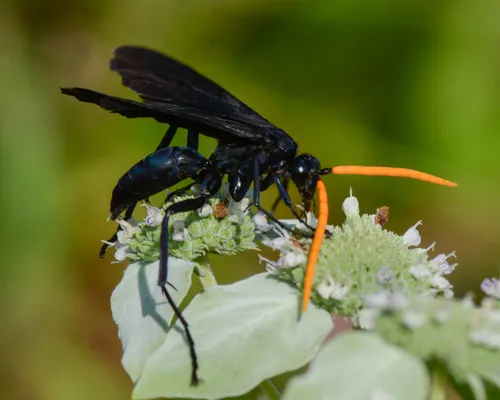
The western cerberus form is orange-winged (dark-bordered), with antennae entirely dark (black to dark brown). The eastern elegans form is a large, blue-black wasp with orange antennae and wings black...likely mimicked by an ichneumonid wasp, Thyreodon atricolor : Rarely encountered is a third form, once known by the name P. novitia , with orange wings and antennae mostly dark...with a few apical segments orange. Pepsis elegans and Pepsis cerberus (its Western counterpart) were recently synonymized under the name Pepsis menechma (by Vardy in 2005). Original description of Pepsis menechma : Histoire naturelle des insectes. Hyménoptères, volume 3, p. 481 BHL link A species of Hogna had been noted as a host species in this reference: Kurczewski FE, et al. New and unusual host records for North American and South American spider wasps (Hymenoptera: Pompilidae). Zootaxa. 2020 Dec 7;4891:zootaxa.4891.1.1. doi: 10.11646/zootaxa.4891.1.1 . PMID: 33311100. However the wasp in that publication, originally labelled Pepsis basifusca , was a misidentified Entypus species (personal communication from Dr. Kurczewski to Patrick Coin, 12/28/22).
Classification
- Kingdom
- Animalia
- Phylum
- Arthropoda
- Class
- Insecta
- Order
- Hymenoptera (Ants, Bees, Wasps and Sawflies)
- Superfamily
- Pompiloidea
- Family
- Pompilidae (Spider Wasps)
- Subfamily
- Pepsinae
- Tribe
- Pepsini
- Genus
- Pepsis (Tarantula-hawk Wasps)
Imported taxonomy record. Source availability varies; see the source references and editorial policy below.
Habitat and Range
Geographic Range
The orange-winged " cerberus " form is recorded from Arizona, Texas, and Kansas, as well as south into Mexico. The all black " elegans " form ranges throughout the eastern and central United States (from PA west to KS, and south to FL and TX) . It is apparently the only Pepsis in the east (outside possible strays of P. marginata and P. saphirus from the West Indies).
Seasonal Activity
Summer-early fall. June-September (North Carolina) ( 3 ) .
Diet and Behavior
Diet: Adults take nectar.
Life History
Females presumably deposit eggs to develop as parasitoids on large spiders, though not necessarily always tarantulas since much of this species' range lies east of that of our native tarantulas (which occur west of the Mississippi ( 4 ) ). The more easterly populations of P. menenchma (i.e. " P. elegans ") may prey on trapdoor spiders (cf. 2nd sentence here , from Ebeling's 1975 "Urban Entomology" from the Univ. California, Riverside, which states that Pepsis prey on "trapdoor spiders and tarantulas"). Vardy (2005) states that there are no prey records for Pepsis menechma and closely-related species.
Additional species information
Species notes from the sources
Etymology: Meaning of species name menechma is a bit obscure. Lepeletier ( BHL link ) called it, in French, Pepsis Menechme . A French Dictionary gives, with English translations by Google: ménechme (nominal): gémeau, jumeau (both meaning twin), sosie (doppelgänger). This is a reference to the Roman comedy, based on a Greek original, The Menaechmi Twins . Seems that Lepeletier was referring to the similarity of menechma to the species he discussed immediately preceding, luteicornis .
About Flies: the wider group
Order-level background for Hymenoptera, the group containing Pepsis menechma. Species-specific details appear above.
Group overview
Hymenoptera includes over 150,000 described species of ants, bees, wasps, and sawflies. Earth harbors approximately 20 quadrillion (20×10^15) ants, with a combined biomass of ~12 megatons of dry carbon - exceeding the combined biomass of all wild birds and mammals (PNAS, 2022).
Ecological role of the group
About 35% of the world's food crops depend on animal pollinators. The chocolate industry, valued at over $100 billion, depends on pollinating flies and midges. Ants are the dominant soil engineers in most terrestrial ecosystems, turning more soil than earthworms in many habitats.
Economic and practical significance of the group
Pollinators contribute $235-577 billion worth of annual global food production (FAO). In the U.S., bee pollination alone benefits crops valued at $18 billion annually, and honey bees are responsible for $5.4 billion in agricultural productivity. Between April 2023-2024, 55.1% of managed honey bee colonies were lost. The U.S. bee population dropped from 5 million to 2.5 million.
Recorded sources for this group: FAO, USDA, EPA, PNAS (2022), US Fish & Wildlife Service. Imported estimates may describe particular regions or reporting periods.
Photos of Elegant Tarantula-hawk Wasp (2)
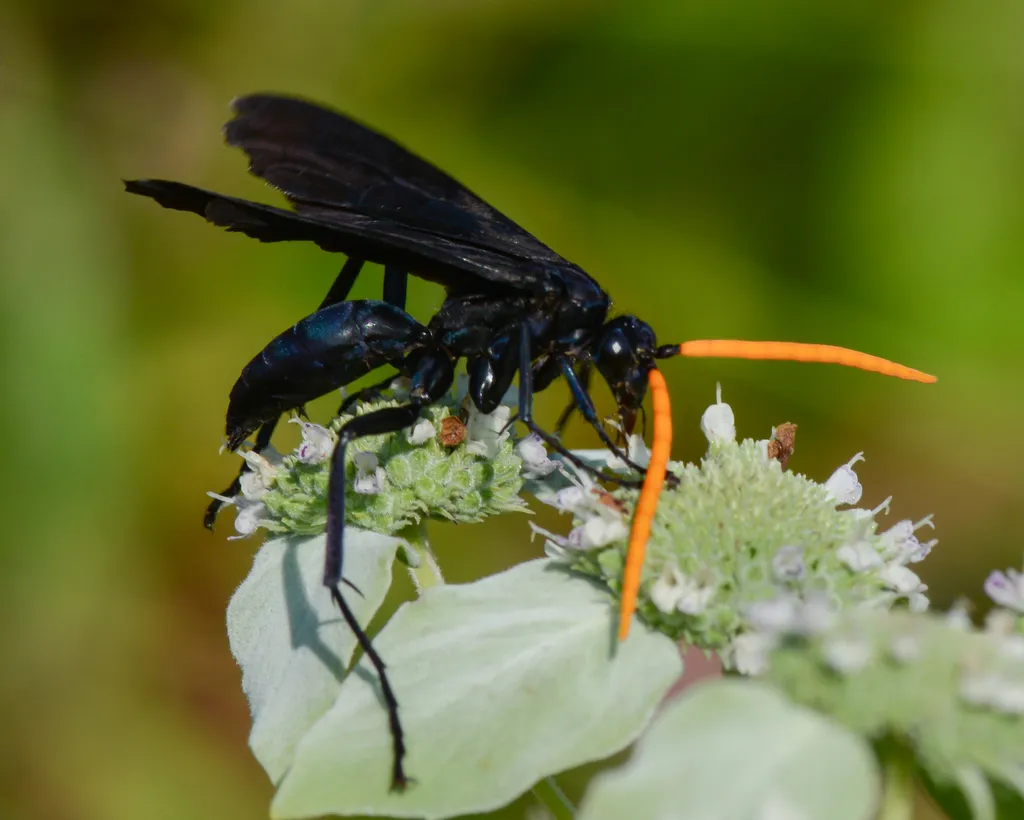
Photo credits: Contributed by Cotinis; Additional contributions by waspGeorge , Aaron Schusteff , PaleoJon
Frequently Asked Questions About Elegant Tarantula-hawk Wasp
What is Elegant Tarantula-hawk Wasp?
Elegant Tarantula-hawk Wasp (Pepsis menechma) is a species in the family Pompilidae, within the order Hymenoptera.
How big is Elegant Tarantula-hawk Wasp?
Circa 20-25 mm. A female specimen from North Carolina measured 22 mm body length. Vardy (2005), p. 133, gives body lengths: 18-26 mm (male), 16-28 mm (female).
How do you identify Elegant Tarantula-hawk Wasp?
The western cerberus form is orange-winged (dark-bordered), with antennae entirely dark (black to dark brown). The eastern elegans form is a large, blue-black wasp with orange antennae and wings black...likely mimicked by an ichneumonid wasp, Thyreodon atricolor : Rarely encountered is a third form, once known by the name P. novitia , with orange wings and antennae mostly dark...with a few apical segments orange.
Where is Elegant Tarantula-hawk Wasp found?
Range: The orange-winged cerberus form is recorded from Arizona, Texas, and Kansas, as well as south into Mexico. The all black elegans form ranges throughout the eastern and central United States (from PA west to KS, and south to FL and TX) . It is apparently the only Pepsis in the east (outside possible strays of P. marginata and P. saphirus from the West Indies).
What does Elegant Tarantula-hawk Wasp eat?
The diet of the Elegant Tarantula-hawk Wasp includes Adults take nectar..
When is Elegant Tarantula-hawk Wasp active?
Elegant Tarantula-hawk Wasp: seasonal activity - Summer-early fall. June-September (North Carolina) ( 3 ) ..
What is the life cycle of a Elegant Tarantula-hawk Wasp?
Females presumably deposit eggs to develop as parasitoids on large spiders, though not necessarily always tarantulas since much of this species' range lies east of that of our native tarantulas (which occur west of the Mississippi ( 4 ) ). The more easterly populations of P. menenchma (i.e. P. elegans ) may prey on trapdoor spiders (cf. 2nd sentence here , from Ebeling's 1975 Urban Entomology from the Univ. California, Riverside, which states that Pepsis prey on trapdoor spiders and tarantulas). Vardy (2005) states that there are no prey records for Pepsis menechma and closely-related species.