
Paramordellaria triloba
This record describes Paramordellaria triloba (species). Recorded family: Mordellidae. Recorded order: Coleoptera.
Identification and Appearance
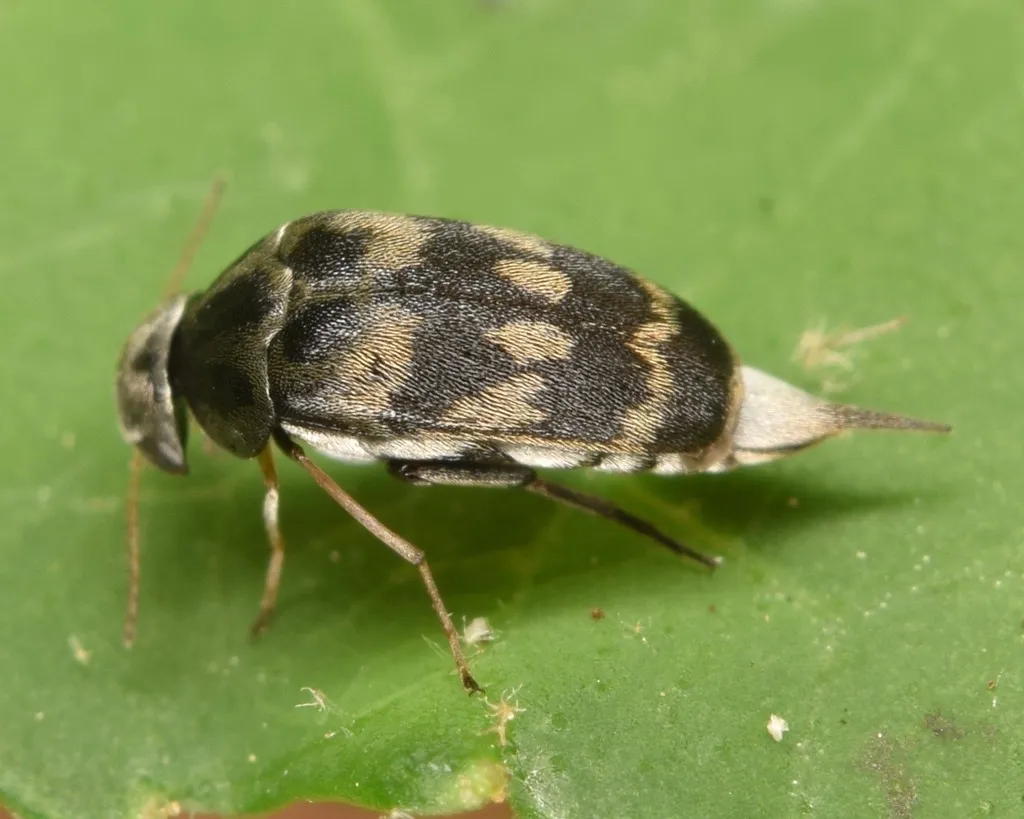
| Feature | Description |
|---|---|
| Additional details | Description : Subcuneiform, broadest in female; black, except mouthparts, antennae, and legs which are fuscotestaceous; head with fine pubescence; thorax with irregular lines or marks of yellowish gray pubescence comprising a line oil each side of middle from base to near apex, with sides more or less diffused; elytra with three such bands, one near base (broad and curved from near humeral angle to suture, enclosing a large scutellar black spot), one at middle (broad, reaching suture and side margin), and a similar band one-fourth from apex, with yellowish gray pubescence; these bands in some specimens may be connected with a narrow marginal line of similar pubescence; remainder of elytra and thorax above with black pubescence ; underside with grayish pubescence; anal style rather thickly covered with silvery pubescence. |
| Head | Head rather large, minutely punctured; eyes reaching occiput, finely granulated and hairy; antennae short, with segments five to ten serrate; last segment of maxillary palpi elongate securiform. |
| Pronotum | Pronotum nearly twice as broad as long, broader than elytra at base and more coarsely punctured; base in front of scutellum broadly rounded, basal angles obtuse; scutellum triangular, rounded at apex. |
| Elytra | Elytra reticulate, coarsely punctured; apex rounded with distinct margin; anterior tarsi with fourth segment dilated; middle tibiae as long as all five tarsal segments of same pair of legs; posterior tibiae with usual subapical ridge, and a carinated dorsal ridge along outer margin, and a similar less pronounced carinated ridge on first segment of posterior tarsi; anal style long and slender, pointed. |
Wikipedia reference for Paramordellaria triloba: https://en.wikipedia.org/wiki/Paramordellaria_triloba.
Classification
- Kingdom
- Animalia
- Phylum
- Arthropoda
- Class
- Insecta
- Order
- Coleoptera (Beetles)
- Suborder
- Polyphaga
- Superfamily
- Tenebrionoidea
- Family
- Mordellidae (Tumbling Flower Beetles)
- Tribe
- Mordellini
- Genus
- Paramordellaria
Imported taxonomy record. Source availability varies; see the source references and editorial policy below.
Habitat and Range
Geographic Range
e. NA (QC-NC to MB-KS-AL) - Map
Seasonal Activity
mostly: Jun-Jul (BG data)
Additional species information
Species notes from the sources
Etymology: Paramordellaria triloba (Say 1824)
About Primitive Winged Insects: the wider group
Order-level background for Coleoptera, the group containing Paramordellaria triloba. Species-specific details appear above.
Group overview
Coleoptera is the largest order of insects with over 400,000 described species, representing ~25% of all known animal species and ~40% of all insects. In the U.S. alone, nearly 30,000 beetle species have been identified.
Ecological role of the group
Beetles are prominent decomposers, especially in forests, breaking down dead wood and recycling nutrients. As predators, they reduce populations of pest insects. Many species are also important pollinators of flowering plants.
Economic and practical significance of the group
Beetles have major economic significance: leaf beetles (Chrysomelidae) and weevils (Curculionoidea) are among the most destructive agricultural pests globally, costing billions annually, while predatory species like ladybugs provide natural pest control.
Recorded sources for this group: Britannica, Smithsonian, NCSU Entomology. Imported estimates may describe particular regions or reporting periods.
Photos of Paramordellaria triloba (3)
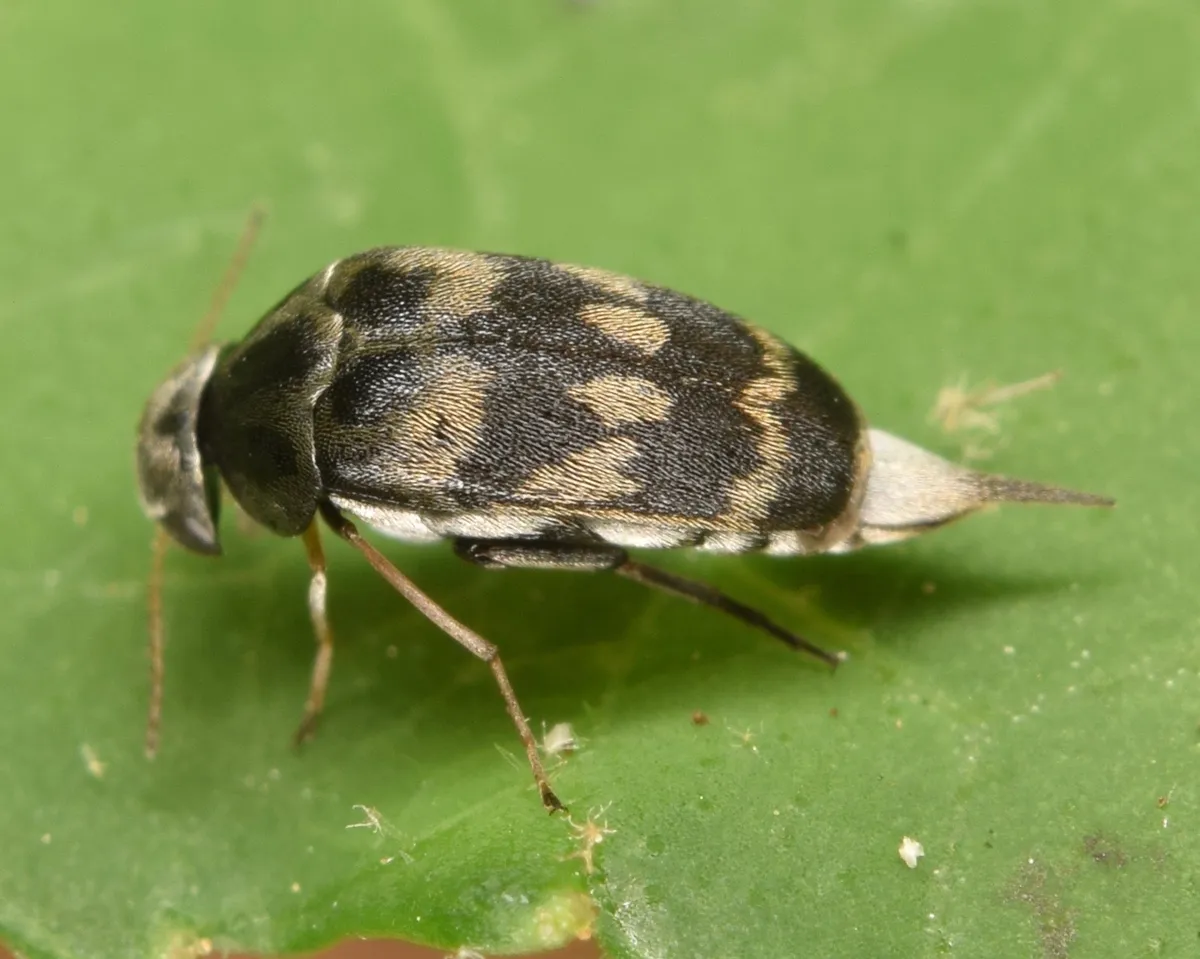
Photo credits: Contributed by Tim Moyer; Additional contributions by cotinis , Mike Quinn , v belov
Frequently Asked Questions About Paramordellaria triloba
What is Paramordellaria triloba?
Paramordellaria triloba is a species in the family Mordellidae, within the order Coleoptera.
How big is Paramordellaria triloba?
Length to apices of elytra 3.5 mm; to tip of anal style, 4.5 mm
How do you identify Paramordellaria triloba?
| Feature | Description |
|---|---|
| Additional details | Description : Subcuneiform, broadest in female; black, except mouthparts, antennae, and legs which are fuscotestaceous; head with fine pubescence; thorax with irregular lines or marks of yellowish gray pubescence comprising a line oil each side of middle from base to near apex, with sides more or less diffused; elytra with three such bands, one near base (broad and curved from near humeral angle to suture, enclosing a large scutellar black spot), one at middle (broad, reaching suture and side margin), and a similar band one-fourth from apex, with yellowish gray pubescence; these bands in some specimens may be connected with a narrow marginal line of similar pubescence; remainder of elytra and thorax above with black pubescence ; underside with grayish pubescence; anal style rather thickly covered with silvery pubescence. |
| Head | Head rather large, minutely punctured; eyes reaching occiput, finely granulated and hairy; antennae short, with segments five to ten serrate; last segment of maxillary palpi elongate securiform. |
| Pronotum | Pronotum nearly twice as broad as long, broader than elytra at base and more coarsely punctured; base in front of scutellum broadly rounded, basal angles obtuse; scutellum triangular, rounded at apex. |
| Elytra | Elytra reticulate, coarsely punctured; apex rounded with distinct margin; anterior tarsi with fourth segment dilated; middle tibiae as long as all five tarsal segments of same pair of legs; posterior tibiae with usual subapical ridge, and a carinated dorsal ridge along outer margin, and a similar less pronounced carinated ridge on first segment of posterior tarsi; anal style long and slender, pointed. |
Where is Paramordellaria triloba found?
Range: e. NA (QC-NC to MB-KS-AL) - Map
When is Paramordellaria triloba active?
Paramordellaria triloba: seasonal activity - mostly: Jun-Jul (BG data).