
Pachybrachis stygicus
This record describes Pachybrachis stygicus (species). Recorded family: Chrysomelidae. Recorded order: Coleoptera.
Identification and Appearance
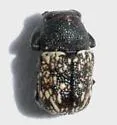
a common, widespread species from the mid-Atlantic Coast to the 100th meridian (Map 1B). While virtually totally black specimens can be found from Florida to Nebraska, trends to a paler form in the southwestern part of its range. Det. E. G. Riley, 2010 Original description of syn Pachybrachis vestigialis by Fall : close to ... atomarius . It varies in color from almost entirely black (typical) to the usual confusedly mottled form so frequent in atomarius . In the type the head has two small obscure yellow spots on the vertex, two or three others very small and barely discernible on the prothorax, and on the elytra a few small brighter yellow spots along the base and in an irregular transverse line behind the middle, of which the bright yellow dot-like shield is the most conspicuous; middle and hind thighs with a small yellow apical spot. In another example the shield is dimly visible, the other pale spots nearly or quite obliterated, the head, prothorax and legs entirely black. The basal joint of the antennae is entirely black, second joint brownish, following joints yellow, the outer three or four infuscate. Eyes a little more distant than in atomarius , being separated in the male by a little more than twice the length of the basal antennal joint. Punctuation of upper surface very dense throughout, and even more broadly confused than in atomarius , with few indications of strial arrangement, chiefly along the sides, and these scarcely at all impressed. The slightly more distant eyes, which are a trifle more prominent, entirely black basal joint of the antennae, and rather dense more completely confused elytral punctuation will, I think, enable the student to separate this from atomarius . (Fall 1915)
Classification
- Kingdom
- Animalia
- Phylum
- Arthropoda
- Class
- Insecta
- Order
- Coleoptera (Beetles)
- Suborder
- Polyphaga
- Superfamily
- Chrysomeloidea
- Family
- Chrysomelidae (Leaf Beetles)
- Subfamily
- Cryptocephalinae
- Tribe
- Cryptocephalini
- Genus
- Pachybrachis (Scriptured Leaf Beetles)
Imported taxonomy record. Source availability varies; see the source references and editorial policy below.
Habitat and Range
Geographic Range
se US (TX-FL-NC-SD) - Map
Seasonal Activity
Mar-Nov (BG data)
Diet and Behavior
Life History
The following potential host plants were listed on labels: Lepidium virginicum L. (Brassicaceae) in Florida, Quercus laevis Walter in Georgia, E. capillifolium in Georgia and North Carolina, and Coreopsis cardaminefolia (= tinctoria Nutt.) (Asteraceae), Rudbeckia sp. (Asteraceae), Englemannia sp. (Asteraceae), Ptilimnium sp. (Apiaceae), and Eleocharis sp. (Cyperaceae) in Texas.
Additional species information
Species notes from the sources
Etymology: Pachybrachis stygicus Fall 1915
About Primitive Winged Insects: the wider group
Order-level background for Coleoptera, the group containing Pachybrachis stygicus. Species-specific details appear above.
Group overview
Coleoptera is the largest order of insects with over 400,000 described species, representing ~25% of all known animal species and ~40% of all insects. In the U.S. alone, nearly 30,000 beetle species have been identified.
Ecological role of the group
Beetles are prominent decomposers, especially in forests, breaking down dead wood and recycling nutrients. As predators, they reduce populations of pest insects. Many species are also important pollinators of flowering plants.
Economic and practical significance of the group
Beetles have major economic significance: leaf beetles (Chrysomelidae) and weevils (Curculionoidea) are among the most destructive agricultural pests globally, costing billions annually, while predatory species like ladybugs provide natural pest control.
Recorded sources for this group: Britannica, Smithsonian, NCSU Entomology. Imported estimates may describe particular regions or reporting periods.
Photos of Pachybrachis stygicus (5)
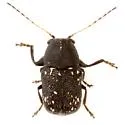
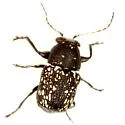
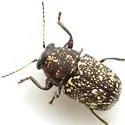
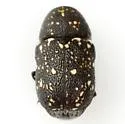
Photo credits: Contributed by Mike Quinn
Frequently Asked Questions About Pachybrachis stygicus
What is Pachybrachis stygicus?
Pachybrachis stygicus is a species in the family Chrysomelidae, within the order Coleoptera.
How big is Pachybrachis stygicus?
L = 1.98–2.33 mm (mean = 2.12 mm, n = 10) - male L = 2.15–2.52 mm (mean = 2.27 mm, n = 10) - female
How do you identify Pachybrachis stygicus?
a common, widespread species from the mid-Atlantic Coast to the 100th meridian (Map 1B). While virtually totally black specimens can be found from Florida to Nebraska, trends to a paler form in the southwestern part of its range. Det. E. G. Riley, 2010 Original description of syn Pachybrachis vestigialis by Fall : close to ... atomarius . It varies in color from almost entirely black (typical) to the usual confusedly mottled form so frequent in atomarius . In the type the head has two small obscure yellow spots on the vertex, two or three others very small and barely discernible on the prothorax, and on the elytra a few small brighter yellow spots along the base and in an irregular transverse line behind the middle, of which the bright yellow dot-like shield is the most conspicuous; middle and hind thighs with a small yellow apical spot. In another example the shield is dimly visible, the other pale spots nearly or quite obliterated, the head, prothorax and legs entirely black. The basal joint of the antennae is entirely black, second joint brownish, following joints yellow, the outer three or four infuscate. Eyes a little more distant than in atomarius , being separated in the male by a little more than twice the length of the basal antennal joint. Punctuation of upper surface very dense throughout, and even more broadly confused than in atomarius , with few indications of strial arrangement, chiefly along the sides, and these scarcely at all impressed. The slightly more distant eyes, which are a trifle more prominent, entirely black basal joint of the antennae, and rather dense more completely confused elytral punctuation will, I think, enable the student to separate this from atomarius . (Fall 1915)
Where is Pachybrachis stygicus found?
Range: se US (TX-FL-NC-SD) - Map
When is Pachybrachis stygicus active?
Pachybrachis stygicus: seasonal activity - Mar-Nov (BG data).
What is the life cycle of a Pachybrachis stygicus?
The following potential host plants were listed on labels: Lepidium virginicum L. (Brassicaceae) in Florida, Quercus laevis Walter in Georgia, E. capillifolium in Georgia and North Carolina, and Coreopsis cardaminefolia (= tinctoria Nutt.) (Asteraceae), Rudbeckia sp. (Asteraceae), Englemannia sp. (Asteraceae), Ptilimnium sp. (Apiaceae), and Eleocharis sp. (Cyperaceae) in Texas.