
Pachybrachis femoratus
This record describes Pachybrachis femoratus (species). Recorded family: Chrysomelidae. Recorded order: Coleoptera.
Identification and Appearance
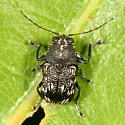
| Feature | Description |
|---|---|
| Additional details | Small to medium in size, females quite robust, blackish and dull yellow, mottled, the darker color usually in excess on the prothorax, and often on the elytra; punctuation rather dense, broadly confused on the elytral disk; no ocular lines; front claws of male distinctly enlarged . Dull yellow, varying to dull gray or whitish yellow, thickly mottled with black or brown punctures. |
| Head | Head yellow with occiput, median frontal vitta, and areas between antennal bases and upper lobes of eyes black and usually connected. Front strongly, closely punctate. |
| Pronotum | Pronotum marked with black areas in which punctation is closer. |
| Elytra | Elytra confusedly punctate basomedially, short series of punctures elsewhere. Three indistinct black lateral spots, and a single, ill-defined, somewhat oblique, black subapical spot. Pygidium black basally, yellow apically, black edge projecting medially into yellow from basal area; also single lateral black areas which are either separate spots or continuous with basal area. Venter mostly black, abdominal sternites sometimes yellow laterally, especially the 5th. |
| Legs | Legs yellow, femora and tibiae with black or brown median spots. |
Classification
- Kingdom
- Animalia
- Phylum
- Arthropoda
- Class
- Insecta
- Order
- Coleoptera (Beetles)
- Suborder
- Polyphaga
- Superfamily
- Chrysomeloidea
- Family
- Chrysomelidae (Leaf Beetles)
- Subfamily
- Cryptocephalinae
- Tribe
- Cryptocephalini
- Genus
- Pachybrachis (Scriptured Leaf Beetles)
Imported taxonomy record. Source availability varies; see the source references and editorial policy below.
Habitat and Range
Geographic Range
TX-FL-NY-IN - Map , one of the most commonly coll'ed sp. in Alabama
Seasonal Activity
Mar-Jul (in AL)
Diet and Behavior
Diet: reported from Quercus, Trifolium, Carya , and Pinus ( 5 )
About Primitive Winged Insects: the wider group
Order-level background for Coleoptera, the group containing Pachybrachis femoratus. Species-specific details appear above.
Group overview
Coleoptera is the largest order of insects with over 400,000 described species, representing ~25% of all known animal species and ~40% of all insects. In the U.S. alone, nearly 30,000 beetle species have been identified.
Ecological role of the group
Beetles are prominent decomposers, especially in forests, breaking down dead wood and recycling nutrients. As predators, they reduce populations of pest insects. Many species are also important pollinators of flowering plants.
Economic and practical significance of the group
Beetles have major economic significance: leaf beetles (Chrysomelidae) and weevils (Curculionoidea) are among the most destructive agricultural pests globally, costing billions annually, while predatory species like ladybugs provide natural pest control.
Recorded sources for this group: Britannica, Smithsonian, NCSU Entomology. Imported estimates may describe particular regions or reporting periods.
Photos of Pachybrachis femoratus (3)
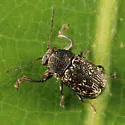
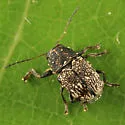
Photo credits: Contributed by Mike Quinn
Frequently Asked Questions About Pachybrachis femoratus
What is Pachybrachis femoratus?
Pachybrachis femoratus is a species in the family Chrysomelidae, within the order Coleoptera.
How big is Pachybrachis femoratus?
Ave length 2.75 mm
How do you identify Pachybrachis femoratus?
| Feature | Description |
|---|---|
| Additional details | Small to medium in size, females quite robust, blackish and dull yellow, mottled, the darker color usually in excess on the prothorax, and often on the elytra; punctuation rather dense, broadly confused on the elytral disk; no ocular lines; front claws of male distinctly enlarged . Dull yellow, varying to dull gray or whitish yellow, thickly mottled with black or brown punctures. |
| Head | Head yellow with occiput, median frontal vitta, and areas between antennal bases and upper lobes of eyes black and usually connected. Front strongly, closely punctate. |
| Pronotum | Pronotum marked with black areas in which punctation is closer. |
| Elytra | Elytra confusedly punctate basomedially, short series of punctures elsewhere. Three indistinct black lateral spots, and a single, ill-defined, somewhat oblique, black subapical spot. Pygidium black basally, yellow apically, black edge projecting medially into yellow from basal area; also single lateral black areas which are either separate spots or continuous with basal area. Venter mostly black, abdominal sternites sometimes yellow laterally, especially the 5th. |
| Legs | Legs yellow, femora and tibiae with black or brown median spots. |
Where is Pachybrachis femoratus found?
Range: TX-FL-NY-IN - Map , one of the most commonly coll'ed sp. in Alabama
What does Pachybrachis femoratus eat?
The diet of the Pachybrachis femoratus includes reported from Quercus, Trifolium, Carya , and Pinus ( 5 ).
When is Pachybrachis femoratus active?
Pachybrachis femoratus: seasonal activity - Mar-Jul (in AL).