
Green Jewel Fly
Ornidia obesa
This record describes Ornidia obesa (species). Recorded family: Syrphidae. Recorded order: Diptera.
Identification and Appearance
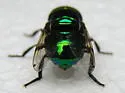
| Feature | Description |
|---|---|
| Body | Body shiny, metallic, green or purplish-blue. |
| Wings | Wings mostly hyaline, but with two spots along anterior margin: one near middle, the other smaller and before the apex. Scutellum with a shallow transverse depression before posterior edge. |
Classification
Habitat and Range
Habitat
Has been found breeding in semiliquid synanthropic material, such as animal dung, human feces, sewage, and rotten fruits and vegetables [ , Martins et. al.]. A hemisynanthropic species, meaning one associated with and making use of resources available in (often rural) human settlements, but not restricted to or entirely dependent on such habitat.
Geographic Range
Widespread and common in the New World tropics...reaching north into our area from Colorado east to Massachusetts and New York (also in Hawaii). Native to New World tropics; historically had spread to various tropical islands of the Pacific & Indian Ocean, and to parts of tropical Africa (see GBIF map ), but has become less common in the Old World with improved sanitation [Thompson(1991)]
About Flies: the wider group
Order-level background for Diptera, the group containing Ornidia obesa. Species-specific details appear above.
Group overview
Diptera includes over 150,000 described species of flies, mosquitoes, and midges. Mosquitoes are the deadliest animal on Earth (CDC). Malaria alone causes ~249 million cases and over 608,000 deaths annually, mostly children under 5 (WHO). Vector-borne diseases account for over 17% of all infectious diseases, causing 700,000+ deaths per year.
Ecological role of the group
Despite their disease impact, flies are critical decomposers and pollinators. Hoverflies alone pollinate hundreds of crop and wildflower species. Flies are also the primary food source for many birds, bats, and fish. Forensic entomology relies heavily on fly species for crime scene analysis.
Economic and practical significance of the group
In the U.S., vector-borne disease cases tripled between 2004-2016, with over 640,000 cases reported in that period (CDC). Tickborne diseases doubled from 22,000 to 48,000 annual reports. Globally, mosquito-borne diseases cost billions in healthcare and lost productivity.
Recorded sources for this group: WHO, CDC, PNAS. Imported estimates may describe particular regions or reporting periods.
Photos of Green Jewel Fly (5)
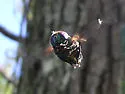
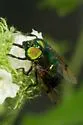
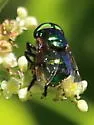
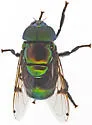
Photo credits: Contributed by Beatriz Moisset; Additional contributions by Aaron Schusteff , v belov , James Bailey
Frequently Asked Questions About Green Jewel Fly
What is Green Jewel Fly?
Green Jewel Fly (Ornidia obesa) is a species in the family Syrphidae, within the order Diptera.
How do you identify Green Jewel Fly?
| Feature | Description |
|---|---|
| Body | Body shiny, metallic, green or purplish-blue. |
| Wings | Wings mostly hyaline, but with two spots along anterior margin: one near middle, the other smaller and before the apex. Scutellum with a shallow transverse depression before posterior edge. |
Where is Green Jewel Fly found?
| Feature | Details |
|---|---|
| Habitat | Has been found breeding in semiliquid synanthropic material, such as animal dung, human feces, sewage, and rotten fruits and vegetables [ , Martins et. al.]. A hemisynanthropic species, meaning one associated with and making use of resources available in (often rural) human settlements, but not restricted to or entirely dependent on such habitat. |
| Range | Widespread and common in the New World tropics...reaching north into our area from Colorado east to Massachusetts and New York (also in Hawaii). Native to New World tropics; historically had spread to various tropical islands of the Pacific & Indian Ocean, and to parts of tropical Africa (see GBIF map ), but has become less common in the Old World with improved sanitation [Thompson(1991)] |