
Handsome Meadow Katydid
Orchelimum pulchellum
This record describes Orchelimum pulchellum (species). Recorded family: Tettigoniidae. Recorded order: Orthoptera.
Identification and Appearance
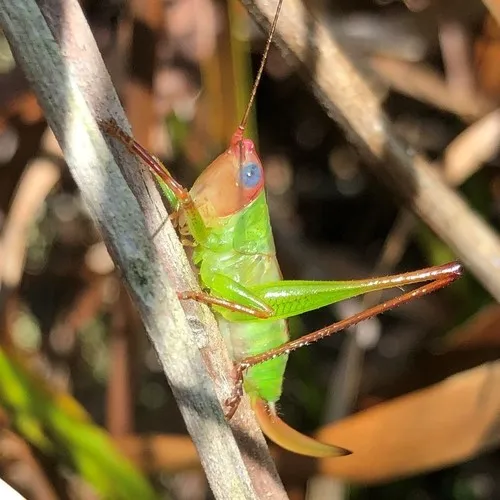
Note white face with brownish to reddish mottling on edges, brown legs, diffuse turquoise stripe on upper sides back along wings. Eyes usually blue --fairly distinctive. Compare cerci of male if possible with illustrations in Singing Insects of North America. Very similar to Blacklegged Meadow Katydid - Orchelimum nigripes . Singing Insects of North America Range maps ( Black-legged , Handsome ) show that the ranges do overlap in the eastern Pennsylvania/central eastern seaboard area. Rehn, Trans. Am. Entomol. Soc. 41: 11-83 differentiate these two based on pronotal shape. Keying couplet for males is on pp. 24-25, quoting: D. Tooth of cercus not strongly adpressed against proximal portaion of sinuate carina. Caudal margin of lateral lobes of pronotum with humeral sinus appreciably indicated and remainder of margin weakly arcuate. Tibiae not blackish.---> O. bullatum (Texas) or O. laticauda = pulchellum D. Tooth of cercus strongly adpressed against proximal portion of sinuate carina. Caudal margin of lateral lobes of pronotum with little indication of humeral sinus and remainder of margin distinctly sinuate. All tibiae blackish. (Ventro-external margin of caudal femora armed.)---> O. nigripes Also, in O. nigripes eyes of living insects are reddish rather than bluish.
Classification
- Kingdom
- Animalia
- Phylum
- Arthropoda
- Class
- Insecta
- Order
- Orthoptera (Grasshoppers, Crickets, Katydids)
- Suborder
- Ensifera
- Family
- Tettigoniidae (Katydids)
- Subfamily
- Conocephalinae
- Tribe
- Conocephalini
- Genus
- Orchelimum (Greater Meadow Katydids)
Imported taxonomy record. Source availability varies; see the source references and editorial policy below.
Habitat and Range
Habitat
Brushy areas, shrubs, especially in wetland habitats bordering lakes, streams, etc.
Geographic Range
Southeastern United States. East and south of Appalachians; north as far as New York; west as far as Mississippi. Meets and intergrades with O. nigripes south of Appalachians (mostly in Mississippi and Alabama). In NJ, DE, MD, DC, western VA, western NC, and most of SC, GA, AL & FL ending with the southwestern part of MS.
Seasonal Activity
Mid-summer to fall. August-frost (North Carolina), June-November (north Florida)
About Grasshoppers, Crickets, Katydids: the wider group
Order-level background for Orthoptera, the group containing Orchelimum pulchellum. Species-specific details appear above.
Group overview
Orthoptera includes ~28,000 described species of grasshoppers, crickets, and katydids. Desert locusts can form swarms covering 460 square miles containing up to 80 million individuals per square kilometer.
Ecological role of the group
Grasshoppers and crickets are a primary food source for birds, reptiles, and small mammals. Cricket farming is a growing industry - crickets require 12× less feed than cattle to produce the same amount of protein, using 2,000× less water.
Economic and practical significance of the group
A single large locust swarm can consume the same amount of food in one day as 35,000 people. The 2019-2021 East Africa locust crisis affected food security for 42 million people across multiple countries. Global crop losses from locusts can reach billions annually.
Recorded sources for this group: FAO, UN World Food Programme, research publications. Imported estimates may describe particular regions or reporting periods.
Photos of Handsome Meadow Katydid (2)
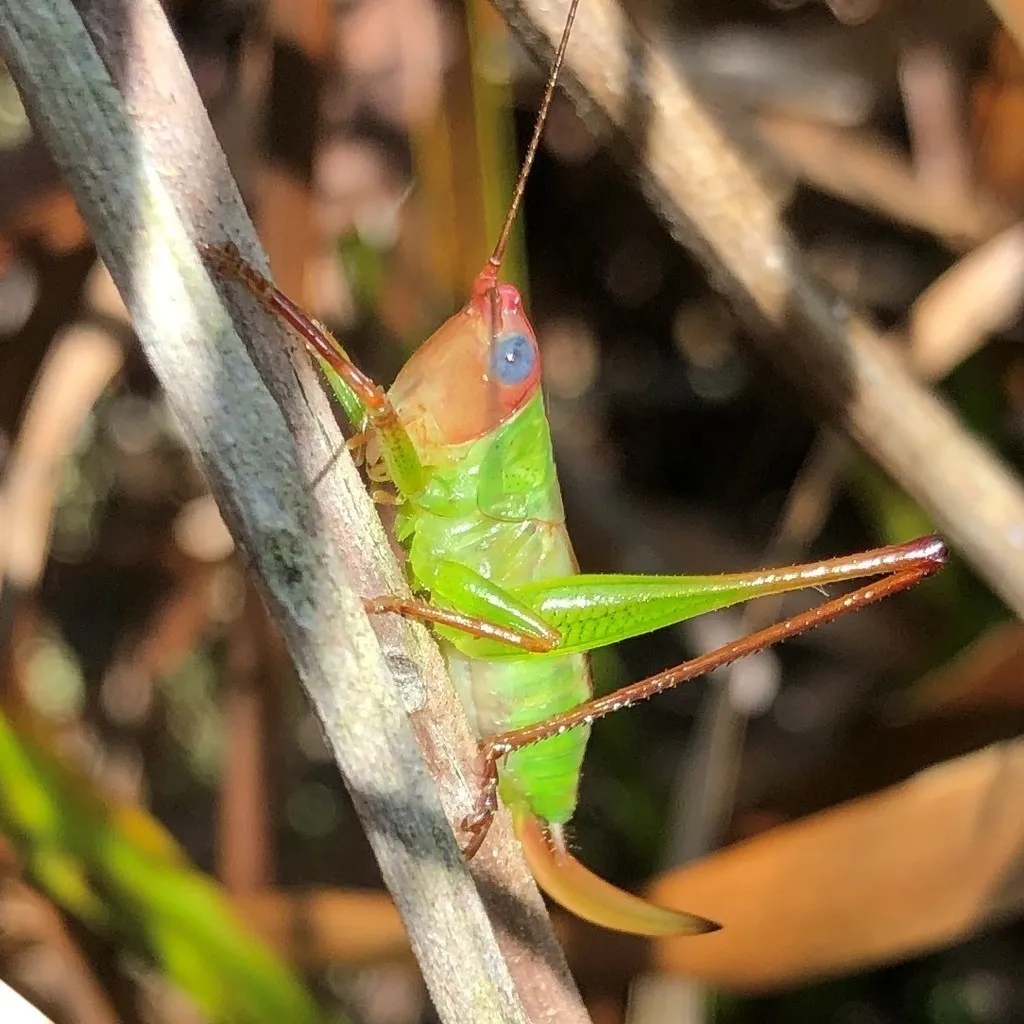
Photo credits: Contributed by Cotinis; Additional contributions by Lynette Elliott , Chuck Entz , David Ferguson , JohnMaxwell22
Frequently Asked Questions About Handsome Meadow Katydid
What is Handsome Meadow Katydid?
Handsome Meadow Katydid (Orchelimum pulchellum) is a species in the family Tettigoniidae, within the order Orthoptera.
How big is Handsome Meadow Katydid?
Body length 18-23 mm (not counting ovipositor in females)
How do you identify Handsome Meadow Katydid?
Note white face with brownish to reddish mottling on edges, brown legs, diffuse turquoise stripe on upper sides back along wings. Eyes usually blue --fairly distinctive. Compare cerci of male if possible with illustrations in Singing Insects of North America. Very similar to Blacklegged Meadow Katydid - Orchelimum nigripes . Singing Insects of North America Range maps ( Black-legged , Handsome ) show that the ranges do overlap in the eastern Pennsylvania/central eastern seaboard area. Rehn, Trans. Am. Entomol. Soc. 41: 11-83 differentiate these two based on pronotal shape. Keying couplet for males is on pp. 24-25, quoting: D. Tooth of cercus not strongly adpressed against proximal portaion of sinuate carina. Caudal margin of lateral lobes of pronotum with humeral sinus appreciably indicated and remainder of margin weakly arcuate. Tibiae not blackish.---> O. bullatum (Texas) or O. laticauda = pulchellum D. Tooth of cercus strongly adpressed against proximal portion of sinuate carina. Caudal margin of lateral lobes of pronotum with little indication of humeral sinus and remainder of margin distinctly sinuate. All tibiae blackish. (Ventro-external margin of caudal femora armed.)---> O. nigripes Also, in O. nigripes eyes of living insects are reddish rather than bluish.
Where is Handsome Meadow Katydid found?
| Feature | Details |
|---|---|
| Habitat | Brushy areas, shrubs, especially in wetland habitats bordering lakes, streams, etc. |
| Range | Southeastern United States. East and south of Appalachians; north as far as New York; west as far as Mississippi. Meets and intergrades with O. nigripes south of Appalachians (mostly in Mississippi and Alabama). In NJ, DE, MD, DC, western VA, western NC, and most of SC, GA, AL & FL ending with the southwestern part of MS. |
When is Handsome Meadow Katydid active?
Handsome Meadow Katydid: seasonal activity - Mid-summer to fall. August-frost (North Carolina), June-November (north Florida).