
Black-legged Meadow Katydid
Orchelimum nigripes
This record describes Orchelimum nigripes (species). Recorded family: Tettigoniidae. Recorded order: Orthoptera.
Identification and Appearance
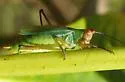
Dark legs distinctive. Face white with mottling. Very similar to Handsome Meadow Katydid , Orchelimum pulchellum , mostly found in the southeast. Singing Insects of North America Range maps ( Black-legged , Handsome ), but that species has bluish rather than reddish eyes (when alive), and the tibiae are usually more reddish or brownish than the black that is most often seen in O. nigripes . Male cerci are somewhat different in shape (see link to SINA below). There are two zones of overlap. One, probably new, is northeastern where the two species apparently produced hybrids of reduced fertility and vigor (so the two species remain distinct there), and another southeastern (between the Gulf of Mexico and the south end of the Appalachians in Mississippi and Alabama), where the two species blend and individuals are intermediate in character.
Classification
- Kingdom
- Animalia
- Phylum
- Arthropoda
- Class
- Insecta
- Order
- Orthoptera (Grasshoppers, Crickets, Katydids)
- Suborder
- Ensifera
- Family
- Tettigoniidae (Katydids)
- Subfamily
- Conocephalinae
- Tribe
- Conocephalini
- Genus
- Orchelimum (Greater Meadow Katydids)
Imported taxonomy record. Source availability varies; see the source references and editorial policy below.
Habitat and Range
Habitat
wetland habitats such as marshes or bordering lakes, streams, etc.
Geographic Range
Eastern and Central US, between Southern Rockies (e. Colorado and se. Wyoming) and Appalachians. Roughly from South Dakota to southeastern Ontario and south to near Gulf Coast in Texas, Louisiana, and Mississippi. South of the Applachians (mostly in Mississippi and northern Alabama) it meets and intergrades with O. pulchellum , which occurs further east. Often very abundant in marshy habitats in the Midwest and on the Great Plains. Also occurs, and probably introduced in Chesapeake Bay drainage (and expanding its range northward), in Virginia, Maryland, Delaware, Pennsylvania, New Jersey, Connecticut, and near Amherst, Massachusetts. Probably also in New York. In this region sometimes hybridizes with closely related O. pulchellum , but seems to remain distinct. These eastern populations seem to have first appeared in Virginia near Washington D.C. and Chesapeake Bay, and were first collected in that region in the early 1900's.
Diet and Behavior
Life History
Overwinters as eggs, hatches in late spring, with adults mostly in late summer-fall. Adults late July to mid-November depending on weather and latitude. Along the Platte and Arkansas Rivers (and probably elsewhere) it often hatches from eggs submersed for a month or more by spring floods.
About Grasshoppers, Crickets, Katydids: the wider group
Order-level background for Orthoptera, the group containing Orchelimum nigripes. Species-specific details appear above.
Group overview
Orthoptera includes ~28,000 described species of grasshoppers, crickets, and katydids. Desert locusts can form swarms covering 460 square miles containing up to 80 million individuals per square kilometer.
Ecological role of the group
Grasshoppers and crickets are a primary food source for birds, reptiles, and small mammals. Cricket farming is a growing industry - crickets require 12× less feed than cattle to produce the same amount of protein, using 2,000× less water.
Economic and practical significance of the group
A single large locust swarm can consume the same amount of food in one day as 35,000 people. The 2019-2021 East Africa locust crisis affected food security for 42 million people across multiple countries. Global crop losses from locusts can reach billions annually.
Recorded sources for this group: FAO, UN World Food Programme, research publications. Imported estimates may describe particular regions or reporting periods.
Photos of Black-legged Meadow Katydid (5)
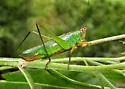
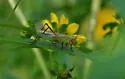
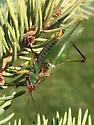
Photo credits: Contributed by Cotinis; Additional contributions by Chuck Entz , Ethan Kistler , David Ferguson
Frequently Asked Questions About Black-legged Meadow Katydid
What is Black-legged Meadow Katydid?
Black-legged Meadow Katydid (Orchelimum nigripes) is a species in the family Tettigoniidae, within the order Orthoptera.
How big is Black-legged Meadow Katydid?
Circa 25-28 mm
How do you identify Black-legged Meadow Katydid?
Dark legs distinctive. Face white with mottling. Very similar to Handsome Meadow Katydid , Orchelimum pulchellum , mostly found in the southeast. Singing Insects of North America Range maps ( Black-legged , Handsome ), but that species has bluish rather than reddish eyes (when alive), and the tibiae are usually more reddish or brownish than the black that is most often seen in O. nigripes . Male cerci are somewhat different in shape (see link to SINA below). There are two zones of overlap. One, probably new, is northeastern where the two species apparently produced hybrids of reduced fertility and vigor (so the two species remain distinct there), and another southeastern (between the Gulf of Mexico and the south end of the Appalachians in Mississippi and Alabama), where the two species blend and individuals are intermediate in character.
Where is Black-legged Meadow Katydid found?
| Feature | Details |
|---|---|
| Habitat | wetland habitats such as marshes or bordering lakes, streams, etc. |
| Range | Eastern and Central US, between Southern Rockies (e. Colorado and se. Wyoming) and Appalachians. Roughly from South Dakota to southeastern Ontario and south to near Gulf Coast in Texas, Louisiana, and Mississippi. South of the Applachians (mostly in Mississippi and northern Alabama) it meets and intergrades with O. pulchellum , which occurs further east. Often very abundant in marshy habitats in the Midwest and on the Great Plains. Also occurs, and probably introduced in Chesapeake Bay drainage (and expanding its range northward), in Virginia, Maryland, Delaware, Pennsylvania, New Jersey, Connecticut, and near Amherst, Massachusetts. Probably also in New York. In this region sometimes hybridizes with closely related O. pulchellum , but seems to remain distinct. These eastern populations seem to have first appeared in Virginia near Washington D.C. and Chesapeake Bay, and were first collected in that region in the early 1900's. |
What is the life cycle of a Black-legged Meadow Katydid?
Overwinters as eggs, hatches in late spring, with adults mostly in late summer-fall. Adults late July to mid-November depending on weather and latitude. Along the Platte and Arkansas Rivers (and probably elsewhere) it often hatches from eggs submersed for a month or more by spring floods.