
Opomyza germinationis agg.
This record describes Opomyza germinationis agg. (species). Recorded family: Opomyzidae. Recorded order: Diptera.
Identification and Appearance
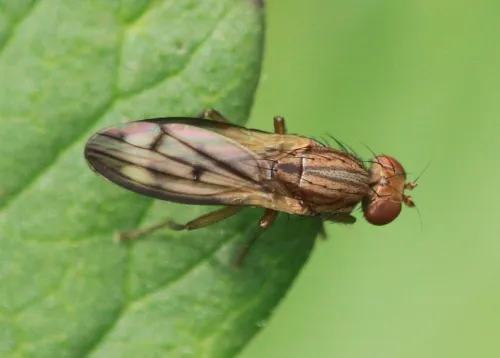
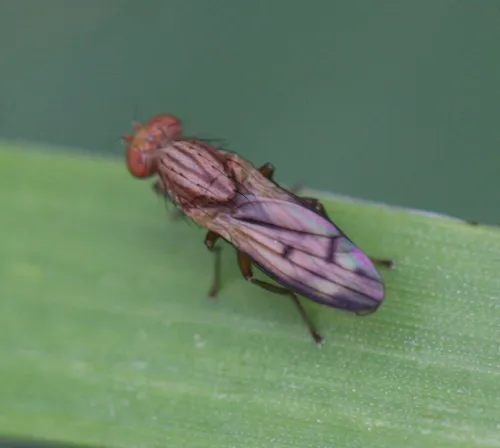
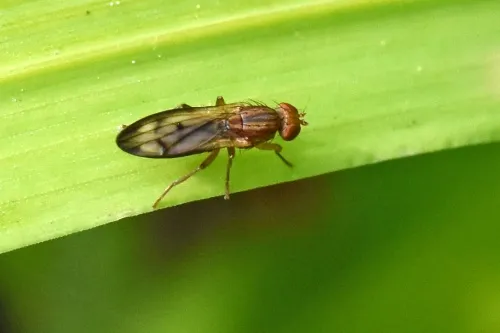
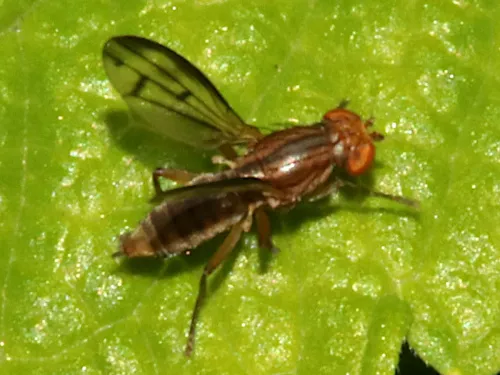
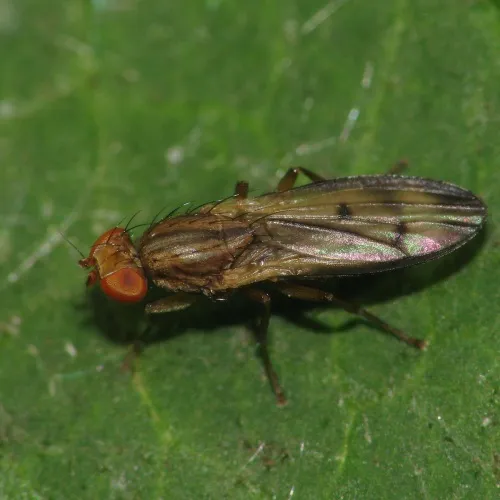
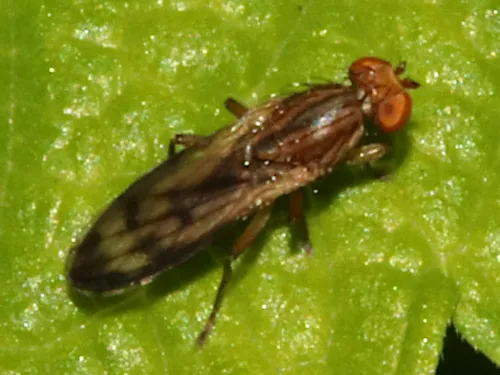
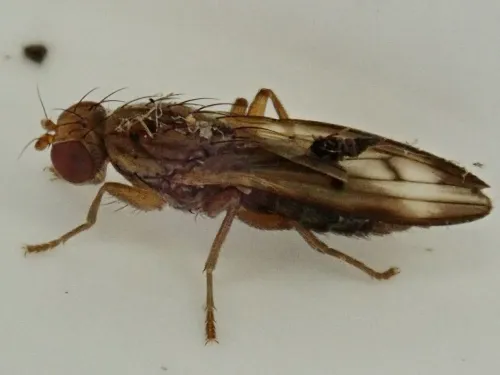
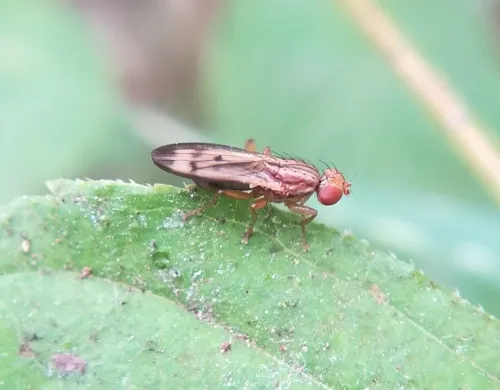
Although Opomyza germinationis is a common and widespread fly, it is hard to distinguish from Opomyza petrei so the two are often recorded as an aggregate - as represented on this page. Both species are largely dull orange though the abdomen is grey with variable dull yellow patches or bands. The top of the thorax has a noticeable pale, central, longitudinal mark. The wings have dark spots but the costa is clear - except for the wing tip. Opomyza petrei can be distinguished by microscopic examination. It has a small patch of setulae in the centre of the proepisternum (the area in front of the front spiracle). This are absent in O. germinationis . Do not confuse these with the setulae along the lower margin of this plate which both species have. Male O. petrei have long dorsal bristles on the end of the last tergite. Females can also be separated by looking at the shape of the ovipositor. Prefers moist habitats and can be found in grasses and leaf litter. Breeds in grass stems. Walks very slowly and is reluctant to fly.
Classification
- Kingdom
- Animalia
- Phylum
- Arthropoda
- Class
- Insecta
- Order
- Diptera
- Family
- Opomyzidae
- Genus
- Opomyza
Imported taxonomy record. Source availability varies; see the source references and editorial policy below.
Habitat and Range
Habitat
Prefers moist habitats and can be found in grasses and leaf litter.
Seasonal Activity
June to October.
Diet and Behavior
Life History
Breeds in grass stems. Walks very slowly and is reluctant to fly.
Additional species information
Recorded status
Widespread and common in Britain.
About Flies: the wider group
Order-level background for Diptera, the group containing Opomyza germinationis agg.. Species-specific details appear above.
Group overview
Diptera includes over 150,000 described species of flies, mosquitoes, and midges. Mosquitoes are the deadliest animal on Earth (CDC). Malaria alone causes ~249 million cases and over 608,000 deaths annually, mostly children under 5 (WHO). Vector-borne diseases account for over 17% of all infectious diseases, causing 700,000+ deaths per year.
Ecological role of the group
Despite their disease impact, flies are critical decomposers and pollinators. Hoverflies alone pollinate hundreds of crop and wildflower species. Flies are also the primary food source for many birds, bats, and fish. Forensic entomology relies heavily on fly species for crime scene analysis.
Economic and practical significance of the group
In the U.S., vector-borne disease cases tripled between 2004-2016, with over 640,000 cases reported in that period (CDC). Tickborne diseases doubled from 22,000 to 48,000 annual reports. Globally, mosquito-borne diseases cost billions in healthcare and lost productivity.
Recorded sources for this group: WHO, CDC, PNAS. Imported estimates may describe particular regions or reporting periods.
Photos of Opomyza germinationis agg. (10)
Frequently Asked Questions About Opomyza germinationis agg.
What is Opomyza germinationis agg.?
Opomyza germinationis agg. is a species in the family Opomyzidae, within the order Diptera.
Where is Opomyza germinationis agg. found?
Habitat: Prefers moist habitats and can be found in grasses and leaf litter.
When is Opomyza germinationis agg. active?
Opomyza germinationis agg.: seasonal activity - June to October..
What is the life cycle of a Opomyza germinationis agg.?
Breeds in grass stems. Walks very slowly and is reluctant to fly.