
Ophryastes simulans
This record describes Ophryastes simulans (species). Recorded family: Curculionidae. Recorded order: Coleoptera.
Identification and Appearance
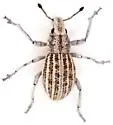
This species like others in the genus is quite variable in size and somewhat unstable as to color pattern. I have selected as types specimens of intermediate size and of the most characteristic color pattern. Some specimens are of a more uniform gray with only the black striae contrasting while others are a bit ocellate. It is evidently a common species in various parts of Texas and has no doubt been confused with dunnianus Csy. The latter is most certainly a synonym of decipiens LeC. I have typical dunnianus from El Paso, Tex., the type locality, which are in absolute agreement with Casey’s description and which cannot be separated from specimens of decipiens checked with the LeConte type. The flattened surface of the front in decipiens, continuing in the same plane on to the rostrum without transverse basal impression, and the absence of the median rostral sulcus readily separates this species from simulans. The latter, however, closely simulates geminatus Horn, a species dwelling in a region fully a thousand miles distant from its own territory, both as regards general size and form as well as color pattern. Simulans, however, differs fundamentally from geminatus by having a rostrum that is decidedly more robust in every regard, broader, almost twice as thick, with the apex markedly depressed, the rostral sulci coarser and thei eyes a bit more convex; prothorax less broad, more convex and more coarsely sculptured; elytral striae generally deeper and the strial punctures coarser; legs decidedly less robust, the posterior tibiae with the apex obliquely rounded, not truncate as in geminatus and varius; third tarsal segment in males but moderately dilated with the lobes elliptical, not broadly dilated and with lobes somewhat triangular; the terminal tarsal segments suddenly enlarged beyond neck or bottled shaped, not gradually enlarged as in geminatus. Type series of forty spmns all collected by J. 0. Martin at Allamore, Hudspeth County, Texas, July 2, 1930. Van Dyke reports also having seen many more from other localities in Texas.
Classification
- Kingdom
- Animalia
- Phylum
- Arthropoda
- Class
- Insecta
- Order
- Coleoptera (Beetles)
- Suborder
- Polyphaga
- Superfamily
- Curculionoidea
- Family
- Curculionidae (Snout and Bark Beetles)
- Subfamily
- Entiminae
- Tribe
- Ophryastini
- Genus
- Ophryastes
Imported taxonomy record. Source availability varies; see the source references and editorial policy below.
Habitat and Range
Geographic Range
NM-TX / Mex. - Map ( 3 ) ( 4 )
Additional species information
Species notes from the sources
Etymology: Ophryastes simulans (Van Dyke)
About Primitive Winged Insects: the wider group
Order-level background for Coleoptera, the group containing Ophryastes simulans. Species-specific details appear above.
Group overview
Coleoptera is the largest order of insects with over 400,000 described species, representing ~25% of all known animal species and ~40% of all insects. In the U.S. alone, nearly 30,000 beetle species have been identified.
Ecological role of the group
Beetles are prominent decomposers, especially in forests, breaking down dead wood and recycling nutrients. As predators, they reduce populations of pest insects. Many species are also important pollinators of flowering plants.
Economic and practical significance of the group
Beetles have major economic significance: leaf beetles (Chrysomelidae) and weevils (Curculionoidea) are among the most destructive agricultural pests globally, costing billions annually, while predatory species like ladybugs provide natural pest control.
Recorded sources for this group: Britannica, Smithsonian, NCSU Entomology. Imported estimates may describe particular regions or reporting periods.
Photos of Ophryastes simulans (5)
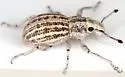
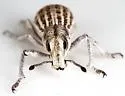
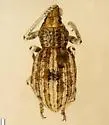
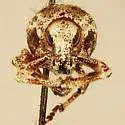
Photo credits: Contributed by Mike Quinn
Frequently Asked Questions About Ophryastes simulans
What is Ophryastes simulans?
Ophryastes simulans is a species in the family Curculionidae, within the order Coleoptera.
How big is Ophryastes simulans?
Length 9.1 to 12.0 mm
How do you identify Ophryastes simulans?
This species like others in the genus is quite variable in size and somewhat unstable as to color pattern. I have selected as types specimens of intermediate size and of the most characteristic color pattern. Some specimens are of a more uniform gray with only the black striae contrasting while others are a bit ocellate. It is evidently a common species in various parts of Texas and has no doubt been confused with dunnianus Csy. The latter is most certainly a synonym of decipiens LeC. I have typical dunnianus from El Paso, Tex., the type locality, which are in absolute agreement with Casey’s description and which cannot be separated from specimens of decipiens checked with the LeConte type. The flattened surface of the front in decipiens, continuing in the same plane on to the rostrum without transverse basal impression, and the absence of the median rostral sulcus readily separates this species from simulans. The latter, however, closely simulates geminatus Horn, a species dwelling in a region fully a thousand miles distant from its own territory, both as regards general size and form as well as color pattern. Simulans, however, differs fundamentally from geminatus by having a rostrum that is decidedly more robust in every regard, broader, almost twice as thick, with the apex markedly depressed, the rostral sulci coarser and thei eyes a bit more convex; prothorax less broad, more convex and more coarsely sculptured; elytral striae generally deeper and the strial punctures coarser; legs decidedly less robust, the posterior tibiae with the apex obliquely rounded, not truncate as in geminatus and varius; third tarsal segment in males but moderately dilated with the lobes elliptical, not broadly dilated and with lobes somewhat triangular; the terminal tarsal segments suddenly enlarged beyond neck or bottled shaped, not gradually enlarged as in geminatus.
Where is Ophryastes simulans found?
Range: NM-TX / Mex. - Map ( 3 ) ( 4 )