
Old House Borer
Hylotrupes bajulus
This record describes Hylotrupes bajulus (species). Recorded family: Cerambycidae. Recorded order: Coleoptera.
Identification and Appearance
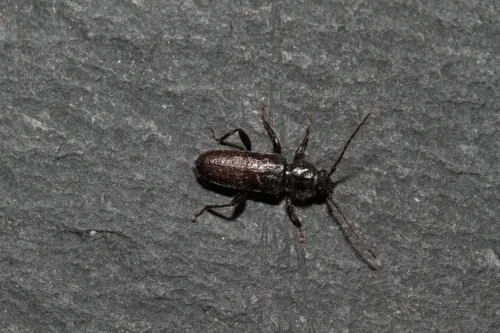
This beetle is around 15 mm long and brown to black, sometimes appearing greyer because of a fine grey furriness on most of the upper surface. On the pronotum two conspicuously hairless tubercles are characteristic of the species. Unless identified by a recognised expert, a photo is required and the specimen should be examined with a microscope. In the comments box, state the key or ID method used and describe the size and identifying characters. Despite the common name Old House Borer, this wood boring species is most likely to attack more recently felled timber, maybe because the beetles are attracted to the higher resin content of wood harvested more recently than 10 years earlier. The life cycle from egg to egg typically takes two to ten years, depending on the type of wood, its age and quality, its moisture content, and also depending on environmental conditions such as temperature. Only the larvae feed on the wood. Larvae usually pupate just beneath the wood surface and emerge as an adult from the pupa in mid to late summer. Once the exoskeleton of the newly emerged adult beetle has hardened sufficiently the adults cut oval exit holes 6 to 10 mm in diameter, typically leaving coarse, powdery frass in the vicinity of the hole. Mainly recorded in the southeast of England with just a few scattered records from elsewhere in Britain. No additional images available for this species.
Classification
- Kingdom
- Animalia
- Phylum
- Arthropoda
- Class
- Insecta
- Order
- Coleoptera (Beetles)
- Suborder
- Polyphaga
- Superfamily
- Chrysomeloidea
- Family
- Cerambycidae (Longhorn Beetles)
- Subfamily
- Cerambycinae
- Tribe
- Hylotrupini
- Genus
- Hylotrupes
Imported taxonomy record. Source availability varies; see the source references and editorial policy below.
Habitat and Range
Habitat
Despite the common name Old House Borer, this wood boring species is most likely to attack more recently felled timber, maybe because the beetles are attracted to the higher resin content of wood harvested more recently than 10 years earlier.
Seasonal Activity
Adults are most active in the summer.
Additional species information
Recorded status
Mainly recorded in the southeast of England with just a few scattered records from elsewhere in Britain.
About Primitive Winged Insects: the wider group
Order-level background for Coleoptera, the group containing Hylotrupes bajulus. Species-specific details appear above.
Group overview
Coleoptera is the largest order of insects with over 400,000 described species, representing ~25% of all known animal species and ~40% of all insects. In the U.S. alone, nearly 30,000 beetle species have been identified.
Ecological role of the group
Beetles are prominent decomposers, especially in forests, breaking down dead wood and recycling nutrients. As predators, they reduce populations of pest insects. Many species are also important pollinators of flowering plants.
Economic and practical significance of the group
Beetles have major economic significance: leaf beetles (Chrysomelidae) and weevils (Curculionoidea) are among the most destructive agricultural pests globally, costing billions annually, while predatory species like ladybugs provide natural pest control.
Recorded sources for this group: Britannica, Smithsonian, NCSU Entomology. Imported estimates may describe particular regions or reporting periods.
Frequently Asked Questions About Old House Borer
What is Old House Borer?
Old House Borer (Hylotrupes bajulus) is a species in the family Cerambycidae, within the order Coleoptera.
Where is Old House Borer found?
Habitat: Despite the common name Old House Borer, this wood boring species is most likely to attack more recently felled timber, maybe because the beetles are attracted to the higher resin content of wood harvested more recently than 10 years earlier.
When is Old House Borer active?
Old House Borer: seasonal activity - Adults are most active in the summer..