
Walker's Tree Cricket
Oecanthus walkeri
This record describes Oecanthus walkeri (species). Recorded family: Oecanthidae. Recorded order: Orthoptera.
Identification and Appearance
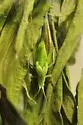
Overall color of both sexes light green, often with small amount of yellow on head/face. Eye color yellow. Palpi pale brown or gray. Prominent areas of bright white color on borders of pronotal area. Ventral abdomen pale creamy white. Pedicel and scape pale anteriorly, pure white posteriorly. Antennal markings: pedicel with two vertical black marks, scape with two black marks - inner is vertical and outer horizontal. Antennae dark, often deep black. Tympana on foretibiae light gray. Tarsi black, tibiae dark gray distally graduating to green proximally, femora translucent green. Yellow-brown at femoral-tibial joints. Cerci pale and long (extending to tip of ovipositor in female). Male: hind wings extend beyond distal edge of tegmina. Inner area of metanotal gland appears dark tan; outer rim appears pale green. Female: prominent white bordering dorsal sides of abdomen. Latticed vein pattern on translucent wings. Instar: dorsal abdomen medium green with bright white at both outer edges. A thin white line bordered with dark green runs from head to distal tip of abdomen. Given its proximity to the Mexican border, it is entirely possible they are fairly recent arrivals to the U.S. - which could explain why they have just now been described.
Classification
- Kingdom
- Animalia
- Phylum
- Arthropoda
- Class
- Insecta
- Order
- Orthoptera (Grasshoppers, Crickets, Katydids)
- Suborder
- Ensifera
- Family
- Oecanthidae (Tree and Bush Crickets)
- Subfamily
- Oecanthinae
- Genus
- Oecanthus (Common Tree Crickets)
Imported taxonomy record. Source availability varies; see the source references and editorial policy below.
Habitat and Range
Habitat
Thus far, found only on shrubs or in trees. Found at Resaca de La Palma, Cameron Co. TX, 8 feet+ on seep willows. A group of fairly young willows was growing in a large tall-grassed field. Found at Bentsen-Rio Grande Valley State Park on 3 species of trees. The Holotype was found at eye level on a very young seep willow near the HQ building of the park. Others were heard singing very high in Tepejuage trees.
Geographic Range
Thus far, only known from extreme southern Texas, Hidalgo and Cameron Counties.
Seasonal Activity
At least 2 generations per year. (Found as adults in May in Hidalgo and Cameron counties in Texas - which oviposited and offspring emerged in July)
Diet and Behavior
Diet: Found on Seep Willow ( Baccharis salicipholia ), Tepejuage ( Leucaena iveruienta ) and Sugar Hackberry ( Celtis laevigata ) trees. (Collins and Symes 2012)
Life History
Click to see Life Cycle photos.
Additional species information
Species notes from the sources
Etymology: Named after Dr. Thomas J. Walker , Professor Emeritus, University of Florida, Gainesville.
About Grasshoppers, Crickets, Katydids: the wider group
Order-level background for Orthoptera, the group containing Oecanthus walkeri. Species-specific details appear above.
Group overview
Orthoptera includes ~28,000 described species of grasshoppers, crickets, and katydids. Desert locusts can form swarms covering 460 square miles containing up to 80 million individuals per square kilometer.
Ecological role of the group
Grasshoppers and crickets are a primary food source for birds, reptiles, and small mammals. Cricket farming is a growing industry - crickets require 12× less feed than cattle to produce the same amount of protein, using 2,000× less water.
Economic and practical significance of the group
A single large locust swarm can consume the same amount of food in one day as 35,000 people. The 2019-2021 East Africa locust crisis affected food security for 42 million people across multiple countries. Global crop losses from locusts can reach billions annually.
Recorded sources for this group: FAO, UN World Food Programme, research publications. Imported estimates may describe particular regions or reporting periods.
Photos of Walker's Tree Cricket (5)
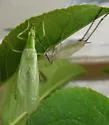
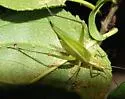
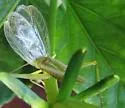
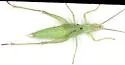
Photo credits: Contributed by Wisconsin Oecanthinancy; Additional contributions by Mike Quinn , metrioptera
Frequently Asked Questions About Walker's Tree Cricket
What is Walker's Tree Cricket?
Walker's Tree Cricket (Oecanthus walkeri) is a species in the family Oecanthidae, within the order Orthoptera.
How big is Walker's Tree Cricket?
15-17mm as adults
How do you identify Walker's Tree Cricket?
Overall color of both sexes light green, often with small amount of yellow on head/face. Eye color yellow. Palpi pale brown or gray. Prominent areas of bright white color on borders of pronotal area. Ventral abdomen pale creamy white. Pedicel and scape pale anteriorly, pure white posteriorly. Antennal markings: pedicel with two vertical black marks, scape with two black marks - inner is vertical and outer horizontal. Antennae dark, often deep black. Tympana on foretibiae light gray. Tarsi black, tibiae dark gray distally graduating to green proximally, femora translucent green. Yellow-brown at femoral-tibial joints. Cerci pale and long (extending to tip of ovipositor in female). Male: hind wings extend beyond distal edge of tegmina. Inner area of metanotal gland appears dark tan; outer rim appears pale green. Female: prominent white bordering dorsal sides of abdomen. Latticed vein pattern on translucent wings. Instar: dorsal abdomen medium green with bright white at both outer edges. A thin white line bordered with dark green runs from head to distal tip of abdomen.
Where is Walker's Tree Cricket found?
| Feature | Details |
|---|---|
| Habitat | Thus far, found only on shrubs or in trees. Found at Resaca de La Palma, Cameron Co. TX, 8 feet+ on seep willows. A group of fairly young willows was growing in a large tall-grassed field. Found at Bentsen-Rio Grande Valley State Park on 3 species of trees. The Holotype was found at eye level on a very young seep willow near the HQ building of the park. Others were heard singing very high in Tepejuage trees. |
| Range | Thus far, only known from extreme southern Texas, Hidalgo and Cameron Counties. |
What does Walker's Tree Cricket eat?
The diet of the Walker's Tree Cricket includes Found on Seep Willow ( Baccharis salicipholia ), Tepejuage ( Leucaena iveruienta ) and Sugar Hackberry ( Celtis laevigata ) trees. (Collins and Symes 2012).
When is Walker's Tree Cricket active?
Walker's Tree Cricket: seasonal activity - At least 2 generations per year. (Found as adults in May in Hidalgo and Cameron counties in Texas - which oviposited and offspring emerged in July).
What is the life cycle of a Walker's Tree Cricket?
Click to see Life Cycle photos.