
Neivamyrmex nigrescens
This record describes Neivamyrmex nigrescens (species). Recorded family: Formicidae. Recorded order: Hymenoptera.
Identification and Appearance
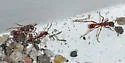
The worker is almost uniform dusky red coloring and matte mesosoma (and usually the head) are distinctive; the rear margin of the head scooped out, with acuminate corners. These are rather typical column-raiding army ants, much like the more conspicuous ones known from the Tropics, save for the fact that they shut down brood prodiction in winter.
Classification
- Kingdom
- Animalia
- Phylum
- Arthropoda
- Class
- Insecta
- Order
- Hymenoptera (Ants, Bees, Wasps and Sawflies)
- Superfamily
- Formicoidea
- Family
- Formicidae (Ants)
- Subfamily
- Dorylinae
- Tribe
- Ecitonini
- Genus
- Neivamyrmex (Common Army Ants)
Imported taxonomy record. Source availability varies; see the source references and editorial policy below.
Habitat and Range
Habitat
Under large rocks in sunny places in spring, more secluded subterranean cavities during hot weather, such as abandoned burrows or ant mounds taken over during a raid.
Geographic Range
The most widely and northerly distributed North American army ant, extending to the Carolinas, then around the bottom of the Appalachian Range and north again in Illinois along the Mississippi River to the Illinois and Missouri River confluences, north into Iowa along the north bank of the Missouri, and westward to Colorado, then avoiding the mountains, all the way to the West Coast.
Seasonal Activity
Spring warm-up till first light frost.
Diet and Behavior
Diet: Brood of other ants, and rarely, other arthropods.
Life History
Colonies often gather under large rocks in sunny places in spring, commencing the first of their monthly brood cycles for the season; the last brood, containing the huge winged males and a few vrigin queens, is reared in September.
Additional species information
Species notes from the sources
Etymology: Neivamyrmex nigrescens (Cresson, 1872)
About Flies: the wider group
Order-level background for Hymenoptera, the group containing Neivamyrmex nigrescens. Species-specific details appear above.
Group overview
Hymenoptera includes over 150,000 described species of ants, bees, wasps, and sawflies. Earth harbors approximately 20 quadrillion (20×10^15) ants, with a combined biomass of ~12 megatons of dry carbon - exceeding the combined biomass of all wild birds and mammals (PNAS, 2022).
Ecological role of the group
About 35% of the world's food crops depend on animal pollinators. The chocolate industry, valued at over $100 billion, depends on pollinating flies and midges. Ants are the dominant soil engineers in most terrestrial ecosystems, turning more soil than earthworms in many habitats.
Economic and practical significance of the group
Pollinators contribute $235-577 billion worth of annual global food production (FAO). In the U.S., bee pollination alone benefits crops valued at $18 billion annually, and honey bees are responsible for $5.4 billion in agricultural productivity. Between April 2023-2024, 55.1% of managed honey bee colonies were lost. The U.S. bee population dropped from 5 million to 2.5 million.
Recorded sources for this group: FAO, USDA, EPA, PNAS (2022), US Fish & Wildlife Service. Imported estimates may describe particular regions or reporting periods.
Photos of Neivamyrmex nigrescens (5)
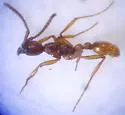
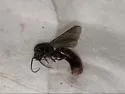
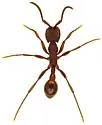
Photo credits: Contributed by James C. Trager; Additional contributions by Mike Quinn , v belov
Frequently Asked Questions About Neivamyrmex nigrescens
What is Neivamyrmex nigrescens?
Neivamyrmex nigrescens is a species in the family Formicidae, within the order Hymenoptera.
How big is Neivamyrmex nigrescens?
3-5mm
How do you identify Neivamyrmex nigrescens?
The worker is almost uniform dusky red coloring and matte mesosoma (and usually the head) are distinctive; the rear margin of the head scooped out, with acuminate corners.
Where is Neivamyrmex nigrescens found?
| Feature | Details |
|---|---|
| Habitat | Under large rocks in sunny places in spring, more secluded subterranean cavities during hot weather, such as abandoned burrows or ant mounds taken over during a raid. |
| Range | The most widely and northerly distributed North American army ant, extending to the Carolinas, then around the bottom of the Appalachian Range and north again in Illinois along the Mississippi River to the Illinois and Missouri River confluences, north into Iowa along the north bank of the Missouri, and westward to Colorado, then avoiding the mountains, all the way to the West Coast. |
What does Neivamyrmex nigrescens eat?
The diet of the Neivamyrmex nigrescens includes Brood of other ants, and rarely, other arthropods..
When is Neivamyrmex nigrescens active?
Neivamyrmex nigrescens: seasonal activity - Spring warm-up till first light frost..
What is the life cycle of a Neivamyrmex nigrescens?
Colonies often gather under large rocks in sunny places in spring, commencing the first of their monthly brood cycles for the season; the last brood, containing the huge winged males and a few vrigin queens, is reared in September.