
Red-legged Ham Beetle
Necrobia rufipes
This record describes Necrobia rufipes (species). Recorded family: Cleridae. Recorded order: Coleoptera.
Identification and Appearance
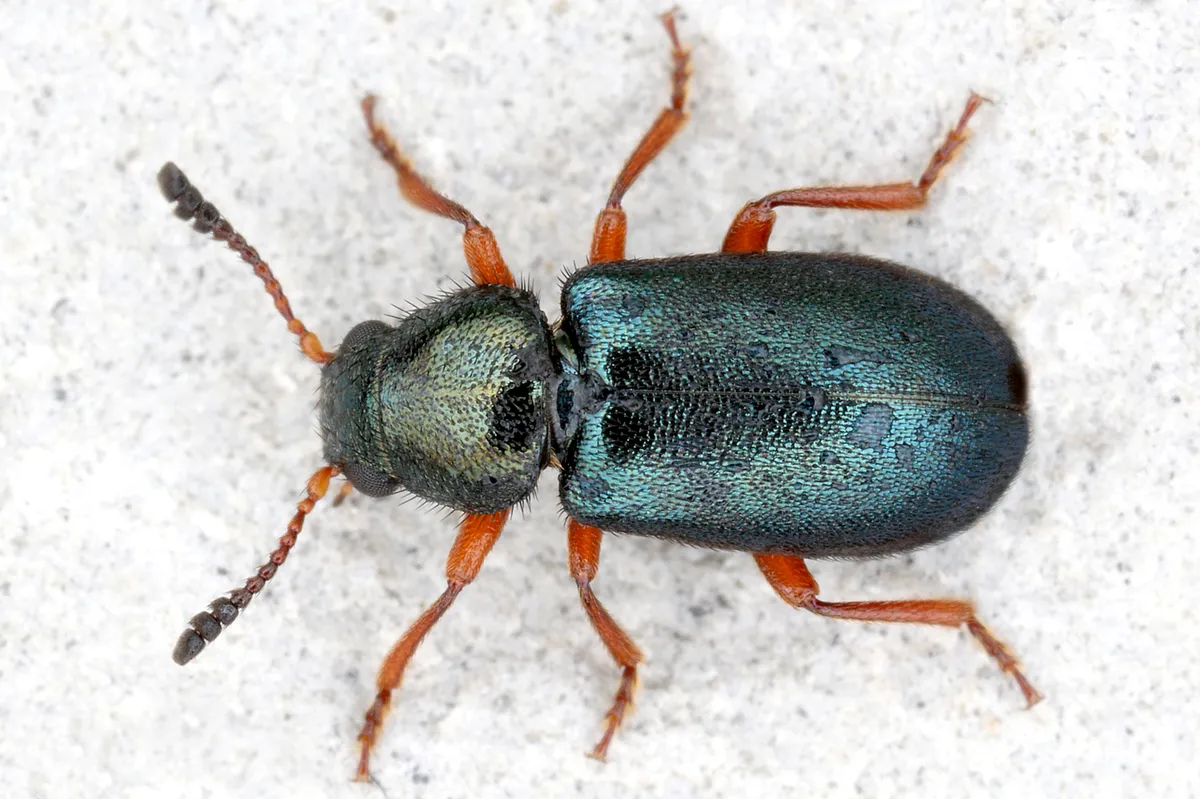
Adult: head, thorax, elytra shiny metallic bluish-green or blackish; underside of abdomen dark blue; legs bright reddish-brown or orange; antennae mainly reddish-brown but with dark brown or black club at tip; sides of thorax and elytra with stiff bristle-like hairs Larva: body creamy-gray with mottled violet-gray markings on upper surface; head and upper surface of first thoracic segment and last (ninth) abdominal segment with brown hardened plates; 2nd and 3rd thoracic segments also with tiny brownish plates; urogomphi strongly curved upwards major pest of copra and materials of animal origin ; considered a pest in museums containing specimens of vertebrate animals, as well as in places where dried fish is stored
Wikipedia reference for Necrobia rufipes: http://en.wikipedia.org/wiki/Necrobia_rufipes.
Classification
- Kingdom
- Animalia
- Phylum
- Arthropoda
- Class
- Insecta
- Order
- Coleoptera (Beetles)
- Suborder
- Polyphaga
- Superfamily
- Cleroidea
- Family
- Cleridae (Checkered Beetles)
- Subfamily
- Korynetinae
- Genus
- Necrobia
Imported taxonomy record. Source availability varies; see the source references and editorial policy below.
Habitat and Range
Habitat
found on dried fish, skins and bones of dead animals, and other carrion; also found on museum specimens
Geographic Range
most Nearctic records from sw US - Map , native to the Palearctic, now cosmopolitan
Seasonal Activity
summer in the north; most of the year in the south; year-round indoors
Diet and Behavior
Diet: dried/salt fish, skins and bones of dead animals, museum specimens, cheese, bacon, dried egg yolk, bones and bone meal, dried figs, palm nut kernels, dried coconut (copra), and guano; also prey on eggs/larvae of some flies, of Dermestes spp., and its own species ( 5 )
Life History
Eggs are laid on the food material; larvae pass through three or four instars; the last instar spins a cocoon in which pupation occurs; life-cycle takes 6 weeks or longer depending on food type and physical conditions. Under optimum conditions, the rate of population increase is about 25 times per month. The adults fly actively and can thus easily disperse to new sources of food.
Additional species information
Species notes from the sources
Etymology: Necrobia rufipes ( De Geer 1775)
About Primitive Winged Insects: the wider group
Order-level background for Coleoptera, the group containing Necrobia rufipes. Species-specific details appear above.
Group overview
Coleoptera is the largest order of insects with over 400,000 described species, representing ~25% of all known animal species and ~40% of all insects. In the U.S. alone, nearly 30,000 beetle species have been identified.
Ecological role of the group
Beetles are prominent decomposers, especially in forests, breaking down dead wood and recycling nutrients. As predators, they reduce populations of pest insects. Many species are also important pollinators of flowering plants.
Economic and practical significance of the group
Beetles have major economic significance: leaf beetles (Chrysomelidae) and weevils (Curculionoidea) are among the most destructive agricultural pests globally, costing billions annually, while predatory species like ladybugs provide natural pest control.
Recorded sources for this group: Britannica, Smithsonian, NCSU Entomology. Imported estimates may describe particular regions or reporting periods.
Photos of Red-legged Ham Beetle (3)
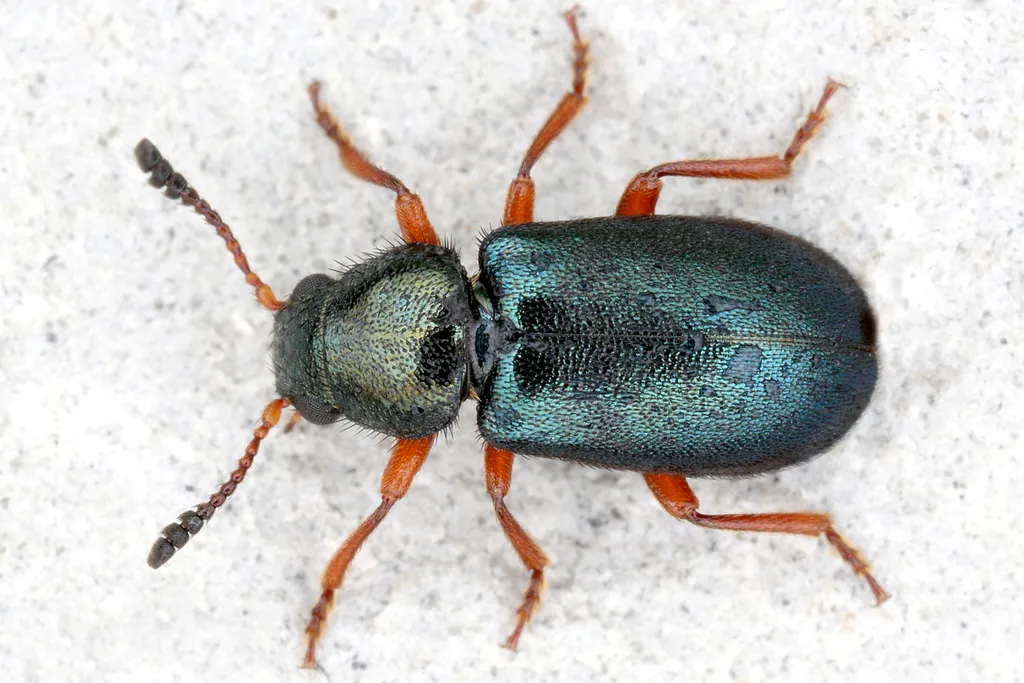
Photo credits: Contributed by Robin McLeod; Additional contributions by cotinis , Mike Quinn , v belov
Frequently Asked Questions About Red-legged Ham Beetle
What is Red-legged Ham Beetle?
Red-legged Ham Beetle (Necrobia rufipes) is a species in the family Cleridae, within the order Coleoptera.
How big is Red-legged Ham Beetle?
3.5-7.0 mm
How do you identify Red-legged Ham Beetle?
Adult: head, thorax, elytra shiny metallic bluish-green or blackish; underside of abdomen dark blue; legs bright reddish-brown or orange; antennae mainly reddish-brown but with dark brown or black club at tip; sides of thorax and elytra with stiff bristle-like hairs Larva: body creamy-gray with mottled violet-gray markings on upper surface; head and upper surface of first thoracic segment and last (ninth) abdominal segment with brown hardened plates; 2nd and 3rd thoracic segments also with tiny brownish plates; urogomphi strongly curved upwards
Where is Red-legged Ham Beetle found?
| Feature | Details |
|---|---|
| Habitat | found on dried fish, skins and bones of dead animals, and other carrion; also found on museum specimens |
| Range | most Nearctic records from sw US - Map , native to the Palearctic, now cosmopolitan |
What does Red-legged Ham Beetle eat?
The diet of the Red-legged Ham Beetle includes dried/salt fish, skins and bones of dead animals, museum specimens, cheese, bacon, dried egg yolk, bones and bone meal, dried figs, palm nut kernels, dried coconut (copra), and guano; also prey on eggs/larvae of some flies, of Dermestes spp., and its own species ( 5 ).
When is Red-legged Ham Beetle active?
Red-legged Ham Beetle: seasonal activity - summer in the north; most of the year in the south; year-round indoors.
What is the life cycle of a Red-legged Ham Beetle?
Eggs are laid on the food material; larvae pass through three or four instars; the last instar spins a cocoon in which pupation occurs; life-cycle takes 6 weeks or longer depending on food type and physical conditions. Under optimum conditions, the rate of population increase is about 25 times per month. The adults fly actively and can thus easily disperse to new sources of food.