
Myrmica schencki
This record describes Myrmica schencki (species). Recorded family: Formicidae. Recorded order: Hymenoptera.
Identification and Appearance
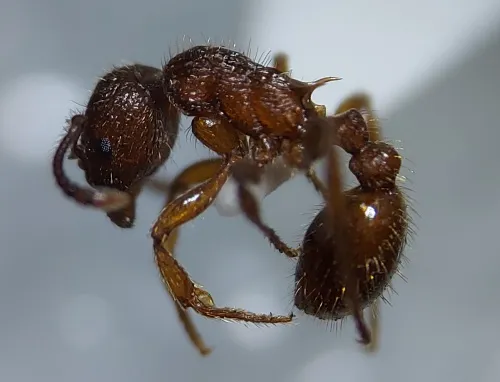
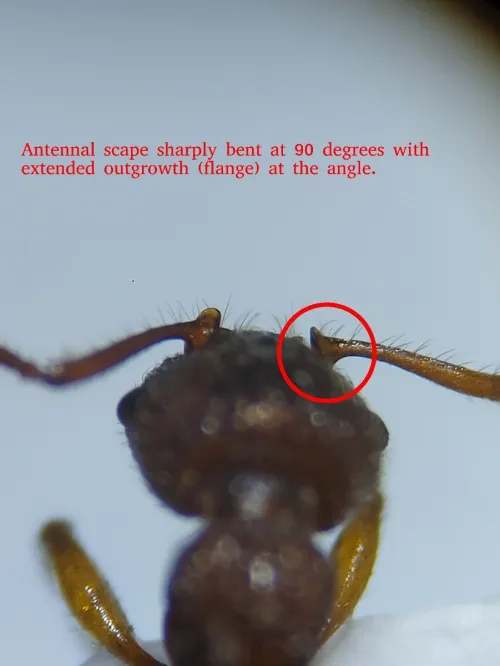
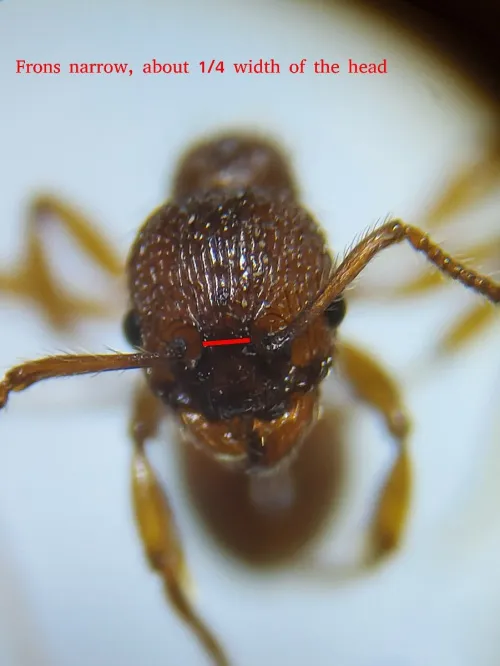
Very similar to Myrmica lobicornis. Workers and queens of both of these species have the antennal scape sharply angled at the base, with this bend bearing a broad upright flange. However, in M. schencki this flange is more strongly developed, with the width across the frontal lobes consequently smaller. Unless identified by a recognised expert, a photo is required and the specimen should be examined with a microscope. In the comments box, state the key or ID method used and describe the size and identifying characters. If possible, the specimen should be retained until the record is verified. A warmth-loving species that is usually found among sparse vegetation or in short turf on hot, dry, sheltered sites, including dunes, cliffs, unimproved pasture and downland, heaths, banks and railway cuttings. Nests contain winged sexuals by the end of July and during August, with mating flights occurring in August. The species is active at night as well as in the daytime. Nests are built usually in soil but occasionally in grass tussocks. Mating swarms have been observed congregating on raised ground or around tall buildings before mating pairs fall to the ground. Mating may also take place on the ground near the nest. Myrmica schencki is predatory, with other ants forming a major part of its diet. Myrmica schencki was added to the British list by Donisthorpe (1915) from Welsh specimens which had previously been wrongly identified. It remains scarce nationally, with most records coming from south eastern England and South Wales. No additional images available for this species.
Classification
- Kingdom
- Animalia
- Phylum
- Arthropoda
- Class
- Insecta
- Order
- Hymenoptera
- Family
- Formicidae
- Genus
- Myrmica
Imported taxonomy record. Source availability varies; see the source references and editorial policy below.
Habitat and Range
Habitat
A warmth-loving species that is usually found among sparse vegetation or in short turf on hot, dry, sheltered sites, including dunes, cliffs, unimproved pasture and downland, heaths, banks and railway cuttings.
Seasonal Activity
Nests contain winged sexuals by the end of July and during August, with mating flights occurring in August. The species is active at night as well as in the daytime.
Diet and Behavior
Life History
Nests are built usually in soil but occasionally in grass tussocks. Mating swarms have been observed congregating on raised ground or around tall buildings before mating pairs fall to the ground. Mating may also take place on the ground near the nest. Myrmica schencki is predatory, with other ants forming a major part of its diet.
Additional species information
Recorded status
Myrmica schencki was added to the British list by Donisthorpe (1915) from Welsh specimens which had previously been wrongly identified. It remains scarce nationally, with most records coming from south eastern England and South Wales.
About Flies: the wider group
Order-level background for Hymenoptera, the group containing Myrmica schencki. Species-specific details appear above.
Group overview
Hymenoptera includes over 150,000 described species of ants, bees, wasps, and sawflies. Earth harbors approximately 20 quadrillion (20×10^15) ants, with a combined biomass of ~12 megatons of dry carbon - exceeding the combined biomass of all wild birds and mammals (PNAS, 2022).
Ecological role of the group
About 35% of the world's food crops depend on animal pollinators. The chocolate industry, valued at over $100 billion, depends on pollinating flies and midges. Ants are the dominant soil engineers in most terrestrial ecosystems, turning more soil than earthworms in many habitats.
Economic and practical significance of the group
Pollinators contribute $235-577 billion worth of annual global food production (FAO). In the U.S., bee pollination alone benefits crops valued at $18 billion annually, and honey bees are responsible for $5.4 billion in agricultural productivity. Between April 2023-2024, 55.1% of managed honey bee colonies were lost. The U.S. bee population dropped from 5 million to 2.5 million.
Recorded sources for this group: FAO, USDA, EPA, PNAS (2022), US Fish & Wildlife Service. Imported estimates may describe particular regions or reporting periods.
Photos of Myrmica schencki (4)
Frequently Asked Questions About Myrmica schencki
What is Myrmica schencki?
Myrmica schencki is a species in the family Formicidae, within the order Hymenoptera.
Where is Myrmica schencki found?
Habitat: A warmth-loving species that is usually found among sparse vegetation or in short turf on hot, dry, sheltered sites, including dunes, cliffs, unimproved pasture and downland, heaths, banks and railway cuttings.
When is Myrmica schencki active?
Myrmica schencki: seasonal activity - Nests contain winged sexuals by the end of July and during August, with mating flights occurring in August. The species is active at night as well as in the daytime..
What is the life cycle of a Myrmica schencki?
Nests are built usually in soil but occasionally in grass tussocks. Mating swarms have been observed congregating on raised ground or around tall buildings before mating pairs fall to the ground. Mating may also take place on the ground near the nest. Myrmica schencki is predatory, with other ants forming a major part of its diet.