
White-headed Monopis - Hodges#0418
Monopis monachella
This record describes Monopis monachella (species). Recorded family: Tineidae. Recorded order: Lepidoptera.
Identification and Appearance
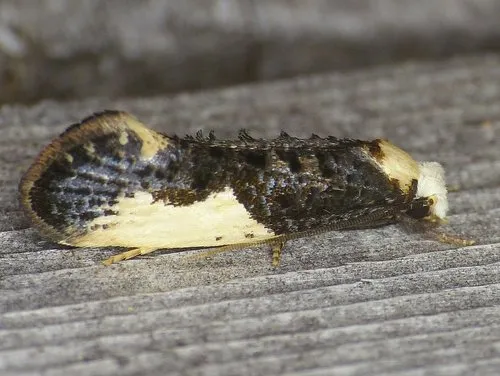
| Feature | Details |
|---|---|
| Head | Head white. Palpi long, folded; dark. Antenna: Dark brown. |
| Thorax | White. Wings: Wider, dark brown; slightly gray-scaled. Large white patch on costa has diagonal edge; extends from mid wing to near tip. Diagonal edge of patch encompasses the semi-translucent circle, typical of all Monopis . Some white scaling on inner margin near wing tip (anal angle). Hindwings gray. |
| Legs | White ringed with brown. Monopis longella (Walker, 1863) has a stained patch inside the white patch along the costa edge. According to Mr. Busck a specimen of this European species from Canada is in the U. S. National Museum, Smithsonian. A specimen without locality label and probably determined by Zeller is in the Cambridge Museum – MCZ assumed. DNA barcoding supports the possibility that specimens found in the US and Canada identified as M. monachella may be an undescribed species. Monopis monachella is a member of the Monopis monachella species complex (see Huang et al. 2011) which is currently represented at BOLD by the following BIN groups (5/26/2019). The synonymy of M. monachella , (TL: Europe) and monacha (TL: Indonesia) may be in question. It would seem that a revision of this complex may be needed: BOLD:ACD6617 = Monopis iuncti o (China and Indonesia) BOLD:ACZ5670 = possible undescribed Monopis species from Africa near M. iunctio BOLD:ACS7044 = possible undescribed Monopis species from Madagascar near M. longella (= pavlovskii ) BOLD:AAK6590 = possible undescribed Monopis species from Australia near M. longella BOLD:AAP6065 = possible undescribed Monopis species from China and Australia near M. longella (lacks dark smudge in pale spot of forewing) BOLD:AAE4730 = Monopis longella (Asia and North America) BOLD:AAB1740 = Monopis monachella (Euope only) BOLD:AAB1739 = possible undescribed Monopis species from North America near M. monachella |
Classification
- Kingdom
- Animalia
- Phylum
- Arthropoda
- Class
- Insecta
- Order
- Lepidoptera (Butterflies and Moths)
- Superfamily
- Tineoidea
- Family
- Tineidae (Clothes Moths)
- Subfamily
- Tineinae
- Genus
- Monopis
Imported taxonomy record. Source availability varies; see the source references and editorial policy below.
Habitat and Range
Geographic Range
Northeastern North America and throughout many regions of the world. Moth Photographers Group - large range map with collection dates. Type locality ( monachella ): Europe Type locality ( monacha ): Indonesia
Seasonal Activity
Adults fly May through October. ; June to September in north.
Diet and Behavior
Diet: Larvae feed on animal remains, skins and owl pellets.
About Butterflies and Moths: the wider group
Order-level background for Lepidoptera, the group containing Monopis monachella. Species-specific details appear above.
Group overview
Lepidoptera includes approximately 180,000 described species of butterflies and moths. Moths outnumber butterflies roughly 10:1. The monarch butterfly's eastern population has declined by more than 80% since the mid-1990s, and the western population by over 95% since the 1980s. The IUCN lists the migratory monarch as Vulnerable.
Ecological role of the group
Butterflies and moths are essential indicators of ecosystem health. As caterpillars, they are a primary food source for birds - a single nest of blue tit chicks requires ~10,000 caterpillars. Adult moths pollinate many night-blooming plants.
Economic and practical significance of the group
Lepidoptera are critical pollinators. In Europe, grassland butterfly species have declined by almost 50% since the early 1990s. In the UK, three-quarters of butterflies are in decline. In the U.S., five butterfly species have gone extinct since 1950, with 29 listed as endangered.
Recorded sources for this group: IUCN Red List, Xerces Society, USFWS, PNAS, WWF. Imported estimates may describe particular regions or reporting periods.
Photos of White-headed Monopis - Hodges#0418 (2)
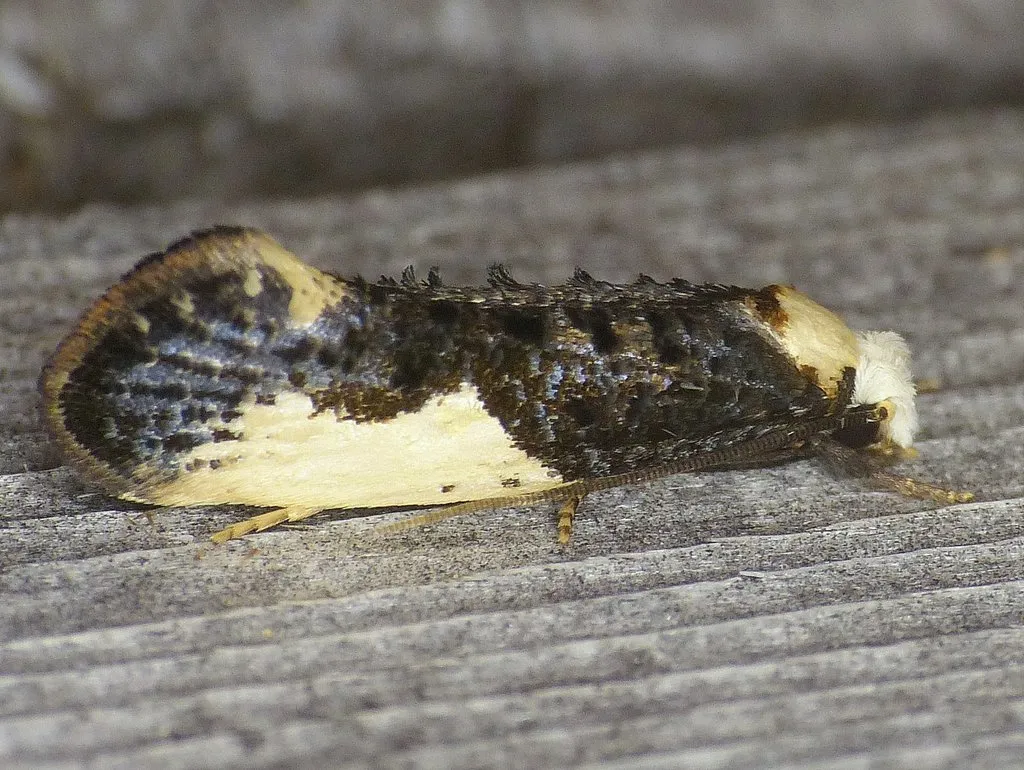
Photo credits: Contributed by Maury J. Heiman; Additional contributions by Steve Nanz , lee_penner
Frequently Asked Questions About White-headed Monopis - Hodges#0418
What is White-headed Monopis - Hodges#0418?
White-headed Monopis - Hodges#0418 (Monopis monachella) is a species in the family Tineidae, within the order Lepidoptera.
How big is White-headed Monopis - Hodges#0418?
5 to 8 mm long. Wingspan:12-20 mm.
How do you identify White-headed Monopis - Hodges#0418?
| Feature | Details |
|---|---|
| Head | Head white. Palpi long, folded; dark. Antenna: Dark brown. |
| Thorax | White. Wings: Wider, dark brown; slightly gray-scaled. Large white patch on costa has diagonal edge; extends from mid wing to near tip. Diagonal edge of patch encompasses the semi-translucent circle, typical of all Monopis . Some white scaling on inner margin near wing tip (anal angle). Hindwings gray. |
| Legs | White ringed with brown. Monopis longella (Walker, 1863) has a stained patch inside the white patch along the costa edge. |
Where is White-headed Monopis - Hodges#0418 found?
Range: Northeastern North America and throughout many regions of the world. Moth Photographers Group - large range map with collection dates. Type locality ( monachella ): Europe Type locality ( monacha ): Indonesia
What does White-headed Monopis - Hodges#0418 eat?
The diet of the White-headed Monopis - Hodges#0418 includes Larvae feed on animal remains, skins and owl pellets..
When is White-headed Monopis - Hodges#0418 active?
White-headed Monopis - Hodges#0418: seasonal activity - Adults fly May through October. ; June to September in north..