
Withered Mocis - Hodges#8744
Mocis marcida
This record describes Mocis marcida (species). Recorded family: Erebidae. Recorded order: Lepidoptera.
Identification and Appearance
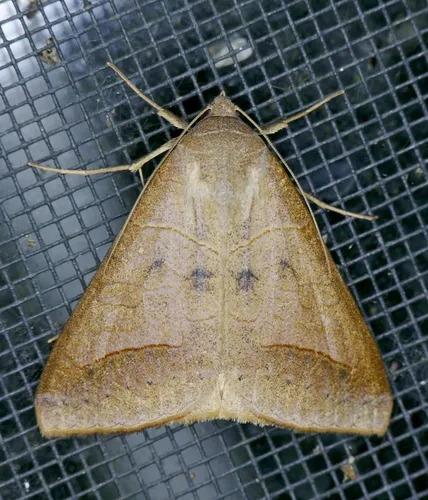
Adult: forewing usually purplish-brown (sometimes yellowish-brown or pale gray) with darker shading in subterminal area, and usually paler shading in terminal area; lines thin, distinct at close range but showing little contrast against ground color and therefore not noticeable at a distance; PM line bulges inward just above inner margin but the bulge is faint, giving the illusion that the PM line stops before reaching the inner margin; subterminal line a series of black dots; hindwing yellowish-brown or orangish-brown with diffuse grayish shading distally, and dark PM and terminal lines. Larva: Mocis species are recognized by intersegmental dorsal black spots between A1-A2 and A2-A3 (but concealed in fold when larva is at rest); prolegs lacking on A3 and A4; body yellowish-brown with broad chocolate subdorsal and subventral stripes; wide yellowish-brown lateral area often divided by narrow dark brown stripe running through spiracles from T1 to A8; head pale brown with numerous fine stripes and contrasting white lines [adapted from description by Wagner et al , who say that Mocis larvae cannot be reliably identified to species] Unlike most catocaline larvae, Mocis caterpillars do not wriggle violently when accosted, but rather simply drop to the ground--a habit shared by many grass feeders--where their coloration blends in with dead, withered grass blades. [David Wagner et al ]
Classification
- Kingdom
- Animalia
- Phylum
- Arthropoda
- Class
- Insecta
- Order
- Lepidoptera (Butterflies and Moths)
- Superfamily
- Noctuoidea
- Family
- Erebidae
- Subfamily
- Erebinae
- Tribe
- Euclidiini
- Genus
- Mocis
Imported taxonomy record. Source availability varies; see the source references and editorial policy below.
Habitat and Range
Habitat
Fields, marshes, grasslands, and other open grassy areas.
Geographic Range
Coastal North Carolina to Florida, west to Texas, rarely straying northward as far as New York. ( 3 ) , ( 4 ) Moth Photographers Group - large range map with some collection dates.
Seasonal Activity
Adults fly from April to November, or all year in southern Florida and Texas. Peak numbers from July to October in Florida. ( 5 ) larvae from late May onward, or all year in the far south
Diet and Behavior
Diet: Larvae feed on grasses.
Life History
Multiple generations per year.
About Butterflies and Moths: the wider group
Order-level background for Lepidoptera, the group containing Mocis marcida. Species-specific details appear above.
Group overview
Lepidoptera includes approximately 180,000 described species of butterflies and moths. Moths outnumber butterflies roughly 10:1. The monarch butterfly's eastern population has declined by more than 80% since the mid-1990s, and the western population by over 95% since the 1980s. The IUCN lists the migratory monarch as Vulnerable.
Ecological role of the group
Butterflies and moths are essential indicators of ecosystem health. As caterpillars, they are a primary food source for birds - a single nest of blue tit chicks requires ~10,000 caterpillars. Adult moths pollinate many night-blooming plants.
Economic and practical significance of the group
Lepidoptera are critical pollinators. In Europe, grassland butterfly species have declined by almost 50% since the early 1990s. In the UK, three-quarters of butterflies are in decline. In the U.S., five butterfly species have gone extinct since 1950, with 29 listed as endangered.
Recorded sources for this group: IUCN Red List, Xerces Society, USFWS, PNAS, WWF. Imported estimates may describe particular regions or reporting periods.
Photos of Withered Mocis - Hodges#8744 (2)
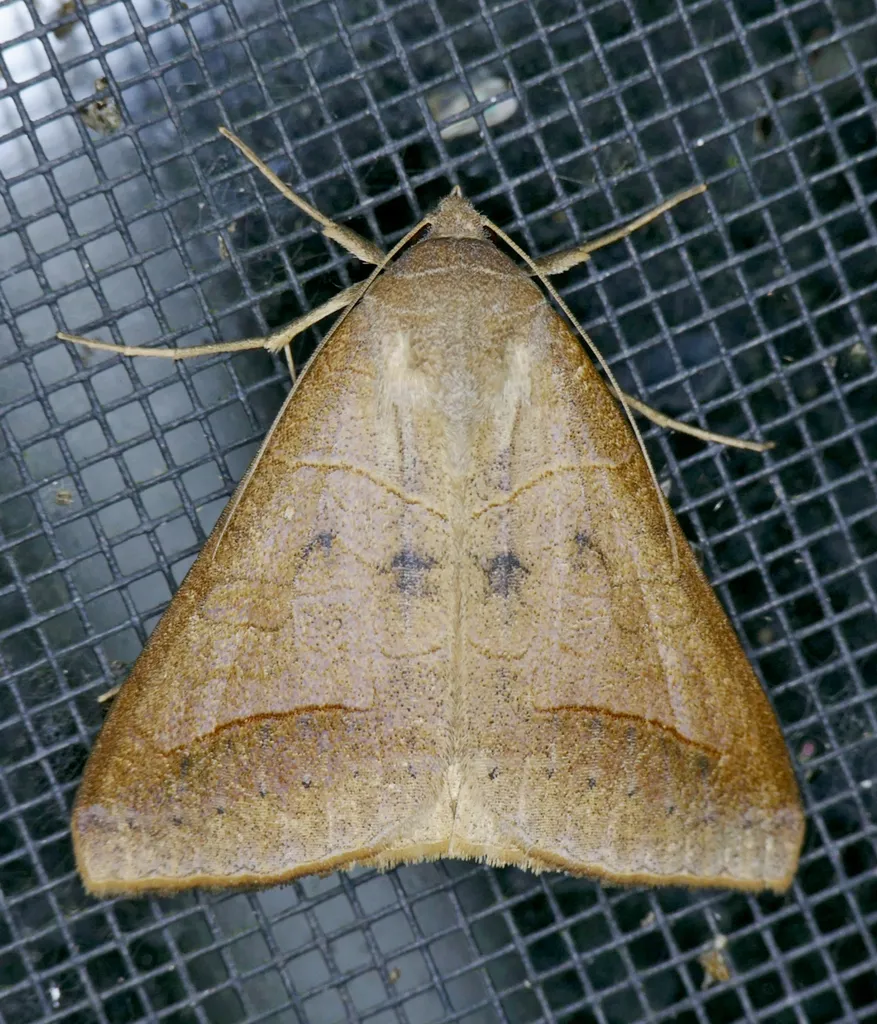
Photo credits: Contributed by Cotinis; Additional contributions by Steve Nanz , Robin McLeod , Maury Heiman , Robert Lord Zimlich
Frequently Asked Questions About Withered Mocis - Hodges#8744
What is Withered Mocis - Hodges#8744?
Withered Mocis - Hodges#8744 (Mocis marcida) is a species in the family Erebidae, within the order Lepidoptera.
How big is Withered Mocis - Hodges#8744?
Wingspan about 47 mm, based on two photos by Jim Vargo at MPG. Larvae to 45 mm.
How do you identify Withered Mocis - Hodges#8744?
Adult: forewing usually purplish-brown (sometimes yellowish-brown or pale gray) with darker shading in subterminal area, and usually paler shading in terminal area; lines thin, distinct at close range but showing little contrast against ground color and therefore not noticeable at a distance; PM line bulges inward just above inner margin but the bulge is faint, giving the illusion that the PM line stops before reaching the inner margin; subterminal line a series of black dots; hindwing yellowish-brown or orangish-brown with diffuse grayish shading distally, and dark PM and terminal lines. Larva: Mocis species are recognized by intersegmental dorsal black spots between A1-A2 and A2-A3 (but concealed in fold when larva is at rest); prolegs lacking on A3 and A4; body yellowish-brown with broad chocolate subdorsal and subventral stripes; wide yellowish-brown lateral area often divided by narrow dark brown stripe running through spiracles from T1 to A8; head pale brown with numerous fine stripes and contrasting white lines [adapted from description by Wagner et al , who say that Mocis larvae cannot be reliably identified to species]
Where is Withered Mocis - Hodges#8744 found?
| Feature | Details |
|---|---|
| Habitat | Fields, marshes, grasslands, and other open grassy areas. |
| Range | Coastal North Carolina to Florida, west to Texas, rarely straying northward as far as New York. ( 3 ) , ( 4 ) Moth Photographers Group - large range map with some collection dates. |
What does Withered Mocis - Hodges#8744 eat?
The diet of the Withered Mocis - Hodges#8744 includes Larvae feed on grasses..
When is Withered Mocis - Hodges#8744 active?
Withered Mocis - Hodges#8744: seasonal activity - Adults fly from April to November, or all year in southern Florida and Texas. Peak numbers from July to October in Florida. ( 5 ) larvae from late May onward, or all year in the far south.
What is the life cycle of a Withered Mocis - Hodges#8744?
Multiple generations per year.