
Greene's Giant Ichneumonid Wasp
Megarhyssa greenei
This record describes Megarhyssa greenei (species). Recorded family: Ichneumonidae. Recorded order: Hymenoptera.
Identification and Appearance
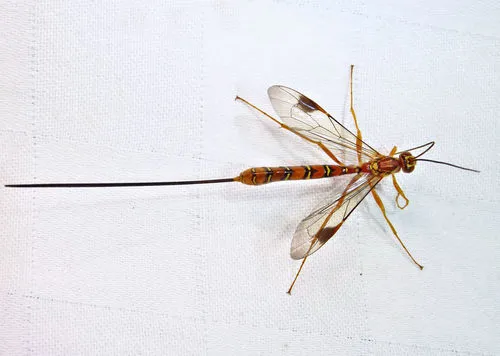
Females are distinguished from those of M. macrurus by having the forewing clear (unpigmented) along the basal vein (such that a single black spot is present) and by the shorter ovipositor length (the shortest in all US species of Megarhyssa ). In live specimens, this is only about 1.5x the body length (1.8x forewing length). Those of M. greenei also have a more extensively yellow face, lacking vertical lineations. Males are noted by their entirely clear wings, red and yellow mesopleuron , and red hind femur. Specimens from the southeastern US are highly variable in terms of yellow markings. Townes described two subspecies, but Carlson found that the extent of geographic variation is not conducive to the recognition of subspecies. BugGuide records have also revealed a third color form from this area that wasn't treated under Townes' subspecies divisions. widespread eastern US, formerly M. g. greenei : red with minor yellow markings on the thorax, paired lines on the mesoscutum, and narrow chevrons on the abdomen; wings hyaline with a single spot of dark pigmentation Florida (with intermediates in South Carolina and Alabama, photo #2), formerly M. g. floridana : yellow markings more restricted on the mesoscutum and abdomen; wings almost uniformly dark Georgia, North Carolina and Maryland, no separate name: yellow markings more extensive on the thorax, abdominal markings developed into spots; wings hyaline with a single spot of dark pigmentation
Wikipedia reference for Megarhyssa greenei: http://en.wikipedia.org/wiki/Megarhyssa_greenei.
Classification
- Kingdom
- Animalia
- Phylum
- Arthropoda
- Class
- Insecta
- Order
- Hymenoptera (Ants, Bees, Wasps and Sawflies)
- Superfamily
- Ichneumonoidea
- Family
- Ichneumonidae (Ichneumonid Wasps)
- Subfamily
- Rhyssinae
- Genus
- Megarhyssa (Giant Ichneumonid Wasps)
Imported taxonomy record. Source availability varies; see the source references and editorial policy below.
Habitat and Range
Geographic Range
e NA to Great Plains (BG data)
Seasonal Activity
mostly May-Sept (BG data)
Diet and Behavior
Diet: Larval host: larvae of Tremex columba (pigeon horntail).
Additional species information
Species notes from the sources
Etymology: Megarhyssa greenei Viereck, 1911
About Flies: the wider group
Order-level background for Hymenoptera, the group containing Megarhyssa greenei. Species-specific details appear above.
Group overview
Hymenoptera includes over 150,000 described species of ants, bees, wasps, and sawflies. Earth harbors approximately 20 quadrillion (20×10^15) ants, with a combined biomass of ~12 megatons of dry carbon - exceeding the combined biomass of all wild birds and mammals (PNAS, 2022).
Ecological role of the group
About 35% of the world's food crops depend on animal pollinators. The chocolate industry, valued at over $100 billion, depends on pollinating flies and midges. Ants are the dominant soil engineers in most terrestrial ecosystems, turning more soil than earthworms in many habitats.
Economic and practical significance of the group
Pollinators contribute $235-577 billion worth of annual global food production (FAO). In the U.S., bee pollination alone benefits crops valued at $18 billion annually, and honey bees are responsible for $5.4 billion in agricultural productivity. Between April 2023-2024, 55.1% of managed honey bee colonies were lost. The U.S. bee population dropped from 5 million to 2.5 million.
Recorded sources for this group: FAO, USDA, EPA, PNAS (2022), US Fish & Wildlife Service. Imported estimates may describe particular regions or reporting periods.
Photos of Greene's Giant Ichneumonid Wasp (3)
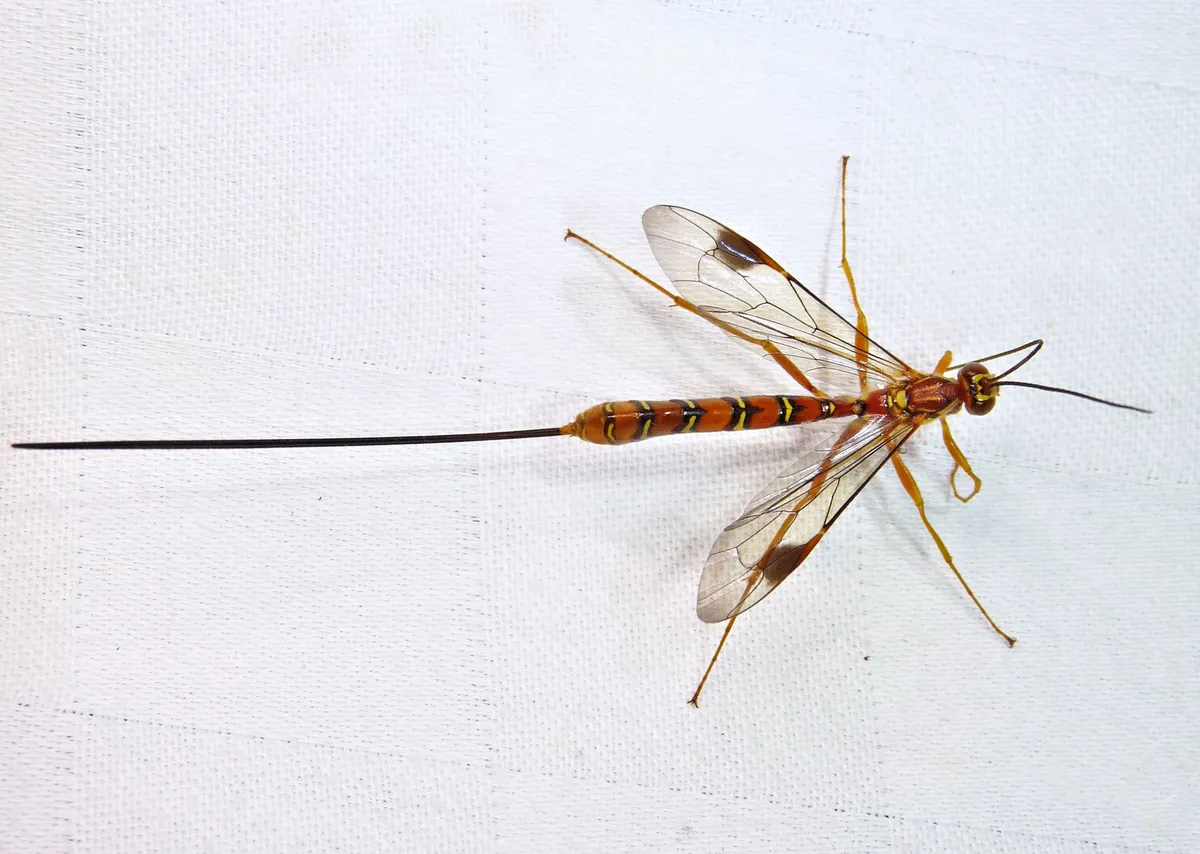
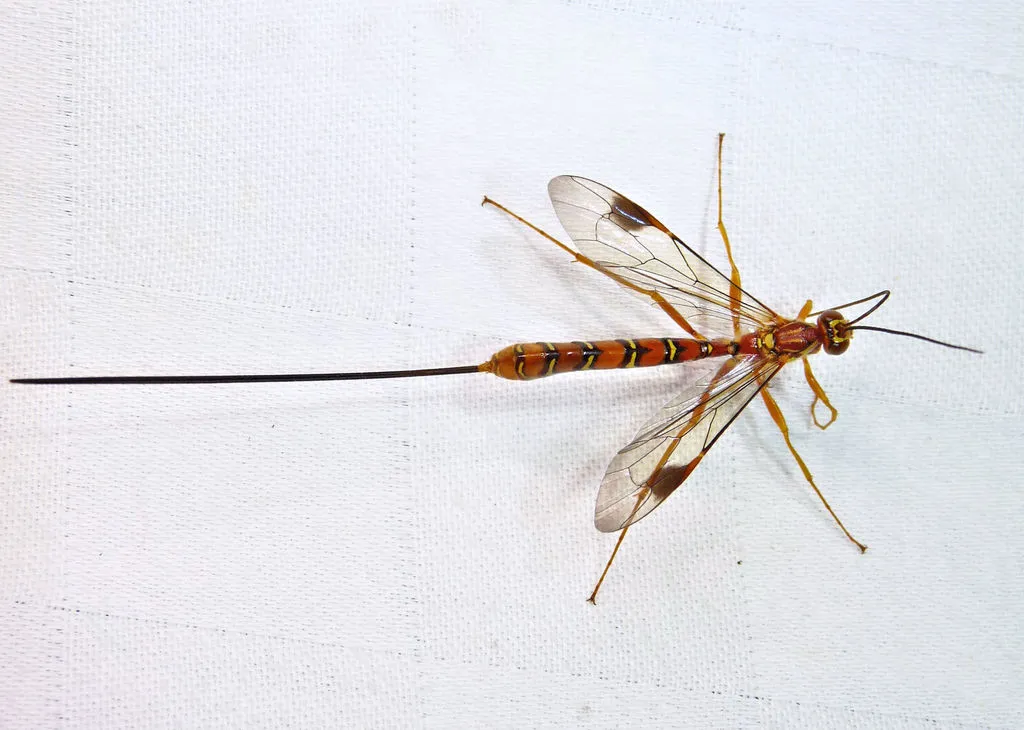
Photo credits: Contributed by john and jane balaban; Additional contributions by Mike Quinn , Bob Carlson , metrioptera , PaleoJon
Frequently Asked Questions About Greene's Giant Ichneumonid Wasp
What is Greene's Giant Ichneumonid Wasp?
Greene's Giant Ichneumonid Wasp (Megarhyssa greenei) is a species in the family Ichneumonidae, within the order Hymenoptera.
How big is Greene's Giant Ichneumonid Wasp?
Forewing 12-27 mm ♀, 10-16 mm ♂
How do you identify Greene's Giant Ichneumonid Wasp?
Females are distinguished from those of M. macrurus by having the forewing clear (unpigmented) along the basal vein (such that a single black spot is present) and by the shorter ovipositor length (the shortest in all US species of Megarhyssa ). In live specimens, this is only about 1.5x the body length (1.8x forewing length). Those of M. greenei also have a more extensively yellow face, lacking vertical lineations. Males are noted by their entirely clear wings, red and yellow mesopleuron , and red hind femur.
Where is Greene's Giant Ichneumonid Wasp found?
Range: e NA to Great Plains (BG data)
What does Greene's Giant Ichneumonid Wasp eat?
The diet of the Greene's Giant Ichneumonid Wasp includes Larval host: larvae of Tremex columba (pigeon horntail)..
When is Greene's Giant Ichneumonid Wasp active?
Greene's Giant Ichneumonid Wasp: seasonal activity - mostly May-Sept (BG data).