
Megaphorus minutus
This record describes Megaphorus minutus (species). Recorded family: Asilidae. Recorded order: Diptera.
Identification and Appearance
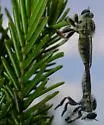
| Feature | Description |
|---|---|
| Additional details | See discussion on images. Differentiation from related species may be difficult from photos. The costa ends at the tip of the wing, femora are black basally, dorsum of abdominal segments 3 or 4-7 are covered in short black pile, the hind tibiae are black-haired dorsally over the entire length, and total body length is around 9-10 mm. The females of this species are described as having the hind tibiae basally with yellowish hairs, which makes separation from M. laphroides a little difficult, but the two species also differ by the palpi being covered by entirely dark hairs above and below in laphroides and covered in dark hairs above, yellow hairs below (instead of dark) in minutus. Females sometimes have a yellower mystax than the males but generally also with more yellowish hairs on the body instead of whitish gray hairs as in the males, especially on the legs. Macquart (1834) gives length as 6 lig. = 6 ligne , lines or Paris lines, which are 2.26 mm--giving a body length of 13-14 mm. Other notes on photos here suggest a somewhat shorter length, about 9-10 mm, so perhaps the 13 mm figure is in error. Here is the original description, with a Google translate version in English: M. PETITE. - Mallophora minuta, Nob. Long. 6 lig. Noire, moustache blanchâtre. |
| Thorax | Thorax à poils jaunes; disque noir. Segmens de l'abdomen bordés de poils jaunes. Pieds à poils jaunes; base des jambes jaunes. Bord extérieur des ailes obscur. De Philadelphie; cabinet de M. Serville. - - - Little Mallophore - Mallophora minuta, new species. Length, 6 lines. Black, whitish mustache. |
| Thorax | Thorax with yellow hairs; black disc. Segments of the abdomen edged with yellow hairs. Feet with yellow hair; base of the legs yellow. Outer edge of the wings obscure (dark). From Philadelphia; collection of Mr. Serville |
Classification
Habitat and Range
Geographic Range
PA-FL
Diet and Behavior
Life History
Eggs are laid in a mass on the stem of a plant, such as a stiff blade of grass: This unusual (for an asilid) egg-laying habit is shared with the related Mallophora (see this page ). See discussion . Pupation is in a cell in the ground:
Additional species information
Species notes from the sources
Etymology: Megaphorus minutus ( Macquart 1834)
About Flies: the wider group
Order-level background for Diptera, the group containing Megaphorus minutus. Species-specific details appear above.
Group overview
Diptera includes over 150,000 described species of flies, mosquitoes, and midges. Mosquitoes are the deadliest animal on Earth (CDC). Malaria alone causes ~249 million cases and over 608,000 deaths annually, mostly children under 5 (WHO). Vector-borne diseases account for over 17% of all infectious diseases, causing 700,000+ deaths per year.
Ecological role of the group
Despite their disease impact, flies are critical decomposers and pollinators. Hoverflies alone pollinate hundreds of crop and wildflower species. Flies are also the primary food source for many birds, bats, and fish. Forensic entomology relies heavily on fly species for crime scene analysis.
Economic and practical significance of the group
In the U.S., vector-borne disease cases tripled between 2004-2016, with over 640,000 cases reported in that period (CDC). Tickborne diseases doubled from 22,000 to 48,000 annual reports. Globally, mosquito-borne diseases cost billions in healthcare and lost productivity.
Recorded sources for this group: WHO, CDC, PNAS. Imported estimates may describe particular regions or reporting periods.
Photos of Megaphorus minutus (5)
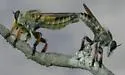
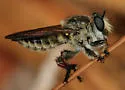
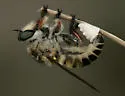
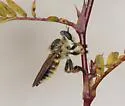
Photo credits: Contributed by Will Chatfield-Taylor; Additional contributions by cotinis , v belov , Arturo Santos
Frequently Asked Questions About Megaphorus minutus
What is Megaphorus minutus?
Megaphorus minutus is a species in the family Asilidae, within the order Diptera.
How big is Megaphorus minutus?
circa 10 mm body length (see Remarks)
How do you identify Megaphorus minutus?
See discussion on images. Differentiation from related species may be difficult from photos. The costa ends at the tip of the wing, femora are black basally, dorsum of abdominal segments 3 or 4-7 are covered in short black pile, the hind tibiae are black-haired dorsally over the entire length, and total body length is around 9-10 mm. The females of this species are described as having the hind tibiae basally with yellowish hairs, which makes separation from M. laphroides a little difficult, but the two species also differ by the palpi being covered by entirely dark hairs above and below in laphroides and covered in dark hairs above, yellow hairs below (instead of dark) in minutus. Females sometimes have a yellower mystax than the males but generally also with more yellowish hairs on the body instead of whitish gray hairs as in the males, especially on the legs.
Where is Megaphorus minutus found?
Range: PA-FL
What is the life cycle of a Megaphorus minutus?
Eggs are laid in a mass on the stem of a plant, such as a stiff blade of grass: This unusual (for an asilid) egg-laying habit is shared with the related Mallophora (see this page ). See discussion . Pupation is in a cell in the ground: