
Megalostomis dimidiata
This record describes Megalostomis dimidiata (species). Recorded family: Chrysomelidae. Recorded order: Coleoptera.
Identification and Appearance
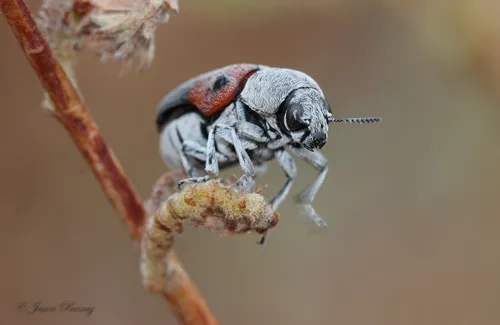
Det. E. G. Riley Walter et al. (1938) report, The larvae of Megalostomis major are casebearers. Their cases, standing out from the walls of the runways like small rounded pegs, present one of the most curious features in the [ Atta texana ] ant nests. The case is made of a thin layer of soil firmly cemented together and, as the larva grows, built up, ring upon ring, from a shallow shell-like cover into a deep inverted cup. That of a mature larva is 12 to 14 mm long and 7 to 8 mm in diameter near the outer, rounded end and tapers uniformly to 5 to 6 mm at the open end, which is cut off square and held tightly against the wall by the enclosed larva. Before pupation this end is cemented to the wall and closed with a thin layer of cement just within the rim of the case. The larvae are most abundant in the older runways, especially those discolored by long use, where they apparently feed on the waxy accumulation's from the ants. ( 6 )
Identification notes
Det. E. G. Riley
Classification
- Kingdom
- Animalia
- Phylum
- Arthropoda
- Class
- Insecta
- Order
- Coleoptera (Beetles)
- Suborder
- Polyphaga
- Superfamily
- Chrysomeloidea
- Family
- Chrysomelidae (Leaf Beetles)
- Subfamily
- Cryptocephalinae
- Tribe
- Clytrini
- Genus
- Megalostomis
Imported taxonomy record. Source availability varies; see the source references and editorial policy below.
Habitat and Range
Geographic Range
c. TX to C. Amer. - Map Range in south TX overlaps with that of the range of Atta texana - Map per USDA Forest Service
Diet and Behavior
Diet: Adults associated with Acacia, Prosopis, Senna (Fabaceae) (legumes) ( 4 )
Life History
Larval stage associated with leaf-cutter ants, Atta texana . (Walter et al. 1938) ( 5 ) E. G. Riley reports having seen this sp. at Welder Wildlife Refuge, Texas, clipping leaves and that they dropped to the ground. He suspects that the dropped leaves may have had eggs on them and the Atta ants may have picked up the leaves and taken them into their nests. (EGRiley, pers. comm. to MAQ, 2014)
Additional species information
Species notes from the sources
Etymology: Megalostomis dimidiata Lacordaire , 1848
About Primitive Winged Insects: the wider group
Order-level background for Coleoptera, the group containing Megalostomis dimidiata. Species-specific details appear above.
Group overview
Coleoptera is the largest order of insects with over 400,000 described species, representing ~25% of all known animal species and ~40% of all insects. In the U.S. alone, nearly 30,000 beetle species have been identified.
Ecological role of the group
Beetles are prominent decomposers, especially in forests, breaking down dead wood and recycling nutrients. As predators, they reduce populations of pest insects. Many species are also important pollinators of flowering plants.
Economic and practical significance of the group
Beetles have major economic significance: leaf beetles (Chrysomelidae) and weevils (Curculionoidea) are among the most destructive agricultural pests globally, costing billions annually, while predatory species like ladybugs provide natural pest control.
Recorded sources for this group: Britannica, Smithsonian, NCSU Entomology. Imported estimates may describe particular regions or reporting periods.
Photos of Megalostomis dimidiata (2)
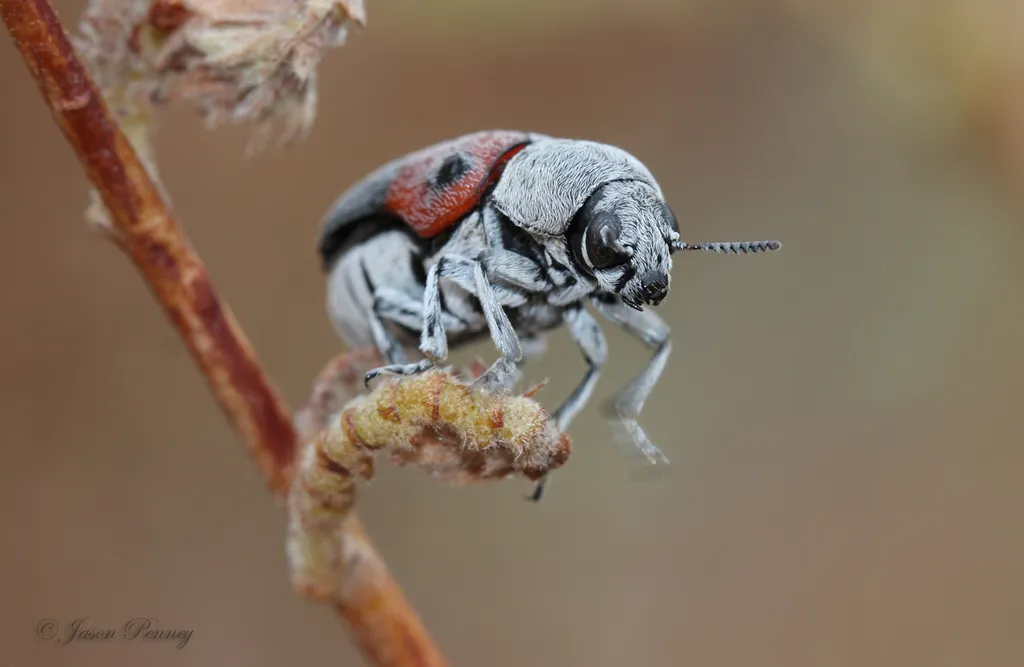
Photo credits: Contributed by Mike Quinn
Frequently Asked Questions About Megalostomis dimidiata
What is Megalostomis dimidiata?
Megalostomis dimidiata is a species in the family Chrysomelidae, within the order Coleoptera.
How big is Megalostomis dimidiata?
10 mm (large for a chrysomelid)
How do you identify Megalostomis dimidiata?
Det. E. G. Riley
Where is Megalostomis dimidiata found?
Range: c. TX to C. Amer. - Map Range in south TX overlaps with that of the range of Atta texana - Map per USDA Forest Service
What does Megalostomis dimidiata eat?
The diet of the Megalostomis dimidiata includes Adults associated with Acacia, Prosopis, Senna (Fabaceae) (legumes) ( 4 ).
What is the life cycle of a Megalostomis dimidiata?
Larval stage associated with leaf-cutter ants, Atta texana . (Walter et al. 1938) ( 5 ) E. G. Riley reports having seen this sp. at Welder Wildlife Refuge, Texas, clipping leaves and that they dropped to the ground. He suspects that the dropped leaves may have had eggs on them and the Atta ants may have picked up the leaves and taken them into their nests. (EGRiley, pers. comm. to MAQ, 2014)