
Longicaudus trirhodus
This record describes Longicaudus trirhodus (species). Recorded family: Aphididae. Recorded order: Hemiptera.
Identification and Appearance
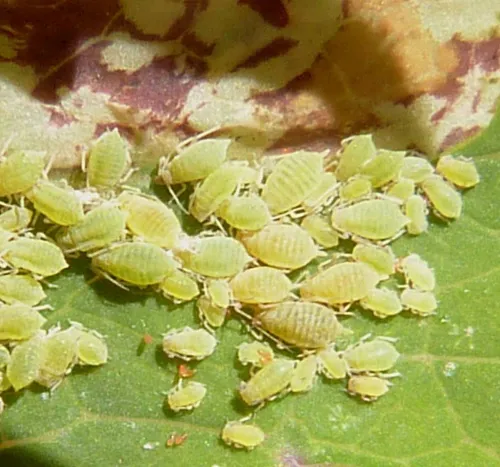
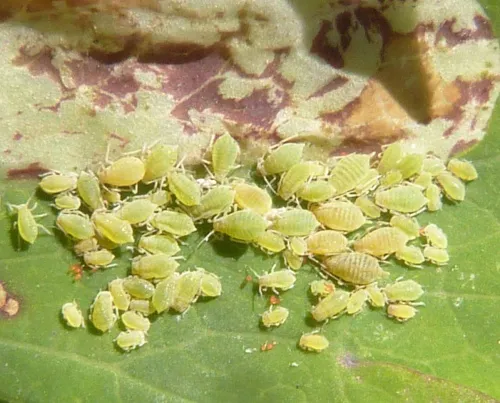
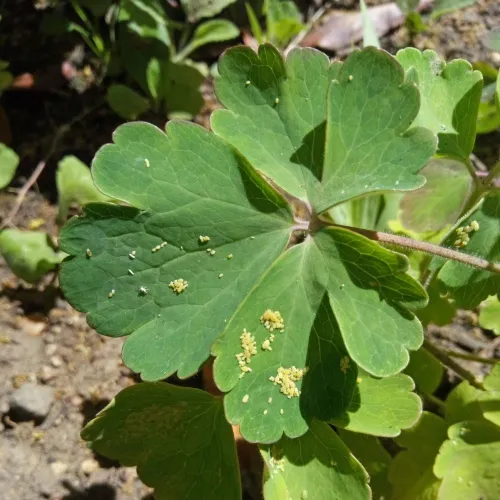
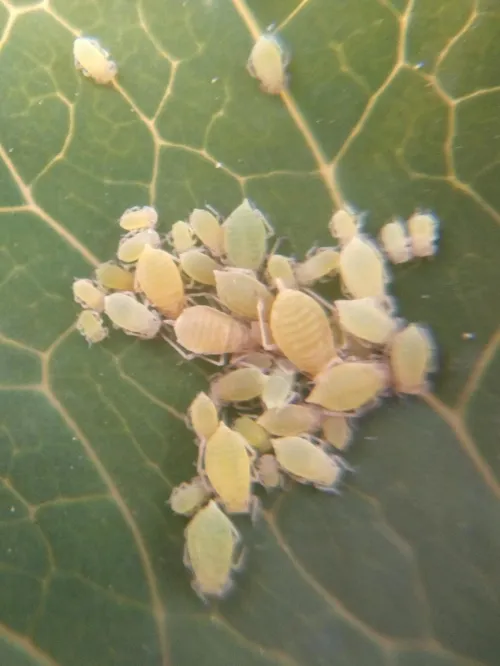
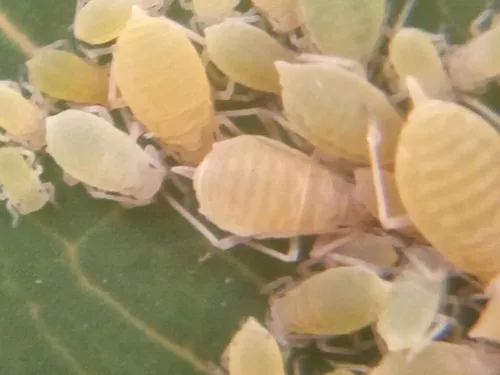
Apterae of Longicaudus trirhodus on their primary host (Rose) are pale yellowish-green and lightly wax-dusted, with slightly darker green transverse bands across the abdomen. Apterae on the secondary hosts (Columbine) are more yellow-green. The third antennal segment is distinctly longer than the total length of the fourth and fifth antennal segments. The siphunculi are cone-shaped with dark tips and much shorter than the cauda. The cauda is long and finger-like much longer than its basal width. The body length of L. trirhodus apterae on rose is 2.0 to 2.7 mm - those on secondary hosts are often smaller, down to 1.3 mm. Close up photographs required, please state the host plant. Can be found on either one of the host species – Rose or Columbine. Overwintering eggs of Longicaudus trirhodus on roses hatch in March, producing fundatrices. In April these yield small colonies on young leaves and buds. In May or June these colonies produce emigrant alatae which fly to the secondary hosts where their offspring feed on stems and leaf undersides. Autumn migrants fly to roses in October. The rose - columbine aphid host alternates from rose ( Rosa spp.) in winter and spring, to cultivated columbine ( Aquilegia vulgaris ) and meadow rue ( Thalictrum ) in the summer. True status in Britain is difficult to determine due to lack of records. https://influentialpoints.com/Gallery/Longicaudus_trirhodus_Rose-columbine_aphid.htm
Classification
- Kingdom
- Animalia
- Phylum
- Arthropoda
- Class
- Insecta
- Order
- Hemiptera (True Bugs, Cicadas, Hoppers, Aphids and Allies)
- Suborder
- Sternorrhyncha
- Superfamily
- Aphidoidea
- Family
- Aphididae (Aphids)
- Subfamily
- Aphidinae
- Tribe
- Macrosiphini
- Genus
- Longicaudus
Imported taxonomy record. Source availability varies; see the source references and editorial policy below.
Habitat and Range
Habitat
Can be found on either one of the host species – Rose or Columbine.
Seasonal Activity
Overwintering eggs of
Diet and Behavior
Life History
The rose - columbine aphid host alternates from rose (
Additional species information
Recorded status
True status in Britain is difficult to determine due to lack of records.
About True Bugs, Cicadas, Hoppers, Aphids and Allies: the wider group
Order-level background for Hemiptera, the group containing Longicaudus trirhodus. Species-specific details appear above.
Group overview
Hemiptera (true bugs) includes over 80,000 described species across cicadas, aphids, leafhoppers, shield bugs, and bed bugs. Aphids alone cost global agriculture an estimated $2.5 billion annually in crop losses.
Ecological role of the group
Many Hemiptera are essential food sources for birds and predatory insects. Cicadas provide massive nutrient pulses during emergence events - a single Brood X emergence can involve trillions of individuals across 15 states.
Economic and practical significance of the group
The brown marmorated stink bug (Halyomorpha halys) caused $37 million in apple crop losses in a single year in the U.S. Mid-Atlantic region. Bed bug infestations in the U.S. increased by 500% between 2001-2010, costing the hotel industry hundreds of millions annually.
Recorded sources for this group: USDA, EPA, University research. Imported estimates may describe particular regions or reporting periods.
Photos of Longicaudus trirhodus (5)
Frequently Asked Questions About Longicaudus trirhodus
What is Longicaudus trirhodus?
Longicaudus trirhodus is a species in the family Aphididae, within the order Hemiptera.
How big is Longicaudus trirhodus?
of the fourth and fifth antennal segments. The siphunculi are cone-shaped with dark tips and much shorter than the cauda. The cauda is long and finger-like much longer than its basal width. The body length of
Where is Longicaudus trirhodus found?
Habitat: Can be found on either one of the host species – Rose or Columbine.
When is Longicaudus trirhodus active?
Longicaudus trirhodus: seasonal activity - Overwintering eggs of.
What is the life cycle of a Longicaudus trirhodus?
The rose - columbine aphid host alternates from rose (