
Leucauge argyra
This record describes Leucauge argyra (species). Recorded family: Tetragnathidae. Recorded order: Araneae.
Identification and Appearance
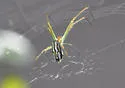
The thing that catches our [JJB] eye about L. argyra is that the three lines on the back run parallel only about halfway across the back when the outer two suddenly bend inward before flowing parallel once again to the end of the abdomen. L. venusta is variable, but seems to have a single line that branches out into three about a quarter of the way which then flow parallel to the back. There's probably something much more importantly different, but we haven't noticed it yet. See Continuing this discussion, the dorsal view of the abdomen has a white stripe that jogs inward about halfway to the back following the black line mentioned above. Below it on the side is a broad downward curving white band ending sometimes in a yellow tip, and below that a smaller curving yellow band. These are separated by broad black bands which get wider as they get farther back, so that the back of the animal is essentially all black with a few yellow spots. The underside has two parallel yellow lines ending in spots. We have not yet seen the frills on the back legs that are often so apparent in venusta , which see for comparable information here . See these images of L. argyra : Web is horizontal & raised in the center
Classification
- Kingdom
- Animalia
- Phylum
- Arthropoda
- Class
- Arachnida
- Order
- Araneae (Spiders)
- Family
- Tetragnathidae (Long-jawed Orb Weavers)
- Genus
- Leucauge
Imported taxonomy record. Source availability varies; see the source references and editorial policy below.
About Spiders: the wider group
Order-level background for Araneae, the group containing Leucauge argyra. Species-specific details appear above.
Group overview
As of 2023, 51,673 spider species in 136 families have been recorded, though an estimated 150,000 species exist. Spiders rank 7th in total species diversity among all organism orders. Only 0.5% of spider species pose any risk to human health.
Ecological role of the group
Spider venom contains complex peptides with diverse pharmacological activities, making them valuable for drug development research. Spiders produce up to 7 types of silk from specialized glands. Spider silk genes have been inserted into mammals and plants for biotech applications.
Economic and practical significance of the group
The global spider community kills an estimated 400-800 million tons of prey annually (2017 study). Spiders provide billions of dollars in natural pest control for agriculture. Spider silk is 5× stronger than steel of the same diameter, driving a biomaterials research industry.
Recorded sources for this group: World Spider Catalog, PNAS, Nature, ScienceDirect. Imported estimates may describe particular regions or reporting periods.
Photos of Leucauge argyra (5)
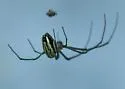
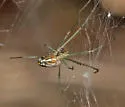
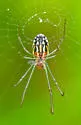
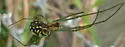
Photo credits: Contributed by Jeff Hollenbeck; Additional contributions by Hannah Nendick-Mason , john and jane balaban , Robin McLeod , Lynette Elliott , Joshua Stuart Rose