
Scaly Bee Fly
Lepidophora lepidocera
This record describes Lepidophora lepidocera (species). Recorded family: Bombyliidae. Recorded order: Diptera.
Identification and Appearance
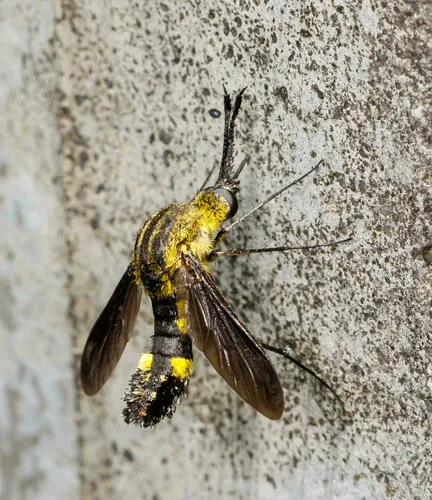
Hunch-backed shape is shared with L. lutea . In L. lepidocera , the pale scales are white or pale yellow, and usually no pale scales are evident on the fourth abdominal segment. Also note fringe at end of abdomen. May be a mimic of Robber-flies and/or bumblebees. A specimen of this species measured 7/30/2006 in Durham, North Carolina measured in a straight line, from tip of abdomen to front of head, 10 mm. The body is so crooked (like an L), the length measured along both legs of the L would be about 13 mm.
Classification
- Kingdom
- Animalia
- Phylum
- Arthropoda
- Class
- Insecta
- Order
- Diptera (Flies)
- Superfamily
- Asiloidea
- Family
- Bombyliidae (Bee Flies)
- Subfamily
- Ecliminae
- Genus
- Lepidophora
Imported taxonomy record. Source availability varies; see the source references and editorial policy below.
Habitat and Range
Habitat
Old fields, adjacent to deciduous woodlands.
Geographic Range
Includes eastern US (FL, GA, IA, LA, MO, NC, OH, OK, SC, TX - and probably intervening/adjacent states)
Seasonal Activity
Late summer-fall? Into November in Piedmont, North Carolina. Brimley lists the species for August-September in the mountains of that state. Insects of Cedar Creek, Minnesota reports flight of this genus in July and August.
Diet and Behavior
Diet: Adults are seen on flowers, presumably taking nectar. Insects of Cedar Creek reports they like to visit a Mountain Mint ( Pycnanthemum virginianum ). Another reference from Minnesota lists Black-eyed Susan ( Rudbeckia hirta ) as a nectar source. Seen on goldenrod ( Solidago spp.) and Bushy Aster ( Symphyotrichum dumosum ) in the Piedmont of North Carolina.
Life History
Larvae of Lepidophora are parasites of solitary wasps (Vespidae and Sphecidae). See: Sivinskil, Marshall, and Petersson, KLEPTOPARASITISM AND PHORESY IN THE DIPTERA. Florida Entomologist vol. 82 no. 2, p. 179xx, available at this web site . (That article quotes the primary reference as Hull, F. M. 1973. Bee Flies of the World. Smithsonian Institution, Washington D.C.) Evans, p. 230 ( 3 ) , lists this species as a kleptoparasite of "certain twig-nesters" (wasps). The larva is reported to feed on the contents of one cell and then to break through into an adjacent cell and to devour its contents as well.
Additional species information
Species notes from the sources
Etymology: Species name, lepidocera is a compound of lepido (scale) + -cera (wax). (Based on Internet searches.)
About Flies: the wider group
Order-level background for Diptera, the group containing Lepidophora lepidocera. Species-specific details appear above.
Group overview
Diptera includes over 150,000 described species of flies, mosquitoes, and midges. Mosquitoes are the deadliest animal on Earth (CDC). Malaria alone causes ~249 million cases and over 608,000 deaths annually, mostly children under 5 (WHO). Vector-borne diseases account for over 17% of all infectious diseases, causing 700,000+ deaths per year.
Ecological role of the group
Despite their disease impact, flies are critical decomposers and pollinators. Hoverflies alone pollinate hundreds of crop and wildflower species. Flies are also the primary food source for many birds, bats, and fish. Forensic entomology relies heavily on fly species for crime scene analysis.
Economic and practical significance of the group
In the U.S., vector-borne disease cases tripled between 2004-2016, with over 640,000 cases reported in that period (CDC). Tickborne diseases doubled from 22,000 to 48,000 annual reports. Globally, mosquito-borne diseases cost billions in healthcare and lost productivity.
Recorded sources for this group: WHO, CDC, PNAS. Imported estimates may describe particular regions or reporting periods.
Photos of Scaly Bee Fly (2)
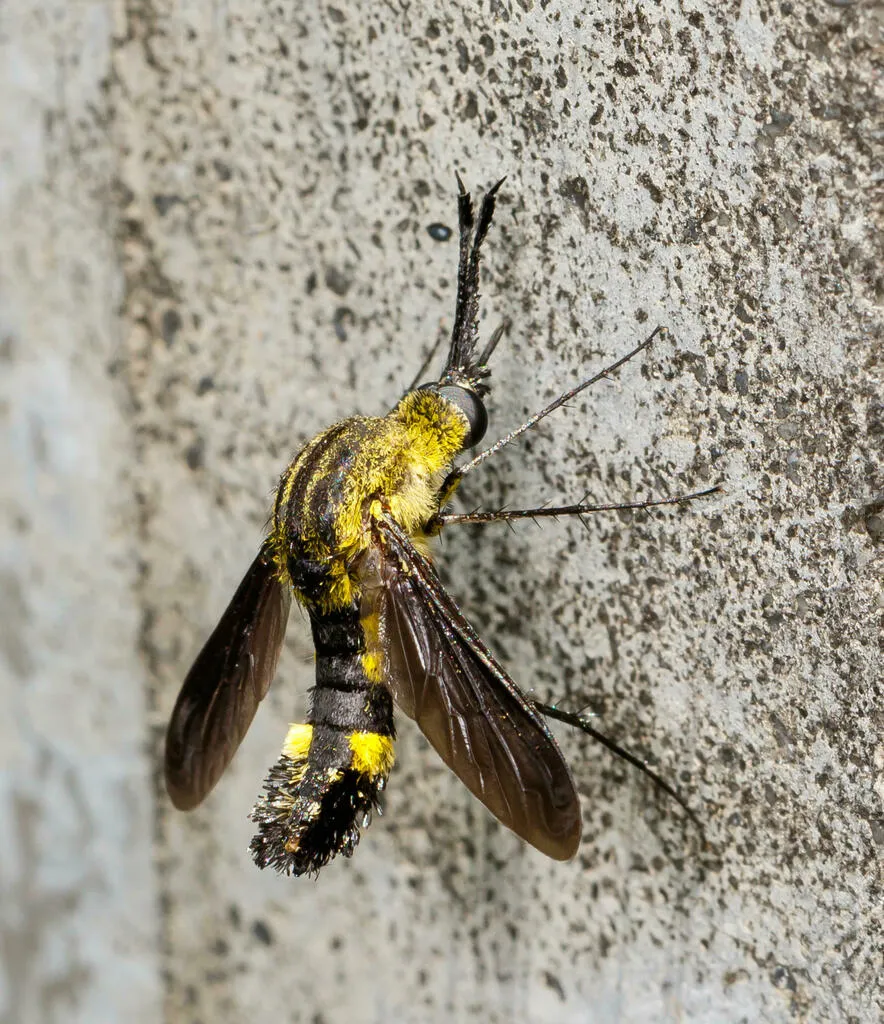
Photo credits: Contributed by Cotinis; Additional contributions by Robin McLeod
Frequently Asked Questions About Scaly Bee Fly
What is Scaly Bee Fly?
Scaly Bee Fly (Lepidophora lepidocera) is a species in the family Bombyliidae, within the order Diptera.
How big is Scaly Bee Fly?
10 mm length (approx.) See remarks.
How do you identify Scaly Bee Fly?
Hunch-backed shape is shared with L. lutea . In L. lepidocera , the pale scales are white or pale yellow, and usually no pale scales are evident on the fourth abdominal segment. Also note fringe at end of abdomen. May be a mimic of Robber-flies and/or bumblebees.
Where is Scaly Bee Fly found?
| Feature | Details |
|---|---|
| Habitat | Old fields, adjacent to deciduous woodlands. |
| Range | Includes eastern US (FL, GA, IA, LA, MO, NC, OH, OK, SC, TX - and probably intervening/adjacent states) |
What does Scaly Bee Fly eat?
The diet of the Scaly Bee Fly includes Adults are seen on flowers, presumably taking nectar. Insects of Cedar Creek reports they like to visit a Mountain Mint ( Pycnanthemum virginianum ). Another reference from Minnesota lists Black-eyed Susan ( Rudbeckia hirta ) as a nectar source. Seen on goldenrod ( Solidago spp.) and Bushy Aster ( Symphyotrichum dumosum ) in the Piedmont of North Carolina..
When is Scaly Bee Fly active?
Scaly Bee Fly: seasonal activity - Late summer-fall? Into November in Piedmont, North Carolina. Brimley lists the species for August-September in the mountains of that state. Insects of Cedar Creek, Minnesota reports flight of this genus in July and August..
What is the life cycle of a Scaly Bee Fly?
Larvae of Lepidophora are parasites of solitary wasps (Vespidae and Sphecidae). See: Sivinskil, Marshall, and Petersson, KLEPTOPARASITISM AND PHORESY IN THE DIPTERA. Florida Entomologist vol. 82 no. 2, p. 179xx, available at this web site . (That article quotes the primary reference as Hull, F. M. 1973. Bee Flies of the World. Smithsonian Institution, Washington D.C.) Evans, p. 230 ( 3 ) , lists this species as a kleptoparasite of certain twig-nesters (wasps). The larva is reported to feed on the contents of one cell and then to break through into an adjacent cell and to devour its contents as well.