
Lasioglossum pilosum
This record describes Lasioglossum pilosum (species). Recorded family: Halictidae. Recorded order: Hymenoptera.
Identification and Appearance
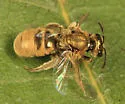
Distinctive features of pilosum sensu lato include an elongate head, densely punctate scutum, and dense tan hairs covering most of the terga. Lasioglossum pilosum sensu stricto differs only subtly from L. leucocomum. The former averages larger, has slightly denser scutal punctures, and most importantly has a more squared off clypeal projection (as opposed to clypeal corners convergent apically in leucocomum). A good strategy for identifying these bees is to make an initial sort by size and subtle differences in pilosity and punctation, after which structural characters such as the clypeal projection can be verified. Common
Classification
- Kingdom
- Animalia
- Phylum
- Arthropoda
- Class
- Insecta
- Order
- Hymenoptera (Ants, Bees, Wasps and Sawflies)
- Superfamily
- Trigonaloidea
- Family
- Halictidae (Sweat, Furrow, Nomiine, and Short-faced Bees)
- Subfamily
- Halictinae
- Tribe
- Halictini
- Genus
- Lasioglossum
Imported taxonomy record. Source availability varies; see the source references and editorial policy below.
Habitat and Range
Geographic Range
Minnesota to Nova Scotia, south to Georgia. Records of "pilosum" from the SE USA may pertain to L. floridanum whereas those from the western USA may pertain to succinipenne. In the NE USA and eastern Canada both pilosum and leucocomum occur together commonly and must be separated with care. Discover Life Map
Seasonal Activity
February to October.
Diet and Behavior
Diet: Visits flowers from several families. The Hosts section on its Discover Life species page lists known floral associations based on specimen records and images.
Additional species information
Species notes from the sources
Etymology: Lasioglossum (Dialictus) pilosum (Smith, 1853)
About Flies: the wider group
Order-level background for Hymenoptera, the group containing Lasioglossum pilosum. Species-specific details appear above.
Group overview
Hymenoptera includes over 150,000 described species of ants, bees, wasps, and sawflies. Earth harbors approximately 20 quadrillion (20×10^15) ants, with a combined biomass of ~12 megatons of dry carbon - exceeding the combined biomass of all wild birds and mammals (PNAS, 2022).
Ecological role of the group
About 35% of the world's food crops depend on animal pollinators. The chocolate industry, valued at over $100 billion, depends on pollinating flies and midges. Ants are the dominant soil engineers in most terrestrial ecosystems, turning more soil than earthworms in many habitats.
Economic and practical significance of the group
Pollinators contribute $235-577 billion worth of annual global food production (FAO). In the U.S., bee pollination alone benefits crops valued at $18 billion annually, and honey bees are responsible for $5.4 billion in agricultural productivity. Between April 2023-2024, 55.1% of managed honey bee colonies were lost. The U.S. bee population dropped from 5 million to 2.5 million.
Recorded sources for this group: FAO, USDA, EPA, PNAS (2022), US Fish & Wildlife Service. Imported estimates may describe particular regions or reporting periods.
Photos of Lasioglossum pilosum (5)
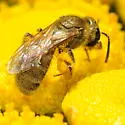
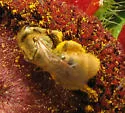
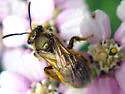
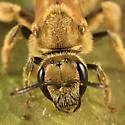
Photo credits: Contributed by Lynette Elliott; Additional contributions by Beatriz Moisset , John S. Ascher , hg , PaleoJon , Nathaniel Green
Frequently Asked Questions About Lasioglossum pilosum
What is Lasioglossum pilosum?
Lasioglossum pilosum is a species in the family Halictidae, within the order Hymenoptera.
How big is Lasioglossum pilosum?
| Feature | Details |
|---|---|
| Female | Length 4.91–6.35 mm |
| Male | Length 5.12–5.73 mm |
How do you identify Lasioglossum pilosum?
Distinctive features of pilosum sensu lato include an elongate head, densely punctate scutum, and dense tan hairs covering most of the terga. Lasioglossum pilosum sensu stricto differs only subtly from L. leucocomum. The former averages larger, has slightly denser scutal punctures, and most importantly has a more squared off clypeal projection (as opposed to clypeal corners convergent apically in leucocomum). A good strategy for identifying these bees is to make an initial sort by size and subtle differences in pilosity and punctation, after which structural characters such as the clypeal projection can be verified.
Where is Lasioglossum pilosum found?
Range: Minnesota to Nova Scotia, south to Georgia. Records of pilosum from the SE USA may pertain to L. floridanum whereas those from the western USA may pertain to succinipenne. In the NE USA and eastern Canada both pilosum and leucocomum occur together commonly and must be separated with care. Discover Life Map
What does Lasioglossum pilosum eat?
The diet of the Lasioglossum pilosum includes Visits flowers from several families. The Hosts section on its Discover Life species page lists known floral associations based on specimen records and images..
When is Lasioglossum pilosum active?
Lasioglossum pilosum: seasonal activity - February to October..