
Champlain Laphria
Laphria champlainii
This record describes Laphria champlainii (species). Recorded family: Asilidae. Recorded order: Diptera.
Identification and Appearance
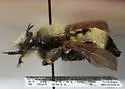
According to Walton's original 1910 description (at BHL, here , figures of plate IX here ), champlainii has dense yellow pile on the first through the fourth abdominal tergites (fifth on male), with 'anvil-shaped' black patches on the dorsum of first three, while grossa has first tergite black, separated from subsequent tergites by a deep groove, and lacking the dorsal black patches. The proboscis of champlainii is thinner and more tapered than grossa , which has a proboscis that is thicker towards the distal end. These two male specimens from the Carnegie Museum of Natural History collection fit the original description: This female specimen also fits Walton's original description: The following individuals were posted as champlainii on BugGuide, but they differ substantially from Walton's description in abdominal pattern and other features, like the color of the hair on the mesopleuron (should be primarily dark on champlainii , while it seems to be entirely yellow on these problematic ones). The shelf of the basistylus on on individual has a sharp lateral angle, while this area is more rounded on champlainii . I am fairly certain these flies are something other than champlainii , probably grossa . (BC) *Please note that champlainii was erroneously identified as huron on Steve Bullington's Laphriini Pages website until recently due to a specimen labeling error. The species account has now been corrected (Feb. 2015), though the key and other references on the site are still in error. Some earlier references by Herschel Raney on BugGuide to huron reflect this error, and referred to individuals now acknowledged to be champlainii . Please keep this in mind when reading older BugGuide comments referencing huron . True huron resembles sacrator with a black abdomen.
Classification
Habitat and Range
Habitat
Said to favor dry barrens habitats, often with bear (scrub) oak ( Quercus ilicifolia ).
Geographic Range
ne. US (MA-NJ-OH)
Additional species information
Species notes from the sources
Etymology: Laphria champlainii (Walton 1910) Champlain Laphria: https://www.robberfliesoftheworld.com/NA_CommonNames.php
About Flies: the wider group
Order-level background for Diptera, the group containing Laphria champlainii. Species-specific details appear above.
Group overview
Diptera includes over 150,000 described species of flies, mosquitoes, and midges. Mosquitoes are the deadliest animal on Earth (CDC). Malaria alone causes ~249 million cases and over 608,000 deaths annually, mostly children under 5 (WHO). Vector-borne diseases account for over 17% of all infectious diseases, causing 700,000+ deaths per year.
Ecological role of the group
Despite their disease impact, flies are critical decomposers and pollinators. Hoverflies alone pollinate hundreds of crop and wildflower species. Flies are also the primary food source for many birds, bats, and fish. Forensic entomology relies heavily on fly species for crime scene analysis.
Economic and practical significance of the group
In the U.S., vector-borne disease cases tripled between 2004-2016, with over 640,000 cases reported in that period (CDC). Tickborne diseases doubled from 22,000 to 48,000 annual reports. Globally, mosquito-borne diseases cost billions in healthcare and lost productivity.
Recorded sources for this group: WHO, CDC, PNAS. Imported estimates may describe particular regions or reporting periods.
Photos of Champlain Laphria (5)
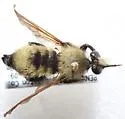
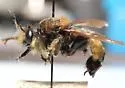
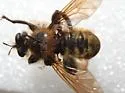
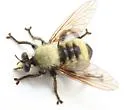
Photo credits: Contributed by Eric R. Eaton; Additional contributions by Ben Coulter , v belov , Chris Cohen
Frequently Asked Questions About Champlain Laphria
What is Champlain Laphria?
Champlain Laphria (Laphria champlainii) is a species in the family Asilidae, within the order Diptera.
How big is Champlain Laphria?
19-24 mm
How do you identify Champlain Laphria?
According to Walton's original 1910 description (at BHL, here , figures of plate IX here ), champlainii has dense yellow pile on the first through the fourth abdominal tergites (fifth on male), with 'anvil-shaped' black patches on the dorsum of first three, while grossa has first tergite black, separated from subsequent tergites by a deep groove, and lacking the dorsal black patches. The proboscis of champlainii is thinner and more tapered than grossa , which has a proboscis that is thicker towards the distal end. These two male specimens from the Carnegie Museum of Natural History collection fit the original description: This female specimen also fits Walton's original description:
Where is Champlain Laphria found?
| Feature | Details |
|---|---|
| Habitat | Said to favor dry barrens habitats, often with bear (scrub) oak ( Quercus ilicifolia ). |
| Range | ne. US (MA-NJ-OH) |