
Cuneate Arches - Hodges#10371
Lacinipolia cuneata
This record describes Lacinipolia cuneata (species). Recorded family: Noctuidae. Recorded order: Lepidoptera.
Identification and Appearance
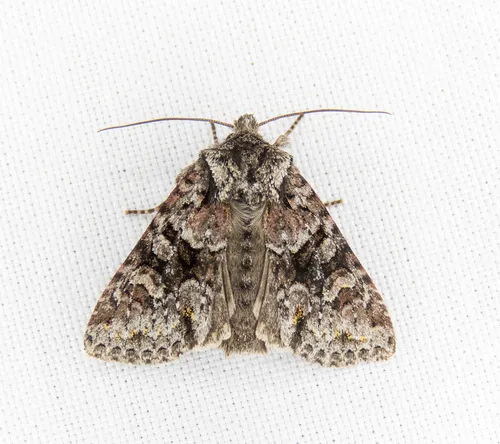
Adult: forewing brownish-gray with large dark brown or blackish patch surrounding reniform and orbicular spots [patch is broad near costa, and narrows toward inner margin, giving overall wedge shape]; short black bar connects AM and PM lines near costa; black basal and anal dashes; small golden-yellow patch superimposed on anal dash is diagnostic when visible hindwing dark brownish-gray with black veins Larva; dark rosy brown dorsally with faint black chevrons; sides dark brown with barely discernible black semicircle on each abdominal segment; head dark gray with black markings
Classification
- Kingdom
- Animalia
- Phylum
- Arthropoda
- Class
- Insecta
- Order
- Lepidoptera (Butterflies and Moths)
- Superfamily
- Noctuoidea
- Family
- Noctuidae (Owlet Moths)
- Subfamily
- Noctuinae
- Tribe
- Eriopygini
- Genus
- Lacinipolia
Imported taxonomy record. Source availability varies; see the source references and editorial policy below.
Habitat and Range
Habitat
coastal forests (not in mountains)
Geographic Range
British Columbia to California
Seasonal Activity
adults fly in spring and early summer
Diet and Behavior
Diet: Jeremy Tatum found an egg on Oceanspray ( Holodiscus discolor ) in July; larva was reared on dandelion, chickweed, and lettuce; probably feeds on leaves of various plants in nature
Life History
one generation per year; overwinters as a larva; pupates in late winter or early spring; adults emerge in spring
Additional species information
Species notes from the sources
Etymology: CUNEATA: from the Latin "cuneatus" (wedge-shaped), from "cuneus" (a wedge); probably refers to the shape of the dark patch on the forewing The common name suggested above follows the pattern of calling Lacinipolia species "Arches", and using the species epithet as a modifier
About Butterflies and Moths: the wider group
Order-level background for Lepidoptera, the group containing Lacinipolia cuneata. Species-specific details appear above.
Group overview
Lepidoptera includes approximately 180,000 described species of butterflies and moths. Moths outnumber butterflies roughly 10:1. The monarch butterfly's eastern population has declined by more than 80% since the mid-1990s, and the western population by over 95% since the 1980s. The IUCN lists the migratory monarch as Vulnerable.
Ecological role of the group
Butterflies and moths are essential indicators of ecosystem health. As caterpillars, they are a primary food source for birds - a single nest of blue tit chicks requires ~10,000 caterpillars. Adult moths pollinate many night-blooming plants.
Economic and practical significance of the group
Lepidoptera are critical pollinators. In Europe, grassland butterfly species have declined by almost 50% since the early 1990s. In the UK, three-quarters of butterflies are in decline. In the U.S., five butterfly species have gone extinct since 1950, with 29 listed as endangered.
Recorded sources for this group: IUCN Red List, Xerces Society, USFWS, PNAS, WWF. Imported estimates may describe particular regions or reporting periods.
Photos of Cuneate Arches - Hodges#10371 (2)
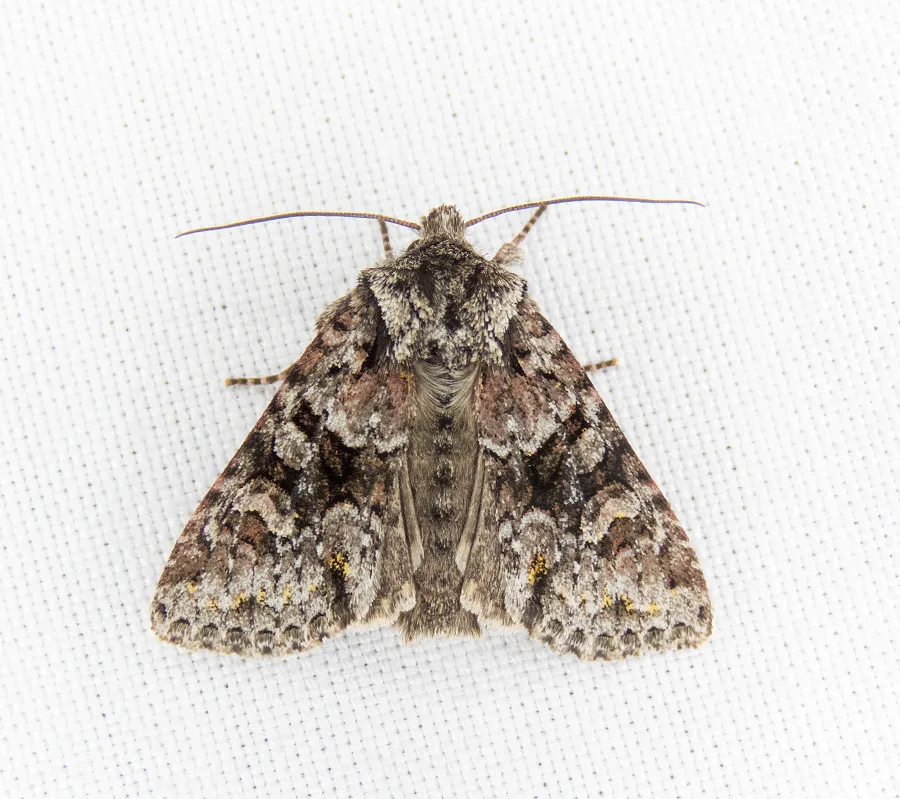
Photo credits: Contributed by Robin McLeod; Additional contributions by Ethan Kistler , Steve Morris
Frequently Asked Questions About Cuneate Arches - Hodges#10371
What is Cuneate Arches - Hodges#10371?
Cuneate Arches - Hodges#10371 (Lacinipolia cuneata) is a species in the family Noctuidae, within the order Lepidoptera.
How big is Cuneate Arches - Hodges#10371?
wingspan about 30 mm
How do you identify Cuneate Arches - Hodges#10371?
Adult: forewing brownish-gray with large dark brown or blackish patch surrounding reniform and orbicular spots [patch is broad near costa, and narrows toward inner margin, giving overall wedge shape]; short black bar connects AM and PM lines near costa; black basal and anal dashes; small golden-yellow patch superimposed on anal dash is diagnostic when visible hindwing dark brownish-gray with black veins Larva; dark rosy brown dorsally with faint black chevrons; sides dark brown with barely discernible black semicircle on each abdominal segment; head dark gray with black markings
Where is Cuneate Arches - Hodges#10371 found?
| Feature | Details |
|---|---|
| Habitat | coastal forests (not in mountains) |
| Range | British Columbia to California |
What does Cuneate Arches - Hodges#10371 eat?
The diet of the Cuneate Arches - Hodges#10371 includes Jeremy Tatum found an egg on Oceanspray ( Holodiscus discolor ) in July; larva was reared on dandelion, chickweed, and lettuce; probably feeds on leaves of various plants in nature.
When is Cuneate Arches - Hodges#10371 active?
Cuneate Arches - Hodges#10371: seasonal activity - adults fly in spring and early summer.
What is the life cycle of a Cuneate Arches - Hodges#10371?
one generation per year; overwinters as a larva; pupates in late winter or early spring; adults emerge in spring