
Kuschelina fallax
This record describes Kuschelina fallax (species). Recorded family: Chrysomelidae. Recorded order: Coleoptera.
Identification and Appearance
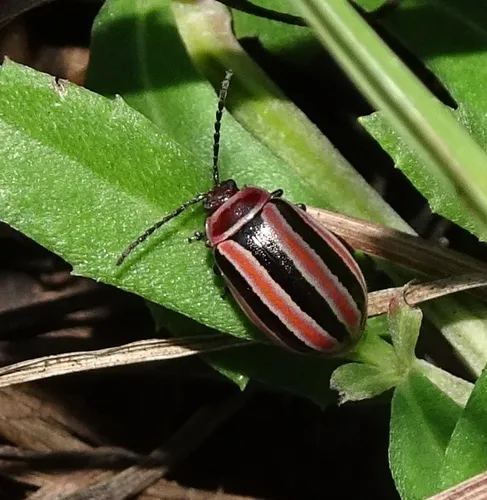
Description : Oblong oval, moderately convex. Head shining, red-brown, coarsely punctate. Prothorax light yellow with irregular red-brown fascia, slightly alutaceous, finely punctate; yellow with black sutural and median fascia; sometimes faint indications of narrow brown fasciae in the yellow vittae (remnants of red stripes of living beetles). Dark vittae usually as wide as or wider than yellow, median turning mesad toward suture at apex. Venter dark red-brown, tibiae and tarsi piceous. ... Blake (ref. 21 = Blake, 1954) remarked concerning the recognition of this species: All have rather convex elytra and remnants of the orange red stripe in the pale vitta. In all, the median dark vitta is as wide if not wider than the pale one, and the elytral punctation is coarse and dense. See also Ciegler . Note that definitive identification at the species level in the Kuschelina miniata complex requires dissection of a male specimen for microscopic examination of the aedeagus.
Classification
- Kingdom
- Animalia
- Phylum
- Arthropoda
- Class
- Insecta
- Order
- Coleoptera (Beetles)
- Suborder
- Polyphaga
- Superfamily
- Chrysomeloidea
- Family
- Chrysomelidae (Leaf Beetles)
- Subfamily
- Galerucinae
- Tribe
- Alticini
- Genus
- Kuschelina
Imported taxonomy record. Source availability varies; see the source references and editorial policy below.
Habitat and Range
Habitat
Presumably sandy areas with host plant.
Geographic Range
e US (TX-FL-NY-IL) - Map ( 4 ) ( 5 ) , few GBIF records
Seasonal Activity
March-August (South Carolina) ; April-October (Alabama)
Diet and Behavior
Life History
Host plant: Beach False Foxglove ( Agalinis fasciculata , Scrophulariaceae) . Other species of Agalinis ( strictifolia, purpurea ) have been reported as well (Cavey et al., 2003).
Additional species information
Species notes from the sources
Etymology: fallac (L). 'deceptive'
About Primitive Winged Insects: the wider group
Order-level background for Coleoptera, the group containing Kuschelina fallax. Species-specific details appear above.
Group overview
Coleoptera is the largest order of insects with over 400,000 described species, representing ~25% of all known animal species and ~40% of all insects. In the U.S. alone, nearly 30,000 beetle species have been identified.
Ecological role of the group
Beetles are prominent decomposers, especially in forests, breaking down dead wood and recycling nutrients. As predators, they reduce populations of pest insects. Many species are also important pollinators of flowering plants.
Economic and practical significance of the group
Beetles have major economic significance: leaf beetles (Chrysomelidae) and weevils (Curculionoidea) are among the most destructive agricultural pests globally, costing billions annually, while predatory species like ladybugs provide natural pest control.
Recorded sources for this group: Britannica, Smithsonian, NCSU Entomology. Imported estimates may describe particular regions or reporting periods.
Photos of Kuschelina fallax (2)
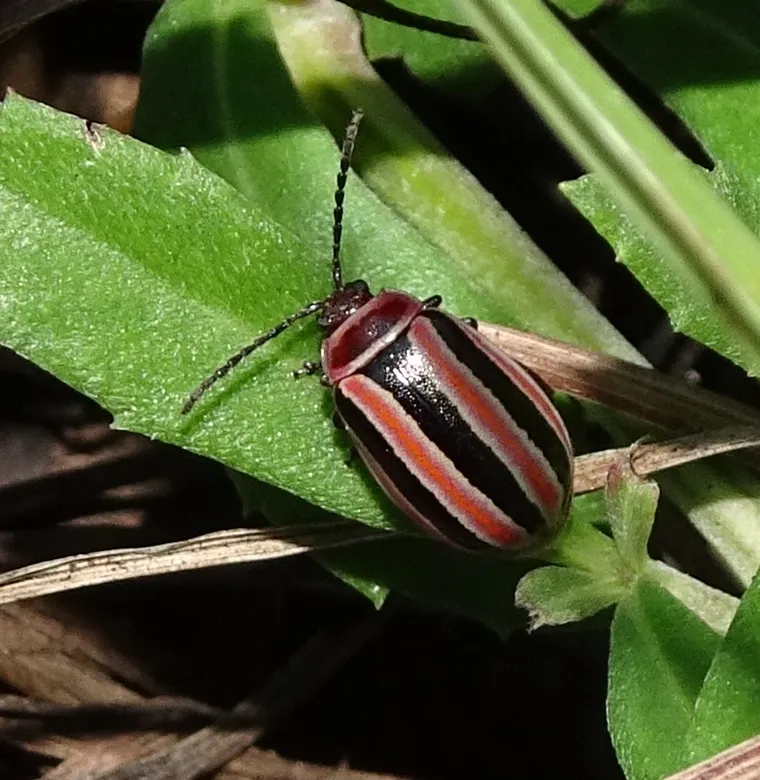
Photo credits: Contributed by Cotinis; Additional contributions by Mike Quinn
Frequently Asked Questions About Kuschelina fallax
What is Kuschelina fallax?
Kuschelina fallax is a species in the family Chrysomelidae, within the order Coleoptera.
How big is Kuschelina fallax?
5.5-7.0 mm ; Length 4.9-5.8 mm. Width 2.8-3.2 mm (males, presumably)
How do you identify Kuschelina fallax?
Description : Oblong oval, moderately convex. Head shining, red-brown, coarsely punctate. Prothorax light yellow with irregular red-brown fascia, slightly alutaceous, finely punctate; yellow with black sutural and median fascia; sometimes faint indications of narrow brown fasciae in the yellow vittae (remnants of red stripes of living beetles). Dark vittae usually as wide as or wider than yellow, median turning mesad toward suture at apex. Venter dark red-brown, tibiae and tarsi piceous. ... Blake (ref. 21 = Blake, 1954) remarked concerning the recognition of this species: All have rather convex elytra and remnants of the orange red stripe in the pale vitta. In all, the median dark vitta is as wide if not wider than the pale one, and the elytral punctation is coarse and dense. See also Ciegler . Note that definitive identification at the species level in the Kuschelina miniata complex requires dissection of a male specimen for microscopic examination of the aedeagus.
Where is Kuschelina fallax found?
| Feature | Details |
|---|---|
| Habitat | Presumably sandy areas with host plant. |
| Range | e US (TX-FL-NY-IL) - Map ( 4 ) ( 5 ) , few GBIF records |
When is Kuschelina fallax active?
Kuschelina fallax: seasonal activity - March-August (South Carolina) ; April-October (Alabama).
What is the life cycle of a Kuschelina fallax?
Host plant: Beach False Foxglove ( Agalinis fasciculata , Scrophulariaceae) . Other species of Agalinis ( strictifolia, purpurea ) have been reported as well (Cavey et al., 2003).