
Mountain Mahogany Looper - Hodges#6575
Iridopsis clivinaria
This record describes Iridopsis clivinaria (species). Recorded family: Geometridae. Recorded order: Lepidoptera.
Identification and Appearance
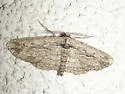
Adult: forewing triangular, pale gray in strip along costa, and medium brownish-gray in lower and outer portions; PM line fine, black, slightly wavy, bordered distally by brown line; AM line fine, black, double, reaches only halfway to costa; ST line white, double, scalloped, contrasting against gray ground color; terminal line scalloped; hindwing color and markings similar to forewing Larva: a grayish-brown twig mimic. Four color morphs: black, gray, reddish, and yellow with slight dorsal bumps on segments two and eight
Classification
- Kingdom
- Animalia
- Phylum
- Arthropoda
- Class
- Insecta
- Order
- Lepidoptera (Butterflies and Moths)
- Superfamily
- Geometroidea
- Family
- Geometridae (Geometrid Moths)
- Subfamily
- Ennominae
- Tribe
- Boarmiini
- Genus
- Iridopsis
Imported taxonomy record. Source availability varies; see the source references and editorial policy below.
Habitat and Range
Geographic Range
British Columbia to southern California, east to Idaho, Utah, Colorado Arizona reports of clivinaria currently showing in BugGuide are likely misplaced I. obliquaria .
Seasonal Activity
adults fly from March to July larvae present in July and August
Diet and Behavior
Diet: larvae feed mainly on leaves of mountain mahogany ( Cercocarpus spp.) and Antelope Bitterbrush ( Purshia tridentata ); also feeds on cherry ( Prunus spp.), and sometimes Snowbrush Ceanothus ( Ceanothus velutinus )
Life History
one generation per year; females lay up to 700 eggs each (average 350) in clusters in bark crevices; first two instars are leaf skeletonizers; overwinters as a pupa in the soil
About Butterflies and Moths: the wider group
Order-level background for Lepidoptera, the group containing Iridopsis clivinaria. Species-specific details appear above.
Group overview
Lepidoptera includes approximately 180,000 described species of butterflies and moths. Moths outnumber butterflies roughly 10:1. The monarch butterfly's eastern population has declined by more than 80% since the mid-1990s, and the western population by over 95% since the 1980s. The IUCN lists the migratory monarch as Vulnerable.
Ecological role of the group
Butterflies and moths are essential indicators of ecosystem health. As caterpillars, they are a primary food source for birds - a single nest of blue tit chicks requires ~10,000 caterpillars. Adult moths pollinate many night-blooming plants.
Economic and practical significance of the group
Lepidoptera are critical pollinators. In Europe, grassland butterfly species have declined by almost 50% since the early 1990s. In the UK, three-quarters of butterflies are in decline. In the U.S., five butterfly species have gone extinct since 1950, with 29 listed as endangered.
Recorded sources for this group: IUCN Red List, Xerces Society, USFWS, PNAS, WWF. Imported estimates may describe particular regions or reporting periods.
Photos of Mountain Mahogany Looper - Hodges#6575 (5)
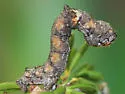
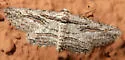
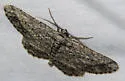
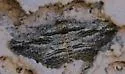
Photo credits: Contributed by Robin McLeod; Additional contributions by Steve Nanz , Randy Hardy , Steve Morris
Frequently Asked Questions About Mountain Mahogany Looper - Hodges#6575
What is Mountain Mahogany Looper - Hodges#6575?
Mountain Mahogany Looper - Hodges#6575 (Iridopsis clivinaria) is a species in the family Geometridae, within the order Lepidoptera.
How big is Mountain Mahogany Looper - Hodges#6575?
forewing length 22-25 mm
How do you identify Mountain Mahogany Looper - Hodges#6575?
Adult: forewing triangular, pale gray in strip along costa, and medium brownish-gray in lower and outer portions; PM line fine, black, slightly wavy, bordered distally by brown line; AM line fine, black, double, reaches only halfway to costa; ST line white, double, scalloped, contrasting against gray ground color; terminal line scalloped; hindwing color and markings similar to forewing Larva: a grayish-brown twig mimic. Four color morphs: black, gray, reddish, and yellow with slight dorsal bumps on segments two and eight
Where is Mountain Mahogany Looper - Hodges#6575 found?
Range: British Columbia to southern California, east to Idaho, Utah, Colorado Arizona reports of clivinaria currently showing in BugGuide are likely misplaced I. obliquaria .
What does Mountain Mahogany Looper - Hodges#6575 eat?
The diet of the Mountain Mahogany Looper - Hodges#6575 includes larvae feed mainly on leaves of mountain mahogany ( Cercocarpus spp.) and Antelope Bitterbrush ( Purshia tridentata ); also feeds on cherry ( Prunus spp.), and sometimes Snowbrush Ceanothus ( Ceanothus velutinus ).
When is Mountain Mahogany Looper - Hodges#6575 active?
Mountain Mahogany Looper - Hodges#6575: seasonal activity - adults fly from March to July larvae present in July and August.
What is the life cycle of a Mountain Mahogany Looper - Hodges#6575?
one generation per year; females lay up to 700 eggs each (average 350) in clusters in bark crevices; first two instars are leaf skeletonizers; overwinters as a pupa in the soil