
Honey Bee
Apis mellifera
This record describes Apis mellifera (species). Recorded family: Apidae. Recorded order: Hymenoptera.
Identification and Appearance
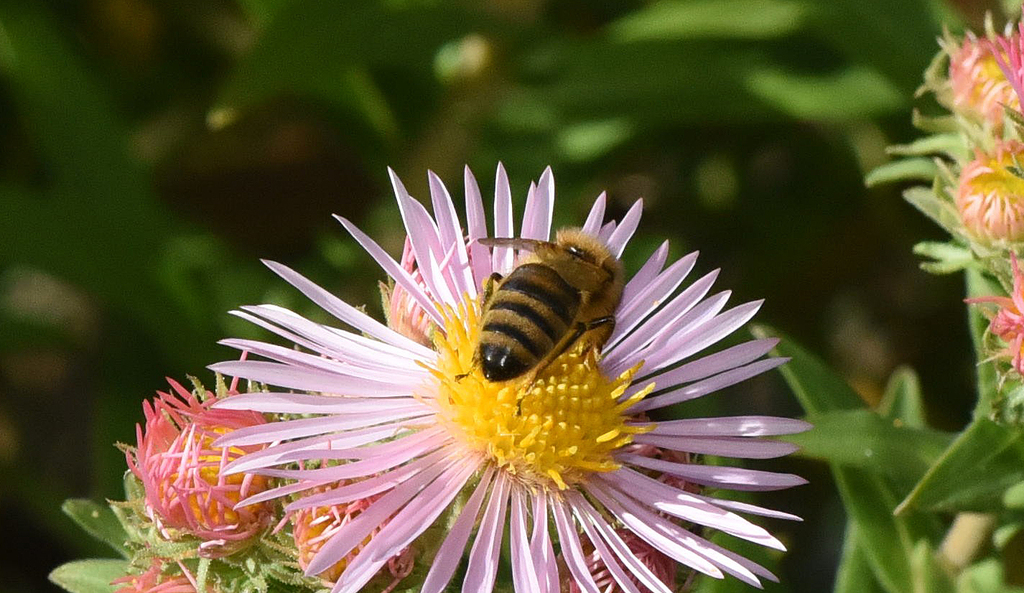
Body thick, marked with yellow and brown, the eyes are hairy. The body is covered in short hairs. Average length about 12 mm. Frequent visitors to flowers in various habitats, but frequent in gardens and parks. Native wild honeybees are no longer believed to live in the UK. However some managed bees do escape and become feral. Honeybees are social bees that live in permanent colonies of perhaps 50,000. Feral colonies like to nest in hollow trees or similar sheltered situations. The hive structure consists of wax 'honeycombs'; each honeycomb is made of small cells, which are used to store food or to rear the brood. Bees feed on nectar and pollen taken from flowers. Stores of honey (regurgitated nectar) and pollen (gathered on the legs in special 'pollen baskets') see them through the winter and enable them to stay together as a colony. Although fairly common and widespread in Britain, competition from introduced species, and cross breeding, plus the threat from the mite Varroa jacobsoni , have caused worrying decline of population numbers.
| Pattern and shape terms |
|
|---|---|
| Activity terms |
|
| Other recorded terms |
|
Terms from the source record, grouped for readability. Broad terms such as size or location are not measurements or a confirmed range.
Wikipedia reference for Apis mellifera: http://en.wikipedia.org/wiki/Western_honey_bee.
Classification
- Kingdom
- Animalia
- Phylum
- Arthropoda
- Class
- Insecta
- Order
- Hymenoptera (Ants, Bees, Wasps and Sawflies)
- Superfamily
- Trigonaloidea
- Family
- Apidae (Cuckoo, Carpenter, Digger, Bumble, and Honey Bees)
- Subfamily
- Apinae
- Tribe
- Apini
- Genus
- Apis (Honey Bees)
Imported taxonomy record. Source availability varies; see the source references and editorial policy below.
Habitat and Range
Habitat
Frequent visitors to flowers in various habitats, but frequent in gardens and parks.
Seasonal Activity
March to October.
Diet and Behavior
Life History
Native wild honeybees are no longer believed to live in the UK. However some managed bees do escape and become feral.
Additional species information
Recorded status
Although fairly common and widespread in Britain, competition from introduced species, and cross breeding, plus the threat from the mite
Species notes from the sources
The western honey bee pollinates crops valued at $5.4 billion in the U.S. alone. A single colony can contain 20,000-80,000 workers. Between 2023-2024, 55.1% of U.S. managed colonies were lost. Honey bees visit 50-100 flowers per foraging trip and can fly up to 5 miles from the hive.
About Flies: the wider group
Order-level background for Hymenoptera, the group containing Apis mellifera. Species-specific details appear above.
Group overview
Hymenoptera includes over 150,000 described species of ants, bees, wasps, and sawflies. Earth harbors approximately 20 quadrillion (20×10^15) ants, with a combined biomass of ~12 megatons of dry carbon - exceeding the combined biomass of all wild birds and mammals (PNAS, 2022).
Ecological role of the group
About 35% of the world's food crops depend on animal pollinators. The chocolate industry, valued at over $100 billion, depends on pollinating flies and midges. Ants are the dominant soil engineers in most terrestrial ecosystems, turning more soil than earthworms in many habitats.
Economic and practical significance of the group
Pollinators contribute $235-577 billion worth of annual global food production (FAO). In the U.S., bee pollination alone benefits crops valued at $18 billion annually, and honey bees are responsible for $5.4 billion in agricultural productivity. Between April 2023-2024, 55.1% of managed honey bee colonies were lost. The U.S. bee population dropped from 5 million to 2.5 million.
Recorded sources for this group: FAO, USDA, EPA, PNAS (2022), US Fish & Wildlife Service. Imported estimates may describe particular regions or reporting periods.
Frequently Asked Questions About Honey Bee
What is Honey Bee?
Honey Bee (Apis mellifera) is a species in the family Apidae, within the order Hymenoptera.
How big is Honey Bee?
about 12 mm.
Where is Honey Bee found?
Habitat: Frequent visitors to flowers in various habitats, but frequent in gardens and parks.
When is Honey Bee active?
Honey Bee: seasonal activity - March to October..
What is the life cycle of a Honey Bee?
Native wild honeybees are no longer believed to live in the UK. However some managed bees do escape and become feral.