
Purple Shore Crab
Hemigrapsus nudus
This record describes Hemigrapsus nudus (species). Recorded family: Grapsidae. Recorded order: Decapoda.
Identification and Appearance
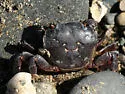
dorsal shell (carapace) is generally a dark purple in color, although it may be olive green or red, with white or cream markings. The color of the legs matches the color of the carapace but the white-tipped claws (chelipeds) are a lighter color with purple or red spots – these spots allow H. nudus to be distinguished from a similar looking crabs (Wikipedia) not always easy to catch, but when you do catch one, watch out; they can pinch! (Slater Museum)
Classification
Habitat and Range
Habitat
most commonly found in the inter-tidal and sub-tidal areas of the beaches. Since these crabs main predator are birds, it usually stays under rocks and other forms of shelter, but does not live in burrows like Hemigrapsus oregonensis . Also can be found high in some estuaries. (Cowles 2005)
Geographic Range
southeastern Alaska to northern Mexico along the Pacific coast (Slater Museum)
Diet and Behavior
Diet: primarily eats sea lettuce and other green algae, and occasionally scavenges dead animals (Wikipedia)
Life History
In Puget Sound, females carrying eggs are found from January to mid-July; especially in April. Female may carry from 400 to 36,000 eggs. (Cowles 2005)
Additional species information
Species notes from the sources
Etymology: Hemigrapsus nudus (Dana, 1851)
About Crabs, Crayfishes, Lobsters, Prawns, and Shrimp: the wider group
Order-level background for Decapoda, the group containing Hemigrapsus nudus. Species-specific details appear above.
Group overview
Decapoda includes ~15,000 described species of crabs, lobsters, shrimp, and crayfish. Although primarily marine and freshwater, some species like hermit crabs and coconut crabs are fully terrestrial.
Ecological role of the group
Crayfish are keystone species in freshwater ecosystems, influencing water clarity, sediment dynamics, and plant communities. Hermit crabs play vital roles in nutrient cycling on tropical islands.
Economic and practical significance of the group
The global shrimp industry alone is worth over $45 billion annually. Crayfish are important aquaculture species and invasive crayfish cause ecological damage estimated in the hundreds of millions annually in Europe and North America.
Recorded sources for this group: FAO fisheries statistics, freshwater ecology. Imported estimates may describe particular regions or reporting periods.
Photos of Purple Shore Crab (5)
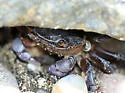
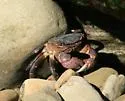
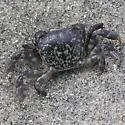
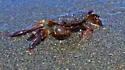
Photo credits: Contributed by Lynette Elliott; Additional contributions by Mike Quinn
Frequently Asked Questions About Purple Shore Crab
What is Purple Shore Crab?
Purple Shore Crab (Hemigrapsus nudus) is a species in the family Grapsidae, within the order Decapoda.
How big is Purple Shore Crab?
carapace width up to 5.6 cm in males and 3.4 cm in females (Slater Museum)
How do you identify Purple Shore Crab?
dorsal shell (carapace) is generally a dark purple in color, although it may be olive green or red, with white or cream markings. The color of the legs matches the color of the carapace but the white-tipped claws (chelipeds) are a lighter color with purple or red spots – these spots allow H. nudus to be distinguished from a similar looking crabs (Wikipedia)
Where is Purple Shore Crab found?
| Feature | Details |
|---|---|
| Habitat | most commonly found in the inter-tidal and sub-tidal areas of the beaches. Since these crabs main predator are birds, it usually stays under rocks and other forms of shelter, but does not live in burrows like Hemigrapsus oregonensis . Also can be found high in some estuaries. (Cowles 2005) |
| Range | southeastern Alaska to northern Mexico along the Pacific coast (Slater Museum) |
What does Purple Shore Crab eat?
The diet of the Purple Shore Crab includes primarily eats sea lettuce and other green algae, and occasionally scavenges dead animals (Wikipedia).
What is the life cycle of a Purple Shore Crab?
In Puget Sound, females carrying eggs are found from January to mid-July; especially in April. Female may carry from 400 to 36,000 eggs. (Cowles 2005)