
Harlequin Ladybird
Harmonia axyridis
This record describes Harmonia axyridis (species). Recorded family: Coccinellidae. Recorded order: Coleoptera.
Identification and Appearance
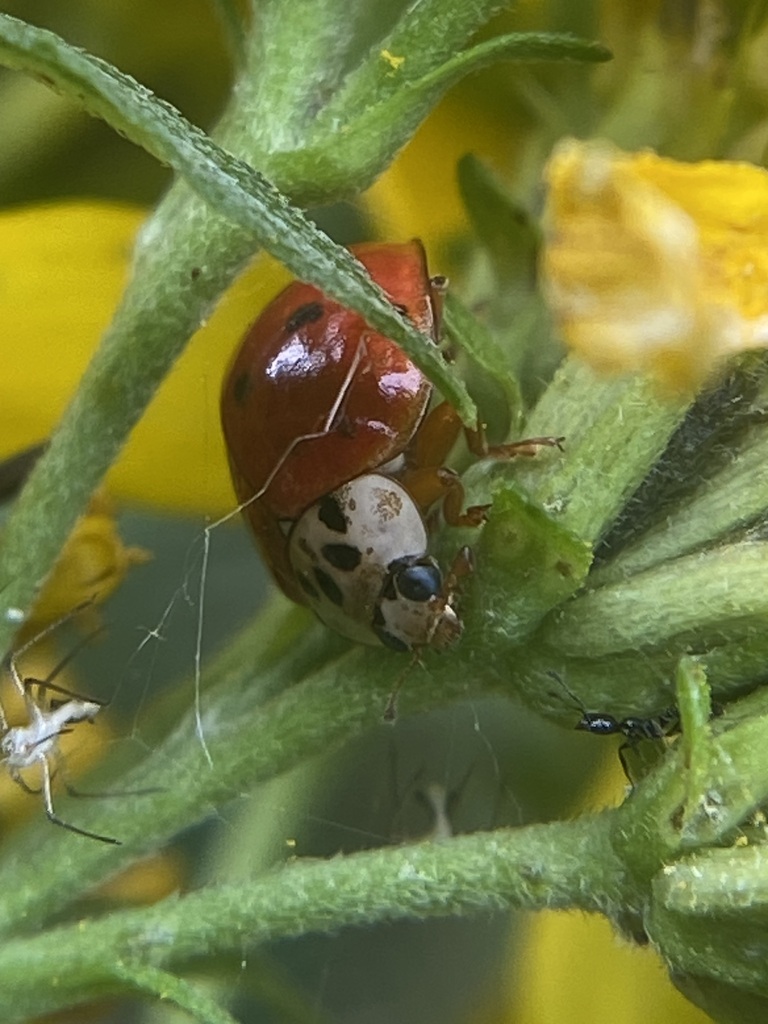
This species is relatively easy to identify and is unlikely to be confused with anything else. However photos are always helpful to confirm your record. The Harlequin has the ability to live in diverse habitats. It is most commonly found on deciduous trees, such as Willow, Sycamore and Maple, and on low growing plants such as Nettles. It can disperse easily and breeds profusely, hence its rapid spread over Britain. April to October. It hibernates through the winter and may be seen active at this time if the weather warms. The Harlequin has a broad diet but predates other ladybirds and has the potential to wipe out some of our native species. Its spread is being closely monitored (see link below). Harlequin Ladybirds feed most commonly on aphids, but have a wide food range, also feeding on scale insects, adelgids, the eggs and larvae of butterflies and moths, many other small insects, including other ladybirds, pollen, nectar, and sugary fluids, including honeydew and the juice from ripe fruits. Adults can begin to lay eggs after 5 days and a single female can lay over a thousand eggs. This species is now well established and common and widespread in much of Britain. The spread of this species is being closely monitored by the Harlequin Ladybird Survey .
| Activity terms |
|
|---|---|
| Other recorded terms |
|
Terms from the source record, grouped for readability. Broad terms such as size or location are not measurements or a confirmed range.
Wikipedia reference for Harmonia axyridis: http://en.wikipedia.org/wiki/Harmonia_axyridis.
Classification
- Kingdom
- Animalia
- Phylum
- Arthropoda
- Class
- Insecta
- Order
- Coleoptera (Beetles)
- Suborder
- Polyphaga
- Superfamily
- Coccinelloidea
- Family
- Coccinellidae (Lady Beetles)
- Subfamily
- Coccinellinae
- Genus
- Harmonia
Imported taxonomy record. Source availability varies; see the source references and editorial policy below.
Habitat and Range
Habitat
The Harlequin has the ability to live in diverse habitats. It is most commonly found on deciduous trees, such as Willow, Sycamore and Maple, and on low growing plants such as Nettles. It can disperse easily and breeds profusely, hence its rapid spread over Britain.
Seasonal Activity
April to October. It hibernates through the winter and may be seen active at this time if the weather warms.
Additional species information
Recorded status
This species is now well established and common and widespread in much of Britain.
About Primitive Winged Insects: the wider group
Order-level background for Coleoptera, the group containing Harmonia axyridis. Species-specific details appear above.
Group overview
Coleoptera is the largest order of insects with over 400,000 described species, representing ~25% of all known animal species and ~40% of all insects. In the U.S. alone, nearly 30,000 beetle species have been identified.
Ecological role of the group
Beetles are prominent decomposers, especially in forests, breaking down dead wood and recycling nutrients. As predators, they reduce populations of pest insects. Many species are also important pollinators of flowering plants.
Economic and practical significance of the group
Beetles have major economic significance: leaf beetles (Chrysomelidae) and weevils (Curculionoidea) are among the most destructive agricultural pests globally, costing billions annually, while predatory species like ladybugs provide natural pest control.
Recorded sources for this group: Britannica, Smithsonian, NCSU Entomology. Imported estimates may describe particular regions or reporting periods.
Frequently Asked Questions About Harlequin Ladybird
What is Harlequin Ladybird?
Harlequin Ladybird (Harmonia axyridis) is a species in the family Coccinellidae, within the order Coleoptera.
How big is Harlequin Ladybird?
4mm to 8mm (0.15" to 0.31")
Where is Harlequin Ladybird found?
Habitat: The Harlequin has the ability to live in diverse habitats. It is most commonly found on deciduous trees, such as Willow, Sycamore and Maple, and on low growing plants such as Nettles. It can disperse easily and breeds profusely, hence its rapid spread over Britain.
When is Harlequin Ladybird active?
Harlequin Ladybird: seasonal activity - April to October. It hibernates through the winter and may be seen active at this time if the weather warms..