
Gazoryctra sciophanes - Hodges#0023.1
Gazoryctra sciophanes
This record describes Gazoryctra sciophanes (species). Recorded family: Hepialidae. Recorded order: Lepidoptera.
Identification and Appearance
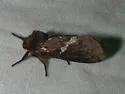
Rounded forewing variably sooty black to dark brown with diffuse gray, dark brown, or black mottling and streaking. It typically shows an elongated white bar or patch with irregular, jagged edges running obliquely across the lower half of the median area, as well as several small, elongated white spots at the base. It may also show white spotting in the subterminal area and along the costa, but these markings are subject to individual variation. Ferguson states that in half of the male specimens he collected, the large white forewing patch was reduced or obscured. Females appear to be lighter overall, perhaps with less distinct patterning (Ferguson, 1979 ; Grehan, 1998 ). Recent mDNA barcoding of Gazoryctra specimens taken from different mountain tops in the state suggests that several cryptic species may be involved (J. Bolling Sullivan, pers. comm.).
Classification
- Kingdom
- Animalia
- Phylum
- Arthropoda
- Class
- Insecta
- Order
- Lepidoptera (Butterflies and Moths)
- Superfamily
- Hepialoidea
- Family
- Hepialidae (Ghost Moths)
- Genus
- Gazoryctra
Imported taxonomy record. Source availability varies; see the source references and editorial policy below.
Habitat and Range
Habitat
All of the records of "Moths of North Carolina" come from Spruce-Fir forests at elevations above 4,000 feet elevation . However, G. sciophanes has also been collected on several high peaks and balds in NC where spruce/fir is not found .
Geographic Range
" G. sciophanes is a southern Appalachian endemic described by Ferguson from a series collected in Jackson County, NC. Additional series were collected by Grehan in Yancey and Mitchell Co., NC. While it also occurs in Virginia and West Virginia (Grehan, 1998 ), it may be most easily be found in NC, where it is likely uncommon. It also occurs in the mountains of eastern Tennessee."
Seasonal Activity
Like other members of the family, this species appears to fly for just a short period right around dusk, and during a relatively short window in early to mid-July. It is at least somewhat attracted to lights .
Diet and Behavior
Diet: It is currently thought that they are subterranean borers that probably feed on the roots of grasses (J. Bolling Sullivan, pers. comm.) .
Life History
Unknown, presumably a root-feeder like other members of this family.
About Butterflies and Moths: the wider group
Order-level background for Lepidoptera, the group containing Gazoryctra sciophanes. Species-specific details appear above.
Group overview
Lepidoptera includes approximately 180,000 described species of butterflies and moths. Moths outnumber butterflies roughly 10:1. The monarch butterfly's eastern population has declined by more than 80% since the mid-1990s, and the western population by over 95% since the 1980s. The IUCN lists the migratory monarch as Vulnerable.
Ecological role of the group
Butterflies and moths are essential indicators of ecosystem health. As caterpillars, they are a primary food source for birds - a single nest of blue tit chicks requires ~10,000 caterpillars. Adult moths pollinate many night-blooming plants.
Economic and practical significance of the group
Lepidoptera are critical pollinators. In Europe, grassland butterfly species have declined by almost 50% since the early 1990s. In the UK, three-quarters of butterflies are in decline. In the U.S., five butterfly species have gone extinct since 1950, with 29 listed as endangered.
Recorded sources for this group: IUCN Red List, Xerces Society, USFWS, PNAS, WWF. Imported estimates may describe particular regions or reporting periods.
Frequently Asked Questions About Gazoryctra sciophanes - Hodges#0023.1
What is Gazoryctra sciophanes - Hodges#0023.1?
Gazoryctra sciophanes - Hodges#0023.1 (Gazoryctra sciophanes) is a species in the family Hepialidae, within the order Lepidoptera.
How big is Gazoryctra sciophanes - Hodges#0023.1?
Forewing length: males, 15-18 mm.; females, 20 mm.
How do you identify Gazoryctra sciophanes - Hodges#0023.1?
Rounded forewing variably sooty black to dark brown with diffuse gray, dark brown, or black mottling and streaking. It typically shows an elongated white bar or patch with irregular, jagged edges running obliquely across the lower half of the median area, as well as several small, elongated white spots at the base. It may also show white spotting in the subterminal area and along the costa, but these markings are subject to individual variation. Ferguson states that in half of the male specimens he collected, the large white forewing patch was reduced or obscured. Females appear to be lighter overall, perhaps with less distinct patterning (Ferguson, 1979 ; Grehan, 1998 ).
Where is Gazoryctra sciophanes - Hodges#0023.1 found?
| Feature | Details |
|---|---|
| Habitat | All of the records of Moths of North Carolina come from Spruce-Fir forests at elevations above 4,000 feet elevation . However, G. sciophanes has also been collected on several high peaks and balds in NC where spruce/fir is not found . |
| Range | G. sciophanes is a southern Appalachian endemic described by Ferguson from a series collected in Jackson County, NC. Additional series were collected by Grehan in Yancey and Mitchell Co., NC. While it also occurs in Virginia and West Virginia (Grehan, 1998 ), it may be most easily be found in NC, where it is likely uncommon. It also occurs in the mountains of eastern Tennessee. |
What does Gazoryctra sciophanes - Hodges#0023.1 eat?
The diet of the Gazoryctra sciophanes - Hodges#0023.1 includes It is currently thought that they are subterranean borers that probably feed on the roots of grasses (J. Bolling Sullivan, pers. comm.) ..
When is Gazoryctra sciophanes - Hodges#0023.1 active?
Gazoryctra sciophanes - Hodges#0023.1: seasonal activity - Like other members of the family, this species appears to fly for just a short period right around dusk, and during a relatively short window in early to mid-July. It is at least somewhat attracted to lights ..
What is the life cycle of a Gazoryctra sciophanes - Hodges#0023.1?
Unknown, presumably a root-feeder like other members of this family.