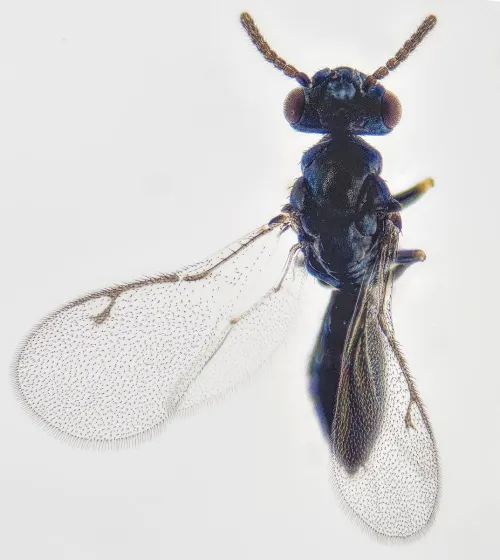
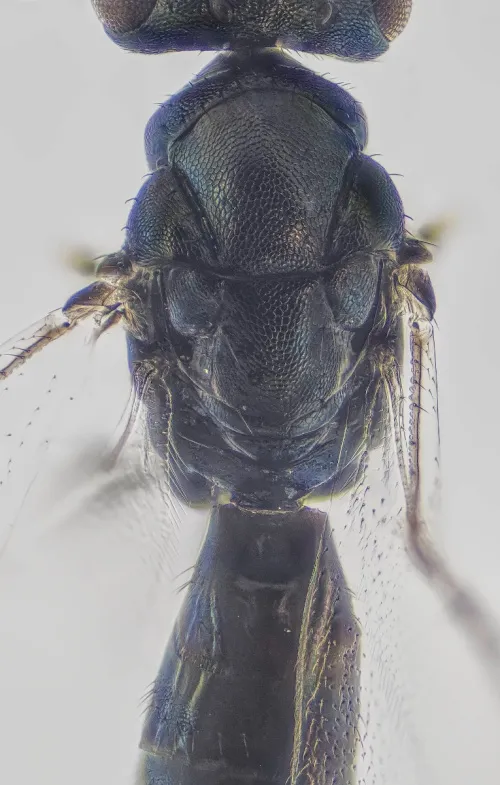
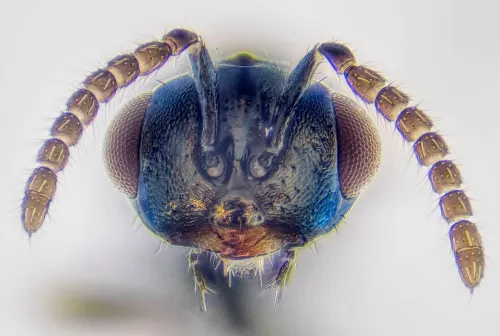
Gastrancistrus
This record describes Gastrancistrus (genus). Recorded family: Pteromalidae. Recorded order: Hymenoptera.
Identification and Appearance
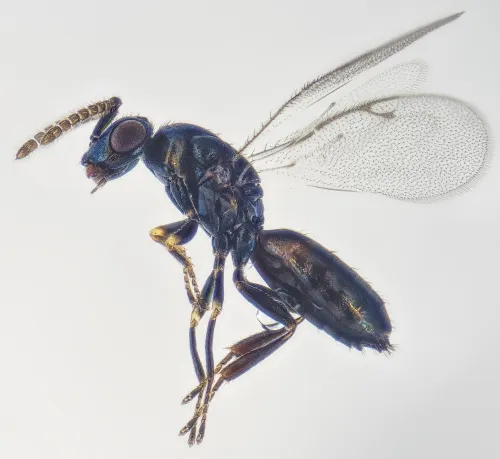
Length 2-3mm. Antennal toruli (antenna sockets) are positioned low on the face, at or below the level of the lower margin of the eyes. Female antennae have 5 or 6 funicle segments and a 3-segmented club (clava); male antennae have 6 funicular segments and a 2-segmented club. The clypeus is convex with a curved anterior margin, and they possess 4-toothed mandibles. The notauli (the longitudinal grooves on the mesoscutum) are complete and relatively deep. The body surface is largely smooth or exhibits a very shallow, delicate reticulate (net-like) patterning, giving them a distinct metallic green, blue, or bronze sheen. The forewings have a distinctly long, thick marginal vein; the postmarginal and stigmal veins are short by comparison. 50 UK species, very difficult to identify. Unless identified by a recognized expert, explain how the specimen was identified and submit photos of key features. The majority of Gastrancistrus species are parasitoids of Diptera, often Cecidomyiidae (gall midges). No additional images available for this species.
Classification
- Kingdom
- Animalia
- Phylum
- Arthropoda
- Class
- Insecta
- Order
- Hymenoptera (Ants, Bees, Wasps and Sawflies)
- Superfamily
- Chalcidoidea
- Family
- Pteromalidae
- Genus
- Gastrancistrus
Imported taxonomy record. Source availability varies; see the source references and editorial policy below.
Diet and Behavior
Life History
The majority of Gastrancistrus species are parasitoids of Diptera, often Cecidomyiidae (gall midges).
Additional species information
Recorded status
Widespread.
About Flies: the wider group
Order-level background for Hymenoptera, the group containing Gastrancistrus. Species-specific details appear above.
Group overview
Hymenoptera includes over 150,000 described species of ants, bees, wasps, and sawflies. Earth harbors approximately 20 quadrillion (20×10^15) ants, with a combined biomass of ~12 megatons of dry carbon - exceeding the combined biomass of all wild birds and mammals (PNAS, 2022).
Ecological role of the group
About 35% of the world's food crops depend on animal pollinators. The chocolate industry, valued at over $100 billion, depends on pollinating flies and midges. Ants are the dominant soil engineers in most terrestrial ecosystems, turning more soil than earthworms in many habitats.
Economic and practical significance of the group
Pollinators contribute $235-577 billion worth of annual global food production (FAO). In the U.S., bee pollination alone benefits crops valued at $18 billion annually, and honey bees are responsible for $5.4 billion in agricultural productivity. Between April 2023-2024, 55.1% of managed honey bee colonies were lost. The U.S. bee population dropped from 5 million to 2.5 million.
Recorded sources for this group: FAO, USDA, EPA, PNAS (2022), US Fish & Wildlife Service. Imported estimates may describe particular regions or reporting periods.