
Asaphes vulgaris
This record describes Asaphes vulgaris (species). Recorded family: Pteromalidae. Recorded order: Hymenoptera.
Identification and Appearance
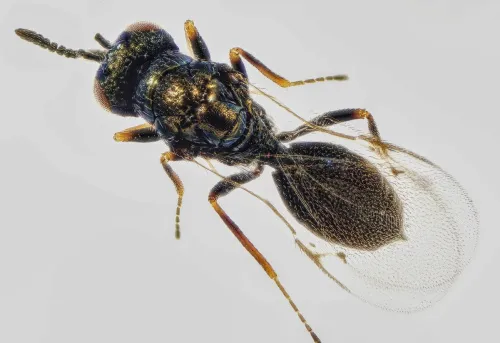
| Feature | Description |
|---|---|
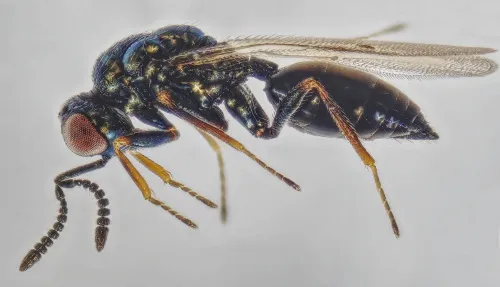
| Additional details | Length 1.5-2mm. Typically dark, metallic greenish-black sheen across the head and thorax. The petiole (waist) is longer than broad and obvious from above. |
| Antennae | Antennae elbowed (geniculate) antennae, with 13 segments including 2 ring segments. Genae bordered by a strong carina which extends some distance up the temples. Frenal line (furrow) of scutellum strongly impressed. |
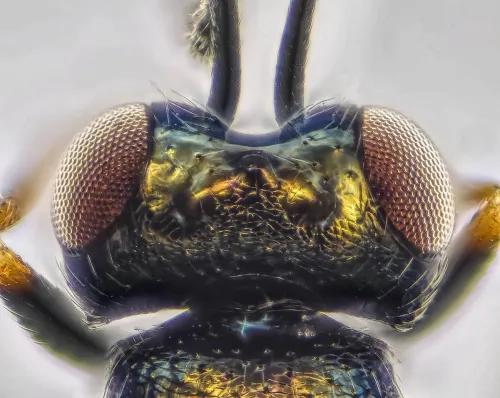
| Head | Head in dorsal view with temples straight, only moderately convergent, forming an angle with the occipital edge of the head ; speculum of forewing well-defined; femora mainly fuscous to black, tibiae at least slightly brownish, usually mainly fuscous to almost wholly black. The other UK species, A. suspensus - temples curved and rather strongly convergent , not angulate posteriorly; speculum of fore wing indistinct or absent; legs, not counting the coxae, testaceous with the femora sometimes more or less infuscate proximally, rarely the tibiae with a dark ring. Unless identified by a recognised expert, explain how the specimen was identifed and indlude photos of key ID features. No additional images available for this species. |
Classification
- Kingdom
- Animalia
- Phylum
- Arthropoda
- Class
- Insecta
- Order
- Hymenoptera
- Family
- Pteromalidae
- Genus
- Asaphes
Imported taxonomy record. Source availability varies; see the source references and editorial policy below.
Habitat and Range
Seasonal Activity
All year.
Diet and Behavior
Life History
Endoparasitoid of aphids.
Additional species information
Recorded status
Common and widespread.
About Flies: the wider group
Order-level background for Hymenoptera, the group containing Asaphes vulgaris. Species-specific details appear above.
Group overview
Hymenoptera includes over 150,000 described species of ants, bees, wasps, and sawflies. Earth harbors approximately 20 quadrillion (20×10^15) ants, with a combined biomass of ~12 megatons of dry carbon - exceeding the combined biomass of all wild birds and mammals (PNAS, 2022).
Ecological role of the group
About 35% of the world's food crops depend on animal pollinators. The chocolate industry, valued at over $100 billion, depends on pollinating flies and midges. Ants are the dominant soil engineers in most terrestrial ecosystems, turning more soil than earthworms in many habitats.
Economic and practical significance of the group
Pollinators contribute $235-577 billion worth of annual global food production (FAO). In the U.S., bee pollination alone benefits crops valued at $18 billion annually, and honey bees are responsible for $5.4 billion in agricultural productivity. Between April 2023-2024, 55.1% of managed honey bee colonies were lost. The U.S. bee population dropped from 5 million to 2.5 million.
Recorded sources for this group: FAO, USDA, EPA, PNAS (2022), US Fish & Wildlife Service. Imported estimates may describe particular regions or reporting periods.
Photos of Asaphes vulgaris (3)
Frequently Asked Questions About Asaphes vulgaris
What is Asaphes vulgaris?
Asaphes vulgaris is a species in the family Pteromalidae, within the order Hymenoptera.
How big is Asaphes vulgaris?
1.5-2mm. Typically dark, metallic greenish-black sheen across the head and thorax. The petiole (waist) is longer than broad and obvious from above. Antennae elbowed (geniculate) antennae, with 13 segments including 2 ring segments. Genae bordered by a strong carina which extends some distance up the temples. Frenal line (furrow) of scutellum strongly impressed.
When is Asaphes vulgaris active?
Asaphes vulgaris: seasonal activity - All year..
What is the life cycle of a Asaphes vulgaris?
Endoparasitoid of aphids.