
Spinybacked Orbweaver
Gasteracantha cancriformis
This record describes Gasteracantha cancriformis (species). Recorded family: Araneidae. Recorded order: Araneae.
Identification and Appearance
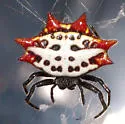
This species can be easily distinguished from all other spiders. Females may be 5 to nearly 9 mm in length, but 10 to 13 mm wide. They have six pointed abdominal projections frequently referred to as spines. The carapace, legs, and venter are black, with some white spots on the underside of the abdomen. The dorsum of the abdomen is, typically for Florida specimens, white with black spots and red spines. Specimens from other areas may have the abdominal dorsum yellow instead of white, may have black spines instead of red, or may be almost entirely black dorsally and ventrally. Males are much smaller than females, 2 to 3 mm long, and slightly longer than wide. Color is similar to the female, except the abdomen is gray with white spots. The large abdominal spines are lacking, although there are four or five posterior small humps (Levi 1978, Muma 1971). Egg case is a tangle of greenish silk. This spider adds little tufts of silk to its web. According to Florida's Fabulous Spiders these little flags serve a warning function to prevent birds from flying into the web, destroying it.
Classification
Habitat and Range
Habitat
It lives in woodland edges and shrubby gardens. Many of the studies on this spider have taken place in citrus groves in Florida. They frequently live in trees or around trees in shrubs. (Levi, 1978)
Geographic Range
This species is primarily found in the southeastern US, CA (TX-FL-MD-OK) / south through much of the New World, including some islands, including much of the Greater Antilles and some of the Bahamian islands. (Levi, 1978),(BG data)
Seasonal Activity
This species is mostly found from May-Dec but year-round in FL (BG data)
Diet and Behavior
Life History
This species of spider does not live very long. In fact, the lifespan only lasts until reproduction, which usually takes place the spring following the winter when they hatched. Females die after producing an egg mass, and males die six days after a complete cycle of sperm induction to the female.
Additional species information
Species notes from the sources
Etymology: Gasteracantha cancriformis (Linnaeus, 1758)
About Spiders: the wider group
Order-level background for Araneae, the group containing Gasteracantha cancriformis. Species-specific details appear above.
Group overview
As of 2023, 51,673 spider species in 136 families have been recorded, though an estimated 150,000 species exist. Spiders rank 7th in total species diversity among all organism orders. Only 0.5% of spider species pose any risk to human health.
Ecological role of the group
Spider venom contains complex peptides with diverse pharmacological activities, making them valuable for drug development research. Spiders produce up to 7 types of silk from specialized glands. Spider silk genes have been inserted into mammals and plants for biotech applications.
Economic and practical significance of the group
The global spider community kills an estimated 400-800 million tons of prey annually (2017 study). Spiders provide billions of dollars in natural pest control for agriculture. Spider silk is 5× stronger than steel of the same diameter, driving a biomaterials research industry.
Recorded sources for this group: World Spider Catalog, PNAS, Nature, ScienceDirect. Imported estimates may describe particular regions or reporting periods.
Photos of Spinybacked Orbweaver (5)
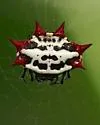
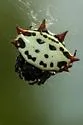
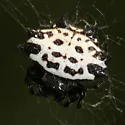
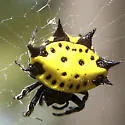
Photo credits: Contributed by Troy Bartlett; Additional contributions by Hannah Nendick-Mason , john and jane balaban , Beatriz Moisset , Lynette Elliott , Jeff Hollenbeck , cheins , Chuck Entz , Mike Quinn , kschnei , Robert Lord Zimlich , pomarinejaeger
Frequently Asked Questions About Spinybacked Orbweaver
What is Spinybacked Orbweaver?
Spinybacked Orbweaver (Gasteracantha cancriformis) is a species in the family Araneidae, within the order Araneae.
How do you identify Spinybacked Orbweaver?
This species can be easily distinguished from all other spiders. Females may be 5 to nearly 9 mm in length, but 10 to 13 mm wide. They have six pointed abdominal projections frequently referred to as spines. The carapace, legs, and venter are black, with some white spots on the underside of the abdomen. The dorsum of the abdomen is, typically for Florida specimens, white with black spots and red spines. Specimens from other areas may have the abdominal dorsum yellow instead of white, may have black spines instead of red, or may be almost entirely black dorsally and ventrally. Males are much smaller than females, 2 to 3 mm long, and slightly longer than wide. Color is similar to the female, except the abdomen is gray with white spots. The large abdominal spines are lacking, although there are four or five posterior small humps (Levi 1978, Muma 1971). Egg case is a tangle of greenish silk.
Where is Spinybacked Orbweaver found?
| Feature | Details |
|---|---|
| Habitat | It lives in woodland edges and shrubby gardens. Many of the studies on this spider have taken place in citrus groves in Florida. They frequently live in trees or around trees in shrubs. (Levi, 1978) |
| Range | This species is primarily found in the southeastern US, CA (TX-FL-MD-OK) / south through much of the New World, including some islands, including much of the Greater Antilles and some of the Bahamian islands. (Levi, 1978),(BG data) |
When is Spinybacked Orbweaver active?
Spinybacked Orbweaver: seasonal activity - This species is mostly found from May-Dec but year-round in FL (BG data).
What is the life cycle of a Spinybacked Orbweaver?
This species of spider does not live very long. In fact, the lifespan only lasts until reproduction, which usually takes place the spring following the winter when they hatched. Females die after producing an egg mass, and males die six days after a complete cycle of sperm induction to the female.