
Four-spotted Orb Weaver
Araneus quadratus
This record describes Araneus quadratus (species). Recorded family: Araneidae. Recorded order: Araneae.
Identification and Appearance
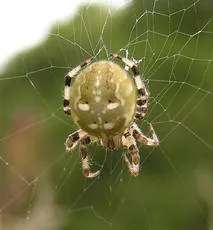
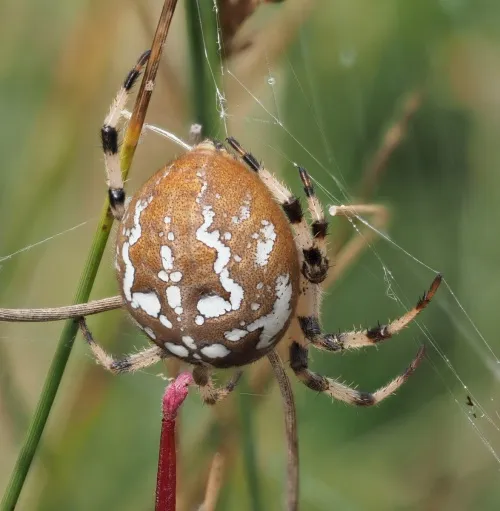
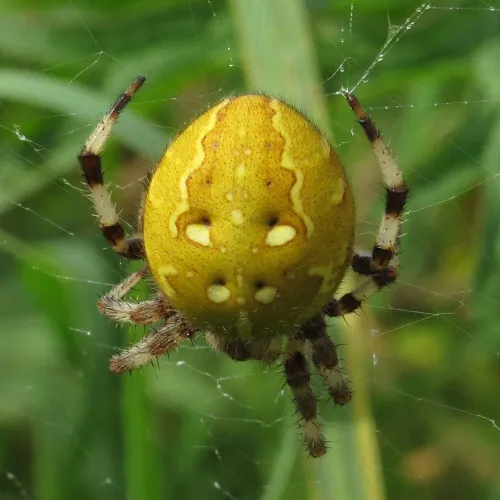
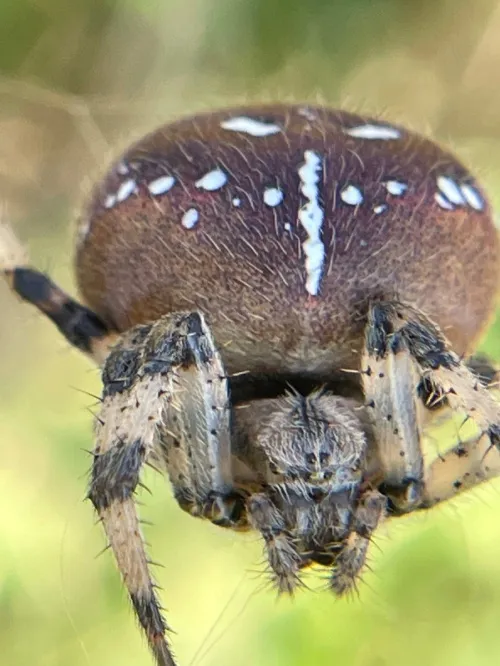
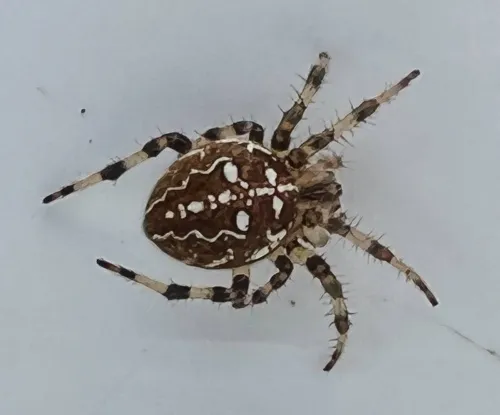
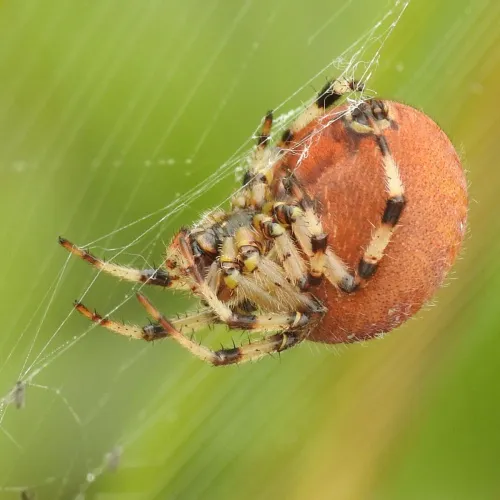
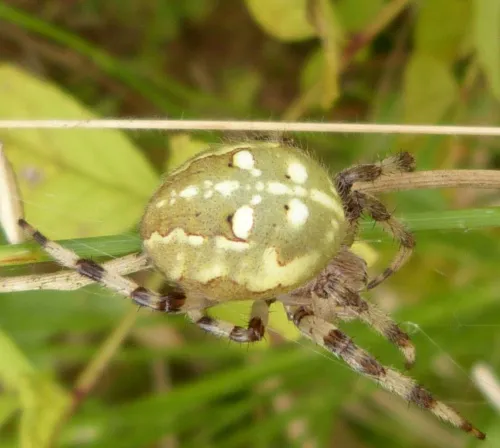
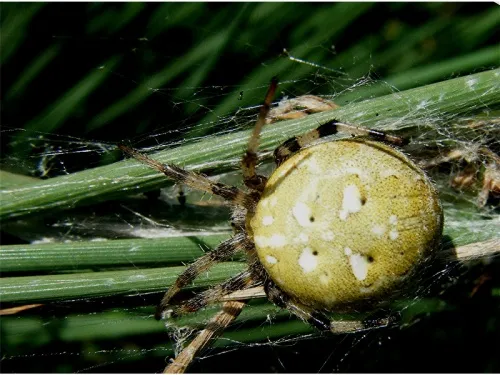
Females can reach 17 mm in length, males approximately half that. The abdomen colour is quite variable, ranging from dark brown to bright orange or yellowy-green. The legs are banded. The appearance of males is quite different from that of the larger and fatter females, but careful examination will usually show the four pale spots on the abdomen to be present in both sexes. This is Britain's heaviest spider, although other species have much longer legs. The spider lives in gardens, wooded areas, marshes or long grassland - wherever there is vegetation to string an orb web across. This species builds its web close to the ground to catch jumping insects such as small grasshoppers. The female builds the more elaborate web, complete with a funnel-shaped retreat off to the side where she goes during inclement weather. The web is smaller and closer to the ground than those of other species of orb weaver. Adult females can actively change their color. It takes about three days to take on colors that accurately match their resting surface. 3,459 British records for this species to 2015
Classification
Habitat and Range
Habitat
The spider lives in gardens, wooded areas, marshes or long grassland - wherever there is vegetation to string an orb web across.
Seasonal Activity
June to October.
Diet and Behavior
Life History
This species builds its web close to the ground to catch jumping insects such as small grasshoppers. The female builds the more elaborate web, complete with a funnel-shaped retreat off to the side where she goes during inclement weather. The web is smaller and closer to the ground than those of other species of orb weaver. Adult females can actively change their color. It takes about three days to take on colors that accurately match their resting surface.
Additional species information
Recorded status
Common and widespread in Britain.
About Spiders: the wider group
Order-level background for Araneae, the group containing Araneus quadratus. Species-specific details appear above.
Group overview
As of 2023, 51,673 spider species in 136 families have been recorded, though an estimated 150,000 species exist. Spiders rank 7th in total species diversity among all organism orders. Only 0.5% of spider species pose any risk to human health.
Ecological role of the group
Spider venom contains complex peptides with diverse pharmacological activities, making them valuable for drug development research. Spiders produce up to 7 types of silk from specialized glands. Spider silk genes have been inserted into mammals and plants for biotech applications.
Economic and practical significance of the group
The global spider community kills an estimated 400-800 million tons of prey annually (2017 study). Spiders provide billions of dollars in natural pest control for agriculture. Spider silk is 5× stronger than steel of the same diameter, driving a biomaterials research industry.
Recorded sources for this group: World Spider Catalog, PNAS, Nature, ScienceDirect. Imported estimates may describe particular regions or reporting periods.
Photos of Four-spotted Orb Weaver (9)
Frequently Asked Questions About Four-spotted Orb Weaver
What is Four-spotted Orb Weaver?
Four-spotted Orb Weaver (Araneus quadratus) is a species in the family Araneidae, within the order Araneae.
Where is Four-spotted Orb Weaver found?
Habitat: The spider lives in gardens, wooded areas, marshes or long grassland - wherever there is vegetation to string an orb web across.
When is Four-spotted Orb Weaver active?
Four-spotted Orb Weaver: seasonal activity - June to October..
What is the life cycle of a Four-spotted Orb Weaver?
This species builds its web close to the ground to catch jumping insects such as small grasshoppers. The female builds the more elaborate web, complete with a funnel-shaped retreat off to the side where she goes during inclement weather. The web is smaller and closer to the ground than those of other species of orb weaver. Adult females can actively change their color. It takes about three days to take on colors that accurately match their resting surface.