
Thatching ant
Formica obscuripes
This record describes Formica obscuripes (species). Recorded family: Formicidae. Recorded order: Hymenoptera.
Identification and Appearance
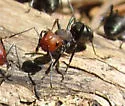
- workers weakly polymorphic, with narrow headed, uniformly dark colored minors and major workers with a broad, and contrastingly bright red head - bristles on all surfaces of hind tibiae (but few or none on scapes (cf. F. oreas ) - cross section of clypeus gently curved or curved with broadly obtuse medial angle (cf. trapezoidal cross section of F. obscuriventris clypeus) This is perhaps the best-known member of the Formica rufa group in North America, and thus the only one with a common name
Classification
- Kingdom
- Animalia
- Phylum
- Arthropoda
- Class
- Insecta
- Order
- Hymenoptera (Ants, Bees, Wasps and Sawflies)
- Superfamily
- Formicoidea
- Family
- Formicidae (Ants)
- Subfamily
- Formicinae
- Tribe
- Formicini
- Genus
- Formica (Wood ants, mound ants, & field ants)
Imported taxonomy record. Source availability varies; see the source references and editorial policy below.
Habitat and Range
Habitat
Habitat changes from east to west -- Sandy prairie and oak savanna (Michigan to Minnesota, also Iowa and way-northern Missouri), dry-mesic tallgrass prairie (Nebraska, Dakotas, Canadian prairie provinces), mid-grass prairie, usually +/- riparian grassland (western Dakotas to New Mexico), sagebrush/rabbitbrush steppe (Alberta to New Mexico and Great Basin), conifer woodland and forest (northern, incl. Canadian Rockies to Washington and British Columbia).
Geographic Range
See "Habitat"
Diet and Behavior
Diet: Thes are predators of a variety of other arthropods and avid collectors of honeydew and extrafloral nectar. May attack and prey on other ants, particularly other Formica .
Additional species information
Species notes from the sources
Etymology: Formica obscuripes Forel, 1886 obscuripes - blackish (dark) legs thatching - characteristic domed nest of fine twigs, petioles, rachises, or conifer needles
About Flies: the wider group
Order-level background for Hymenoptera, the group containing Formica obscuripes. Species-specific details appear above.
Group overview
Hymenoptera includes over 150,000 described species of ants, bees, wasps, and sawflies. Earth harbors approximately 20 quadrillion (20×10^15) ants, with a combined biomass of ~12 megatons of dry carbon - exceeding the combined biomass of all wild birds and mammals (PNAS, 2022).
Ecological role of the group
About 35% of the world's food crops depend on animal pollinators. The chocolate industry, valued at over $100 billion, depends on pollinating flies and midges. Ants are the dominant soil engineers in most terrestrial ecosystems, turning more soil than earthworms in many habitats.
Economic and practical significance of the group
Pollinators contribute $235-577 billion worth of annual global food production (FAO). In the U.S., bee pollination alone benefits crops valued at $18 billion annually, and honey bees are responsible for $5.4 billion in agricultural productivity. Between April 2023-2024, 55.1% of managed honey bee colonies were lost. The U.S. bee population dropped from 5 million to 2.5 million.
Recorded sources for this group: FAO, USDA, EPA, PNAS (2022), US Fish & Wildlife Service. Imported estimates may describe particular regions or reporting periods.
Photos of Thatching ant (5)
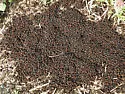
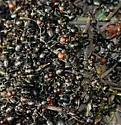
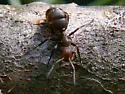
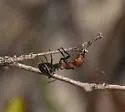
Photo credits: Contributed by Robin McLeod; Additional contributions by john and jane balaban , James C. Trager
Frequently Asked Questions About Thatching ant
What is Thatching ant?
Thatching ant (Formica obscuripes) is a species in the family Formicidae, within the order Hymenoptera.
How big is Thatching ant?
workers 4-7.5 mm queens 10-11 mm males 9-11 mm
How do you identify Thatching ant?
- workers weakly polymorphic, with narrow headed, uniformly dark colored minors and major workers with a broad, and contrastingly bright red head - bristles on all surfaces of hind tibiae (but few or none on scapes (cf. F. oreas ) - cross section of clypeus gently curved or curved with broadly obtuse medial angle (cf. trapezoidal cross section of F. obscuriventris clypeus)
Where is Thatching ant found?
| Feature | Details |
|---|---|
| Habitat | Habitat changes from east to west -- Sandy prairie and oak savanna (Michigan to Minnesota, also Iowa and way-northern Missouri), dry-mesic tallgrass prairie (Nebraska, Dakotas, Canadian prairie provinces), mid-grass prairie, usually +/- riparian grassland (western Dakotas to New Mexico), sagebrush/rabbitbrush steppe (Alberta to New Mexico and Great Basin), conifer woodland and forest (northern, incl. Canadian Rockies to Washington and British Columbia). |
| Range | See Habitat |
What does Thatching ant eat?
The diet of the Thatching ant includes Thes are predators of a variety of other arthropods and avid collectors of honeydew and extrafloral nectar. May attack and prey on other ants, particularly other Formica ..