
Formica lemani
This record describes Formica lemani (species). Recorded family: Formicidae. Recorded order: Hymenoptera.
Identification and Appearance
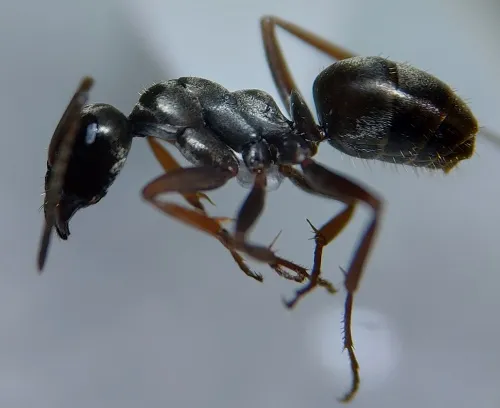
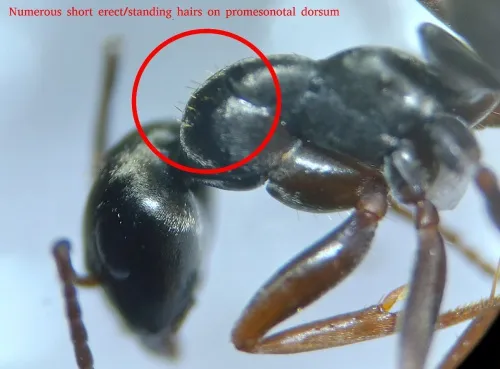
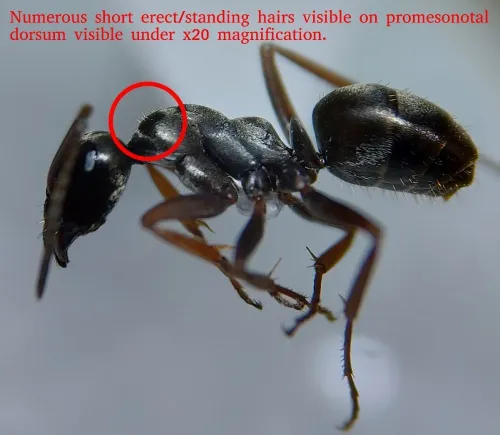
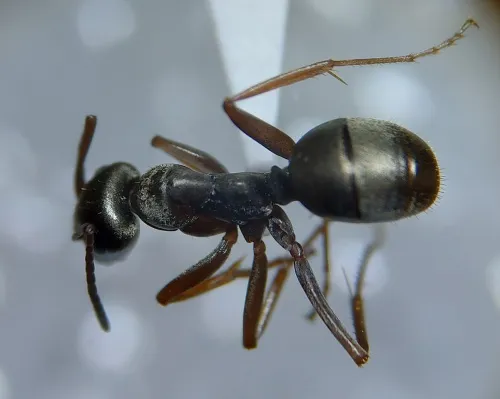
One of the large formica species commonly known as wood ants. This species is very similar in appearance, size and nesting habits to Formica fusca but was firmly described and keyed by Yarrow in 1954. Workers differ from those of F. fusca by the presence of short stubby hairs on the promesonotal dorsum which is usually bare in F. fusca, and there are good diagnostic differences in males and queens. Greyish to brownish black with paler legs. Adult workers are typically 5 to 7 mm in length. Short stout hairs present on promesonotum normally numerous but occasionally abraded or few. Underside of mid and hind femora normally with one or more hairs at mid length. Frons coarsely sculptured to that punctures readily seen under ordinary magnification. Unless identified by a recognised expert, a photo is required. If the photo doesn't show the key ID features then in the comments box describe the size and identifying characters you have observed. Formica lemani is abundant on high moorland in south-west England - Bodmin, Dartmoor, Exmoor, Mendips and Blackdown and on uncultivated land throughout Wales, northern England and Scotland as far as Hoy in Orkney. Nests are sited in open woodland, woodland verges, heaths and moorland. The ants nest under stones and in tree stumps under loose bark, but F. lemani may sometimes nest in turfy banks. Mating flights typically occur between in July and August. Adult workers can be seen from early spring through to autumn. Workers forage individually. They are predators on other insects. In Yorkshire an experiment on biological control of bracken was ruined by F. lemani workers destroying an introduced population of bracken-feeding caterpillars! This species also seeks out aphid honey dew. It appears to be absent from the counties of south-east England - Hampshire and the Isle of Wight to Kent, Bedford and Northampton. There is no decline in this species which continues to do well in its known locations. http://www.bwars.com/index.php?q=ant/formicidae/formicinae/formica-lemani
Classification
- Kingdom
- Animalia
- Phylum
- Arthropoda
- Class
- Insecta
- Order
- Hymenoptera
- Family
- Formicidae
- Genus
- Formica
Imported taxonomy record. Source availability varies; see the source references and editorial policy below.
Habitat and Range
Habitat
Formica lemani is abundant on high moorland in south-west England - Bodmin, Dartmoor, Exmoor, Mendips and Blackdown and on uncultivated land throughout Wales, northern England and Scotland as far as Hoy in Orkney. Nests are sited in open woodland, woodland verges, heaths and moorland. The ants nest under stones and in tree stumps under loose bark, but F. lemani may sometimes nest in turfy banks.
Seasonal Activity
Mating flights typically occur between in July and August. Adult workers can be seen from early spring through to autumn.
Diet and Behavior
Life History
Workers forage individually. They are predators on other insects. In Yorkshire an experiment on biological control of bracken was ruined by F. lemani workers destroying an introduced population of bracken-feeding caterpillars! This species also seeks out aphid honey dew.
Additional species information
Recorded status
It appears to be absent from the counties of south-east England - Hampshire and the Isle of Wight to Kent, Bedford and Northampton. There is no decline in this species which continues to do well in its known locations.
About Flies: the wider group
Order-level background for Hymenoptera, the group containing Formica lemani. Species-specific details appear above.
Group overview
Hymenoptera includes over 150,000 described species of ants, bees, wasps, and sawflies. Earth harbors approximately 20 quadrillion (20×10^15) ants, with a combined biomass of ~12 megatons of dry carbon - exceeding the combined biomass of all wild birds and mammals (PNAS, 2022).
Ecological role of the group
About 35% of the world's food crops depend on animal pollinators. The chocolate industry, valued at over $100 billion, depends on pollinating flies and midges. Ants are the dominant soil engineers in most terrestrial ecosystems, turning more soil than earthworms in many habitats.
Economic and practical significance of the group
Pollinators contribute $235-577 billion worth of annual global food production (FAO). In the U.S., bee pollination alone benefits crops valued at $18 billion annually, and honey bees are responsible for $5.4 billion in agricultural productivity. Between April 2023-2024, 55.1% of managed honey bee colonies were lost. The U.S. bee population dropped from 5 million to 2.5 million.
Recorded sources for this group: FAO, USDA, EPA, PNAS (2022), US Fish & Wildlife Service. Imported estimates may describe particular regions or reporting periods.
Photos of Formica lemani (4)
Frequently Asked Questions About Formica lemani
What is Formica lemani?
Formica lemani is a species in the family Formicidae, within the order Hymenoptera.
Where is Formica lemani found?
Habitat: Formica lemani is abundant on high moorland in south-west England - Bodmin, Dartmoor, Exmoor, Mendips and Blackdown and on uncultivated land throughout Wales, northern England and Scotland as far as Hoy in Orkney. Nests are sited in open woodland, woodland verges, heaths and moorland. The ants nest under stones and in tree stumps under loose bark, but F. lemani may sometimes nest in turfy banks.
When is Formica lemani active?
Formica lemani: seasonal activity - Mating flights typically occur between in July and August. Adult workers can be seen from early spring through to autumn..
What is the life cycle of a Formica lemani?
Workers forage individually. They are predators on other insects. In Yorkshire an experiment on biological control of bracken was ruined by F. lemani workers destroying an introduced population of bracken-feeding caterpillars! This species also seeks out aphid honey dew.