
American Plum Borer - Hodges#5995
Euzophera semifuneralis
This record describes Euzophera semifuneralis (species). Recorded family: Pyralidae. Recorded order: Lepidoptera.
Identification and Appearance
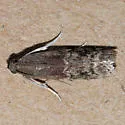
Adult: forewing reddish-brown to AM line, which is almost halfway along wing; AM and PM lines white, zigzag, enclosing a large mottled blackish patch that begins at the costa but usually stops short of the inner margin; dark shading immediately beyond PM line resembles a diffuse irregular subterminal line; terminal area pale gray to whitish, especially near apex; hindwing dirty white or pale gray with dark terminal line and pale fringe. Larva: body color varies from dusky white to grayish purple with the dorsum darker than the underside, though many specimens taken are dark lavender or dark red; head capsule, cervical shield and anal plate vary from dark yellow to dark brown, and often exhibit indefinite pigmented areas; only long and distinct primary setae are present, giving the larva a bristly appearance. [description by Michigan State U.] Larvae may be a pest in commercial cherry orchards, especially those that use mechanical harvesting methods which can damage the bark and provide prime oviposition sites.
Classification
- Kingdom
- Animalia
- Phylum
- Arthropoda
- Class
- Insecta
- Order
- Lepidoptera (Butterflies and Moths)
- Superfamily
- Pyraloidea
- Family
- Pyralidae (Pyralid Moths)
- Subfamily
- Phycitinae
- Tribe
- Phycitini
- Genus
- Euzophera
Imported taxonomy record. Source availability varies; see the source references and editorial policy below.
Habitat and Range
Habitat
Forest, ornamental, and fruit trees; larvae are found beneath the bark of living trees, usually in the trunk rather than the branches; adults are attracted to light.
Geographic Range
Southern Canada and all of United States.
Seasonal Activity
Adults fly from May to November (2 broods). Larvae from April to October, and overwinter beneath bark.
Diet and Behavior
Diet: Larvae feed beneath bark on the cambium layer of tree trunks of various species, including apple, apricot, basswood, cherry, cottonwood, ginkgo, mountain-ash, mulberry, nectarine, olive, peach, pear, pecan, persimmon, plum, poplar, sweet gum, walnut.
Life History
Two generations per year; overwinters as a mature larva beneath bark in a silken cocoon that appears identical to the one in which it pupates in April; first-brood adults emerge in May and June; 25-50 eggs are laid singly or in small clusters in bark cracks or around tree wounds; eggs hatch in about 9 days, and larval development through 7 instars takes about 5 weeks; second-brood adults emerge from July to September; eggs are laid, and larvae feed until mid-October or first frost.
About Butterflies and Moths: the wider group
Order-level background for Lepidoptera, the group containing Euzophera semifuneralis. Species-specific details appear above.
Group overview
Lepidoptera includes approximately 180,000 described species of butterflies and moths. Moths outnumber butterflies roughly 10:1. The monarch butterfly's eastern population has declined by more than 80% since the mid-1990s, and the western population by over 95% since the 1980s. The IUCN lists the migratory monarch as Vulnerable.
Ecological role of the group
Butterflies and moths are essential indicators of ecosystem health. As caterpillars, they are a primary food source for birds - a single nest of blue tit chicks requires ~10,000 caterpillars. Adult moths pollinate many night-blooming plants.
Economic and practical significance of the group
Lepidoptera are critical pollinators. In Europe, grassland butterfly species have declined by almost 50% since the early 1990s. In the UK, three-quarters of butterflies are in decline. In the U.S., five butterfly species have gone extinct since 1950, with 29 listed as endangered.
Recorded sources for this group: IUCN Red List, Xerces Society, USFWS, PNAS, WWF. Imported estimates may describe particular regions or reporting periods.
Photos of American Plum Borer - Hodges#5995 (5)
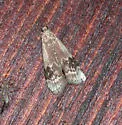
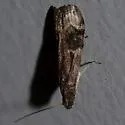
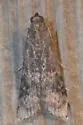
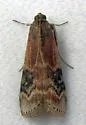
Photo credits: Contributed by Robin McLeod; Additional contributions by Chuck Sexton , Randy Hardy
Frequently Asked Questions About American Plum Borer - Hodges#5995
What is American Plum Borer - Hodges#5995?
American Plum Borer - Hodges#5995 (Euzophera semifuneralis) is a species in the family Pyralidae, within the order Lepidoptera.
How big is American Plum Borer - Hodges#5995?
Wingspan 20-25 mm. Larva to 25 mm.
How do you identify American Plum Borer - Hodges#5995?
Adult: forewing reddish-brown to AM line, which is almost halfway along wing; AM and PM lines white, zigzag, enclosing a large mottled blackish patch that begins at the costa but usually stops short of the inner margin; dark shading immediately beyond PM line resembles a diffuse irregular subterminal line; terminal area pale gray to whitish, especially near apex; hindwing dirty white or pale gray with dark terminal line and pale fringe. Larva: body color varies from dusky white to grayish purple with the dorsum darker than the underside, though many specimens taken are dark lavender or dark red; head capsule, cervical shield and anal plate vary from dark yellow to dark brown, and often exhibit indefinite pigmented areas; only long and distinct primary setae are present, giving the larva a bristly appearance. [description by Michigan State U.]
Where is American Plum Borer - Hodges#5995 found?
| Feature | Details |
|---|---|
| Habitat | Forest, ornamental, and fruit trees; larvae are found beneath the bark of living trees, usually in the trunk rather than the branches; adults are attracted to light. |
| Range | Southern Canada and all of United States. |
What does American Plum Borer - Hodges#5995 eat?
The diet of the American Plum Borer - Hodges#5995 includes Larvae feed beneath bark on the cambium layer of tree trunks of various species, including apple, apricot, basswood, cherry, cottonwood, ginkgo, mountain-ash, mulberry, nectarine, olive, peach, pear, pecan, persimmon, plum, poplar, sweet gum, walnut..
When is American Plum Borer - Hodges#5995 active?
American Plum Borer - Hodges#5995: seasonal activity - Adults fly from May to November (2 broods). Larvae from April to October, and overwinter beneath bark..
What is the life cycle of a American Plum Borer - Hodges#5995?
Two generations per year; overwinters as a mature larva beneath bark in a silken cocoon that appears identical to the one in which it pupates in April; first-brood adults emerge in May and June; 25-50 eggs are laid singly or in small clusters in bark cracks or around tree wounds; eggs hatch in about 9 days, and larval development through 7 instars takes about 5 weeks; second-brood adults emerge from July to September; eggs are laid, and larvae feed until mid-October or first frost.