
Eriocraniella mediabulla - Hodges#0013.1
Eriocraniella mediabulla
This record describes Eriocraniella mediabulla (species). Recorded family: Eriocraniidae. Recorded order: Lepidoptera.
Identification and Appearance
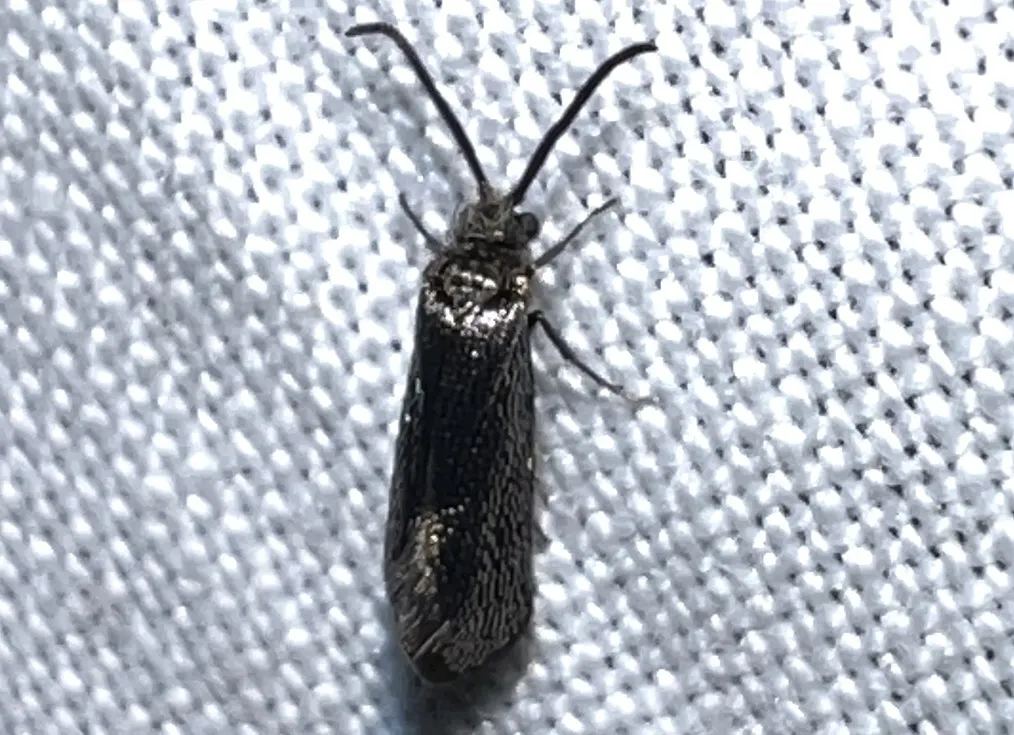
Adult : Antennae approximately 0.5 the length of FW (29-34 segmented) ● Pronotum shiny black to dark fuscous. Venter sparsely covered with buff to grayish white scales ● FW uniformly black with a distinct golden to sometimes bluish luster ● HW slightly paler, fuscous with a distinct purplish luster along costal half. Larva : Head uniformly light brown to stramineous, with frontal sutures darkly outlined. See cited reference for detailed description and images.
Wikipedia reference for Eriocraniella mediabulla: https://en.wikipedia.org/wiki/Eriocraniella_mediabulla.
Classification
- Kingdom
- Animalia
- Phylum
- Arthropoda
- Class
- Insecta
- Order
- Lepidoptera (Butterflies and Moths)
- Superfamily
- Eriocranioidea
- Family
- Eriocraniidae (Eriocraniid Moths)
- Genus
- Eriocraniella
Imported taxonomy record. Source availability varies; see the source references and editorial policy below.
Habitat and Range
Seasonal Activity
Adults are on wing from early March to mid April, univoltine.
Diet and Behavior
Diet: Larvae known to feed on Water Oak ( Quercus nigra ) and Southern Red Oak ( Quercus falcata ). May possibly feed on other oaks, as Quercus alba , Quercus hemisphaerica and Quercus virginiana . They mine the leaves of their host plant. The mine starts as a serpentine mine in the upper epidermis of the leaf, proceeding along the leaf edge to the apical portion of the leaf where a full-depth, blotch-shaped mine is produced. Full-grown larvae cut a hole in the lower leaf surface and drop to the soil surface. There, they burrow into the soil and spin a cocoon.
Life History
Eggs have been found inserted near the edge of leaves of Quercus nigra , usually beyond the distal half, and only in leaves of newly emerging buds, approximately in mid-March. Eggs hatch in 7-10 days.
Additional species information
Species notes from the sources
Etymology: The specific name is derived from Latin media (middle) and bulla (knob) and refers to the diagnostic midventral, knoblike process on the vinculum of the male.
About Butterflies and Moths: the wider group
Order-level background for Lepidoptera, the group containing Eriocraniella mediabulla. Species-specific details appear above.
Group overview
Lepidoptera includes approximately 180,000 described species of butterflies and moths. Moths outnumber butterflies roughly 10:1. The monarch butterfly's eastern population has declined by more than 80% since the mid-1990s, and the western population by over 95% since the 1980s. The IUCN lists the migratory monarch as Vulnerable.
Ecological role of the group
Butterflies and moths are essential indicators of ecosystem health. As caterpillars, they are a primary food source for birds - a single nest of blue tit chicks requires ~10,000 caterpillars. Adult moths pollinate many night-blooming plants.
Economic and practical significance of the group
Lepidoptera are critical pollinators. In Europe, grassland butterfly species have declined by almost 50% since the early 1990s. In the UK, three-quarters of butterflies are in decline. In the U.S., five butterfly species have gone extinct since 1950, with 29 listed as endangered.
Recorded sources for this group: IUCN Red List, Xerces Society, USFWS, PNAS, WWF. Imported estimates may describe particular regions or reporting periods.
Photos of Eriocraniella mediabulla - Hodges#0013.1 (2)
Photo credits: Contributed by Robert Lord Zimlich; Additional contributions by ceiseman , marcie oconnor
Frequently Asked Questions About Eriocraniella mediabulla - Hodges#0013.1
What is Eriocraniella mediabulla - Hodges#0013.1?
Eriocraniella mediabulla - Hodges#0013.1 (Eriocraniella mediabulla) is a species in the family Eriocraniidae, within the order Lepidoptera.
How big is Eriocraniella mediabulla - Hodges#0013.1?
Adult : FWL (male) = 3.8-4.1 mm; (female) 3.3-3.7 mm Larva : Length of largest larva 9 mm; diameter 1.5 mm
How do you identify Eriocraniella mediabulla - Hodges#0013.1?
Adult : Antennae approximately 0.5 the length of FW (29-34 segmented) ● Pronotum shiny black to dark fuscous. Venter sparsely covered with buff to grayish white scales ● FW uniformly black with a distinct golden to sometimes bluish luster ● HW slightly paler, fuscous with a distinct purplish luster along costal half. Larva : Head uniformly light brown to stramineous, with frontal sutures darkly outlined. See cited reference for detailed description and images.
What does Eriocraniella mediabulla - Hodges#0013.1 eat?
The diet of the Eriocraniella mediabulla - Hodges#0013.1 includes Larvae known to feed on Water Oak ( Quercus nigra ) and Southern Red Oak ( Quercus falcata ). May possibly feed on other oaks, as Quercus alba , Quercus hemisphaerica and Quercus virginiana . They mine the leaves of their host plant. The mine starts as a serpentine mine in the upper epidermis of the leaf, proceeding along the leaf edge to the apical portion of the leaf where a full-depth, blotch-shaped mine is produced. Full-grown larvae cut a hole in the lower leaf surface and drop to the soil surface. There, they burrow into the soil and spin a cocoon..
When is Eriocraniella mediabulla - Hodges#0013.1 active?
Eriocraniella mediabulla - Hodges#0013.1: seasonal activity - Adults are on wing from early March to mid April, univoltine..
What is the life cycle of a Eriocraniella mediabulla - Hodges#0013.1?
Eggs have been found inserted near the edge of leaves of Quercus nigra , usually beyond the distal half, and only in leaves of newly emerging buds, approximately in mid-March. Eggs hatch in 7-10 days.