
Dyseriocrania auricyanea - Hodges#0004
Dyseriocrania auricyanea
This record describes Dyseriocrania auricyanea (species). Recorded family: Eriocraniidae. Recorded order: Lepidoptera.
Identification and Appearance
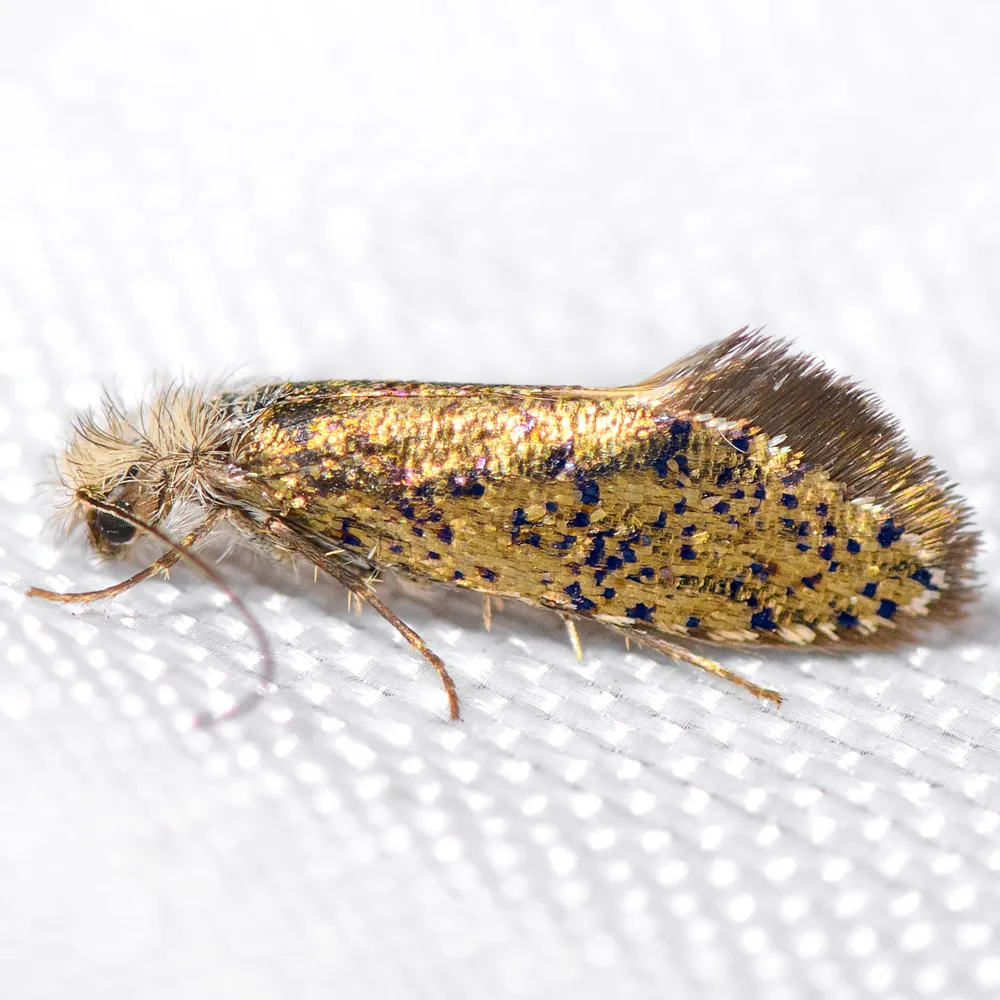
Adult - mottled golden, distinctly marked by shining purplish, most conspicuously by three regular, transverse bands slanted outward from the dorsal margin. Larva - head dark brown, abdomen appearing whitish except for a minute pair of longitudinal, brownish spots. Diurnal or crepuscular.
Wikipedia reference for Dyseriocrania auricyanea: http://en.wikipedia.org/wiki/Dyseriocrania_auricyanea.
Classification
- Kingdom
- Animalia
- Phylum
- Arthropoda
- Class
- Insecta
- Order
- Lepidoptera (Butterflies and Moths)
- Superfamily
- Eriocranioidea
- Family
- Eriocraniidae (Eriocraniid Moths)
- Genus
- Dyseriocrania
Imported taxonomy record. Source availability varies; see the source references and editorial policy below.
Habitat and Range
Geographic Range
Northern coast of California and northern Sierra Nevada to southern California and Santa Cruz Island.
Seasonal Activity
February to May.
Diet and Behavior
Diet: Larvae are leaf miners of oaks
Life History
Oviposition usually on the tip of the leaf. Eggs hatch in a week or two. Larva goes quickly goes through at least four instars. First instar mine begins as a linear or slightly curved passage to the leaf margin. Later the mine is enlarged to a full length blotch. At maturity, the larva leaves the mine through a slit in the upper leaf and burrows into the litter, forming a silken cocoon covered with darker soil particles. The larva diapauses and then pupates in winter. Adults emerge in the late winter or early spring. Moths most active in the hours just before sunset. ( 3 )
Additional species information
Species notes from the sources
Etymology: Specific epithet from Latin auri (shine like gold) and Cyane , a mythological nymph, whose name means "dark blue."
About Butterflies and Moths: the wider group
Order-level background for Lepidoptera, the group containing Dyseriocrania auricyanea. Species-specific details appear above.
Group overview
Lepidoptera includes approximately 180,000 described species of butterflies and moths. Moths outnumber butterflies roughly 10:1. The monarch butterfly's eastern population has declined by more than 80% since the mid-1990s, and the western population by over 95% since the 1980s. The IUCN lists the migratory monarch as Vulnerable.
Ecological role of the group
Butterflies and moths are essential indicators of ecosystem health. As caterpillars, they are a primary food source for birds - a single nest of blue tit chicks requires ~10,000 caterpillars. Adult moths pollinate many night-blooming plants.
Economic and practical significance of the group
Lepidoptera are critical pollinators. In Europe, grassland butterfly species have declined by almost 50% since the early 1990s. In the UK, three-quarters of butterflies are in decline. In the U.S., five butterfly species have gone extinct since 1950, with 29 listed as endangered.
Recorded sources for this group: IUCN Red List, Xerces Society, USFWS, PNAS, WWF. Imported estimates may describe particular regions or reporting periods.
Photos of Dyseriocrania auricyanea - Hodges#0004 (3)
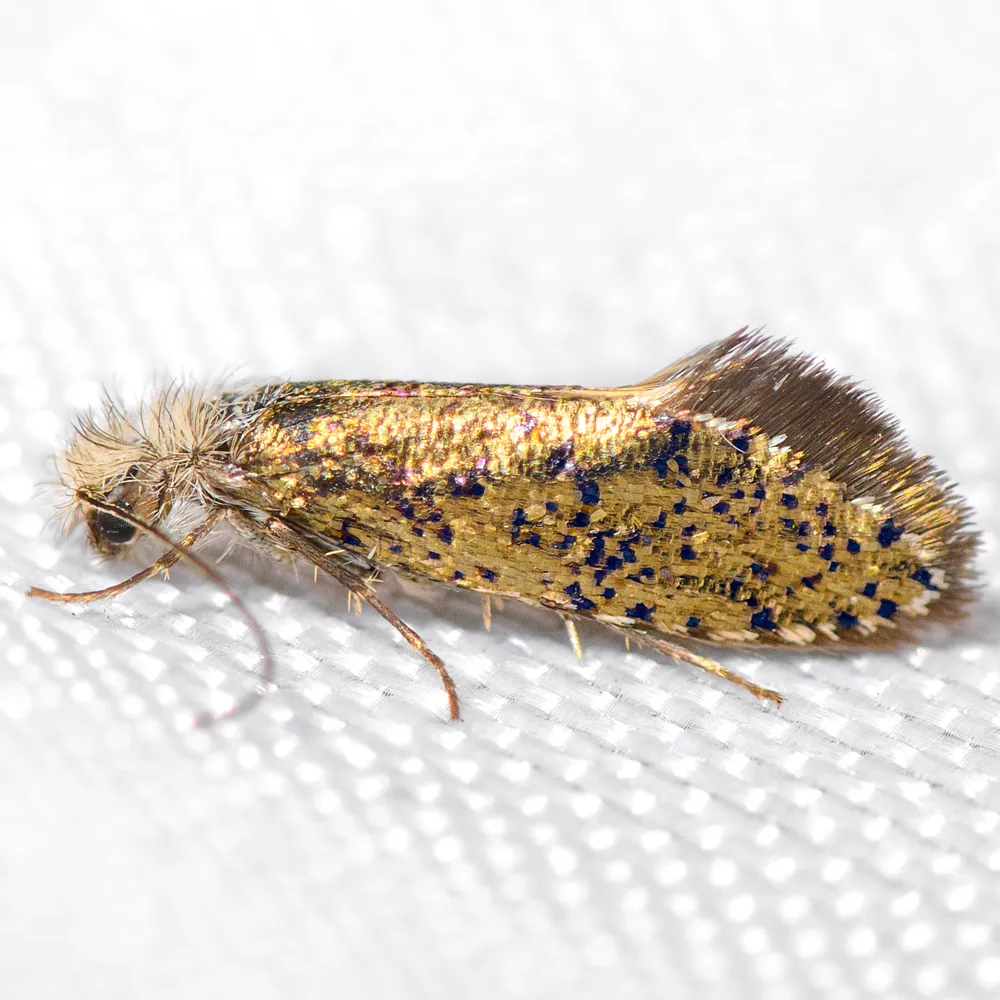
Photo credits: Contributed by Chris Grinter; Additional contributions by Randy Hardy
Frequently Asked Questions About Dyseriocrania auricyanea - Hodges#0004
What is Dyseriocrania auricyanea - Hodges#0004?
Dyseriocrania auricyanea - Hodges#0004 (Dyseriocrania auricyanea) is a species in the family Eriocraniidae, within the order Lepidoptera.
How big is Dyseriocrania auricyanea - Hodges#0004?
Forewing length 4.5-7.0 mm. Mature larva to 8.5 mm.
How do you identify Dyseriocrania auricyanea - Hodges#0004?
Adult - mottled golden, distinctly marked by shining purplish, most conspicuously by three regular, transverse bands slanted outward from the dorsal margin. Larva - head dark brown, abdomen appearing whitish except for a minute pair of longitudinal, brownish spots.
Where is Dyseriocrania auricyanea - Hodges#0004 found?
Range: Northern coast of California and northern Sierra Nevada to southern California and Santa Cruz Island.
What does Dyseriocrania auricyanea - Hodges#0004 eat?
The diet of the Dyseriocrania auricyanea - Hodges#0004 includes Larvae are leaf miners of oaks.
When is Dyseriocrania auricyanea - Hodges#0004 active?
Dyseriocrania auricyanea - Hodges#0004: seasonal activity - February to May..
What is the life cycle of a Dyseriocrania auricyanea - Hodges#0004?
Oviposition usually on the tip of the leaf. Eggs hatch in a week or two. Larva goes quickly goes through at least four instars. First instar mine begins as a linear or slightly curved passage to the leaf margin. Later the mine is enlarged to a full length blotch. At maturity, the larva leaves the mine through a slit in the upper leaf and burrows into the litter, forming a silken cocoon covered with darker soil particles. The larva diapauses and then pupates in winter. Adults emerge in the late winter or early spring. Moths most active in the hours just before sunset. ( 3 )