
Elymana sulphurella
This record describes Elymana sulphurella (species). Recorded family: Cicadellidae. Recorded order: Hemiptera.
Identification and Appearance
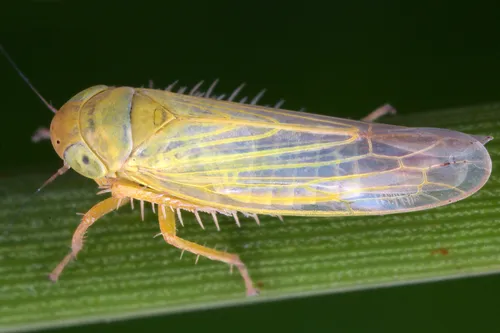
nearly identical to the native E. inornata which has overlapping range. it is imperative to obtain underside shots of females showing the pregenital sternite which has a less-pronounced median lobe. this species also has a rounder vertex than E. inornata which has a slightly pointed head. males of this species must be dissected for identification. This European species was first recorded from North America at Fredericton, New Brunswick as a pair of adults taken on 6 July 1935. A female was taken 4 days later, but the species was not again recorded until 1951, when a long series was taken at Lac Mondor, near Grand'Mkre, Quebec. By 1957 it had been found in 8 localities within a 200-km radius. Twelve years later it had spread west to Ottawa, Ontario and east to Cape Breton Highlands National Park. During the 1970s it spread throughout south- ern Ontario and Nova Scotia, where it is now locally abundant. The first record from Newfoundland is 1977, from the major port of St. John's. Surveys in 1983 and 1984 verified that this species had spread throughout Newfoundland, Prince Edward Island, and southern Quebec. - Chiykowski & Hamilton, 1985
Classification
- Kingdom
- Animalia
- Phylum
- Arthropoda
- Class
- Insecta
- Order
- Hemiptera (True Bugs, Cicadas, Hoppers, Aphids and Allies)
- Suborder
- Auchenorrhyncha
- Superfamily
- Membracoidea
- Family
- Cicadellidae (Typical Leafhoppers)
- Subfamily
- Deltocephalinae
- Tribe
- Cicadulini
- Genus
- Elymana
Imported taxonomy record. Source availability varies; see the source references and editorial policy below.
Habitat and Range
Geographic Range
native to Europe, adventive to eastern U.S. + Canada
About True Bugs, Cicadas, Hoppers, Aphids and Allies: the wider group
Order-level background for Hemiptera, the group containing Elymana sulphurella. Species-specific details appear above.
Group overview
Hemiptera (true bugs) includes over 80,000 described species across cicadas, aphids, leafhoppers, shield bugs, and bed bugs. Aphids alone cost global agriculture an estimated $2.5 billion annually in crop losses.
Ecological role of the group
Many Hemiptera are essential food sources for birds and predatory insects. Cicadas provide massive nutrient pulses during emergence events - a single Brood X emergence can involve trillions of individuals across 15 states.
Economic and practical significance of the group
The brown marmorated stink bug (Halyomorpha halys) caused $37 million in apple crop losses in a single year in the U.S. Mid-Atlantic region. Bed bug infestations in the U.S. increased by 500% between 2001-2010, costing the hotel industry hundreds of millions annually.
Recorded sources for this group: USDA, EPA, University research. Imported estimates may describe particular regions or reporting periods.
Photos of Elymana sulphurella (2)
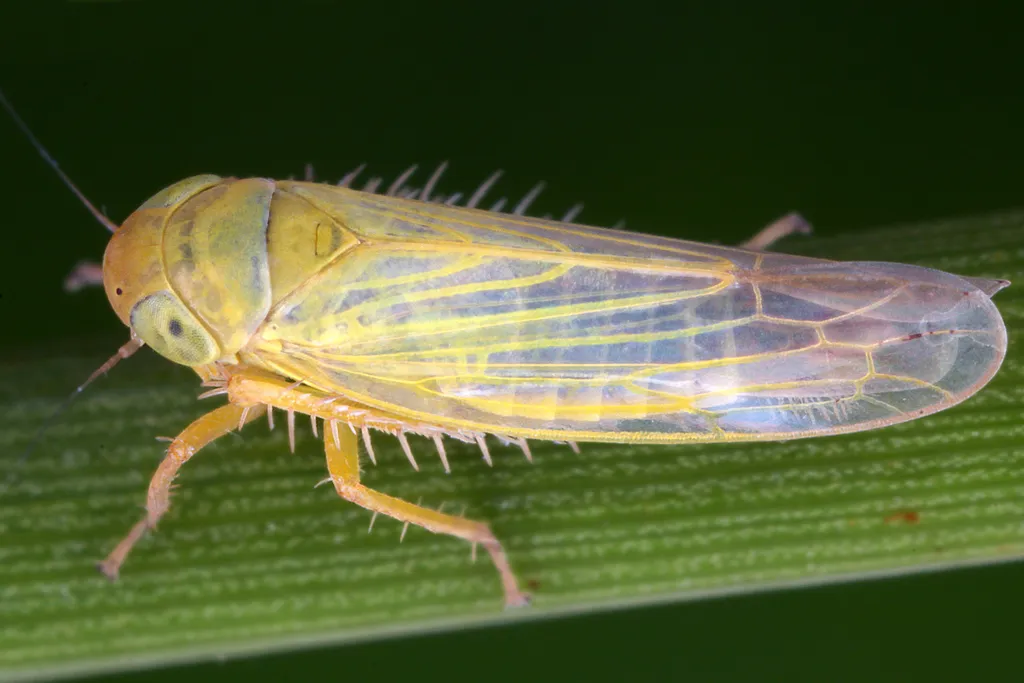
Photo credits: Contributed by Hannah Nendick-Mason; Additional contributions by v belov , antarctica
Frequently Asked Questions About Elymana sulphurella
What is Elymana sulphurella?
Elymana sulphurella is a species in the family Cicadellidae, within the order Hemiptera.
How do you identify Elymana sulphurella?
nearly identical to the native E. inornata which has overlapping range. it is imperative to obtain underside shots of females showing the pregenital sternite which has a less-pronounced median lobe. this species also has a rounder vertex than E. inornata which has a slightly pointed head. males of this species must be dissected for identification.
Where is Elymana sulphurella found?
Range: native to Europe, adventive to eastern U.S. + Canada