
Scrub Hammertail
Efferia slossonae
This record describes Efferia slossonae (species). Recorded family: Asilidae. Recorded order: Diptera.
Identification and Appearance
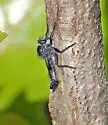
From account at Robber Flies of Florida : Quoting original description (Hine, 1919): Male. Total length 14 millimeters. Mystax prominent, mostly white, but with a number of black bristles in the upper part, palpi with black pile, beard white, dorsum of the mesothorax with long black hair and bristles, scutellum with white hairs on its disc and a few black bristles on its margin. Wings hyaline, very short, much shorter than the connecting vein; legs entirely shining black, clothed with white and black hair and black bristles. Abdominal segments two, three and four black before the narrow, gray pollinose, hind-margins, dorsally. Narrow posterior margin of four, all of five, six and seven silvery; genitalia shining black, with black hair, widened from the side gradually to middle, then narrowed gradually and with a rather large extension apically partly cut off by incisions above and below. See Figure 25. Male type from Jacksonville, Florida, collected by Mrs. Anna T. Slosson and forwarded by C. W. Johnson. Very distinct from other species of its group from Eastern United States on account of its entirely shining black legs. The male genitalia distinguish it readily.
Classification
Habitat and Range
Habitat
Areas with deep sand.
Geographic Range
Eastern Georgia (disjunct populations), south to central Florida--Highlands and Martin Counties.
Seasonal Activity
February-May (Florida)
Additional species information
Species notes from the sources
Etymology: Eponym for entomologist and author Annie Trumbull Slosson (1838-1926). Scrub Hammertail: https://www.robberfliesoftheworld.com/NA_CommonNames.php
About Flies: the wider group
Order-level background for Diptera, the group containing Efferia slossonae. Species-specific details appear above.
Group overview
Diptera includes over 150,000 described species of flies, mosquitoes, and midges. Mosquitoes are the deadliest animal on Earth (CDC). Malaria alone causes ~249 million cases and over 608,000 deaths annually, mostly children under 5 (WHO). Vector-borne diseases account for over 17% of all infectious diseases, causing 700,000+ deaths per year.
Ecological role of the group
Despite their disease impact, flies are critical decomposers and pollinators. Hoverflies alone pollinate hundreds of crop and wildflower species. Flies are also the primary food source for many birds, bats, and fish. Forensic entomology relies heavily on fly species for crime scene analysis.
Economic and practical significance of the group
In the U.S., vector-borne disease cases tripled between 2004-2016, with over 640,000 cases reported in that period (CDC). Tickborne diseases doubled from 22,000 to 48,000 annual reports. Globally, mosquito-borne diseases cost billions in healthcare and lost productivity.
Recorded sources for this group: WHO, CDC, PNAS. Imported estimates may describe particular regions or reporting periods.
Photos of Scrub Hammertail (2)
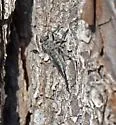
Photo credits: Contributed by Giff Beaton; Additional contributions by cotinis , Chris Cohen
Frequently Asked Questions About Scrub Hammertail
What is Scrub Hammertail?
Scrub Hammertail (Efferia slossonae) is a species in the family Asilidae, within the order Diptera.
How big is Scrub Hammertail?
12-14 mm (small--Robber Flies of Florida)
How do you identify Scrub Hammertail?
From account at Robber Flies of Florida : Quoting original description (Hine, 1919): Male. Total length 14 millimeters. Mystax prominent, mostly white, but with a number of black bristles in the upper part, palpi with black pile, beard white, dorsum of the mesothorax with long black hair and bristles, scutellum with white hairs on its disc and a few black bristles on its margin. Wings hyaline, very short, much shorter than the connecting vein; legs entirely shining black, clothed with white and black hair and black bristles. Abdominal segments two, three and four black before the narrow, gray pollinose, hind-margins, dorsally. Narrow posterior margin of four, all of five, six and seven silvery; genitalia shining black, with black hair, widened from the side gradually to middle, then narrowed gradually and with a rather large extension apically partly cut off by incisions above and below. See Figure 25. Male type from Jacksonville, Florida, collected by Mrs. Anna T. Slosson and forwarded by C. W. Johnson. Very distinct from other species of its group from Eastern United States on account of its entirely shining black legs. The male genitalia distinguish it readily.
Where is Scrub Hammertail found?
| Feature | Details |
|---|---|
| Habitat | Areas with deep sand. |
| Range | Eastern Georgia (disjunct populations), south to central Florida--Highlands and Martin Counties. |
When is Scrub Hammertail active?
Scrub Hammertail: seasonal activity - February-May (Florida).