
Northern Flare Fly
Eccritosia zamon
This record describes Eccritosia zamon (species). Recorded family: Asilidae. Recorded order: Diptera.
Identification and Appearance
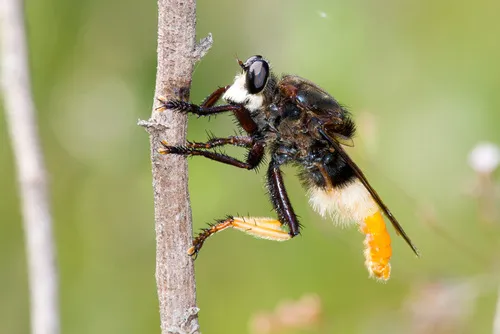
| Feature | Description |
|---|---|
| Additional details | Appearance distinctive--see images. Quoting original description (Townsend, 1895): A stout species with large thorax. |
| Head | Head blackish, front with black hair; face more yellowish, with long pale yellow beard, extending on the cheeks. First antennal joint black; second and third brown, subequal, shorter than first, style longer than antennae. |
| Thorax | Thorax soft brownish black, with an indistinct pair of median vittae, having a narrow reddish line between them anteriorly which may extend to scutellum. A reddish line extending inward on suture from root of wings, and a line outside median vittae posteriorly. A whitish spot inside the humeri. Humeri, edges of thoracic dorsum, and the scutellum brown, the latter with bristly black hair, hind margins of thorax with black macrochaetae. First two abdominal segments blackish with blackish pile, the second usually with a yellow hind margin; rest of abdomen yellow, with yellow pile which is chiefly on third and fourth segments. Some yellow pile on hind margin of second segment in both sexes Terminal segments with a deeper yellow tinge. |
| Abdomen | Abdomen tapering in both sexes, more so in female, ovipositor rather small and spinose, hypopygium small. |
| Legs | Legs chestnut brown, with black hair and black macrochaetae, the hind tibiae conspicuously yellowish with yellow hair, the hind tarsi pale brownish. Pulvilli broadly yellowish on borders. |
| Wings | Wings subhyaline, very evenly tinged with smoky. Mimics orchid bees, in particular Eulaema polychroma. |
Classification
Habitat and Range
Geographic Range
AZ-TX to Panama ; BugGuide records from LA, FL.
Additional species information
Species notes from the sources
Etymology: Eccritosia zamon ( Townsend 1895) Northern Flare Fly: Robber Flies of the World
About Flies: the wider group
Order-level background for Diptera, the group containing Eccritosia zamon. Species-specific details appear above.
Group overview
Diptera includes over 150,000 described species of flies, mosquitoes, and midges. Mosquitoes are the deadliest animal on Earth (CDC). Malaria alone causes ~249 million cases and over 608,000 deaths annually, mostly children under 5 (WHO). Vector-borne diseases account for over 17% of all infectious diseases, causing 700,000+ deaths per year.
Ecological role of the group
Despite their disease impact, flies are critical decomposers and pollinators. Hoverflies alone pollinate hundreds of crop and wildflower species. Flies are also the primary food source for many birds, bats, and fish. Forensic entomology relies heavily on fly species for crime scene analysis.
Economic and practical significance of the group
In the U.S., vector-borne disease cases tripled between 2004-2016, with over 640,000 cases reported in that period (CDC). Tickborne diseases doubled from 22,000 to 48,000 annual reports. Globally, mosquito-borne diseases cost billions in healthcare and lost productivity.
Recorded sources for this group: WHO, CDC, PNAS. Imported estimates may describe particular regions or reporting periods.
Photos of Northern Flare Fly (2)
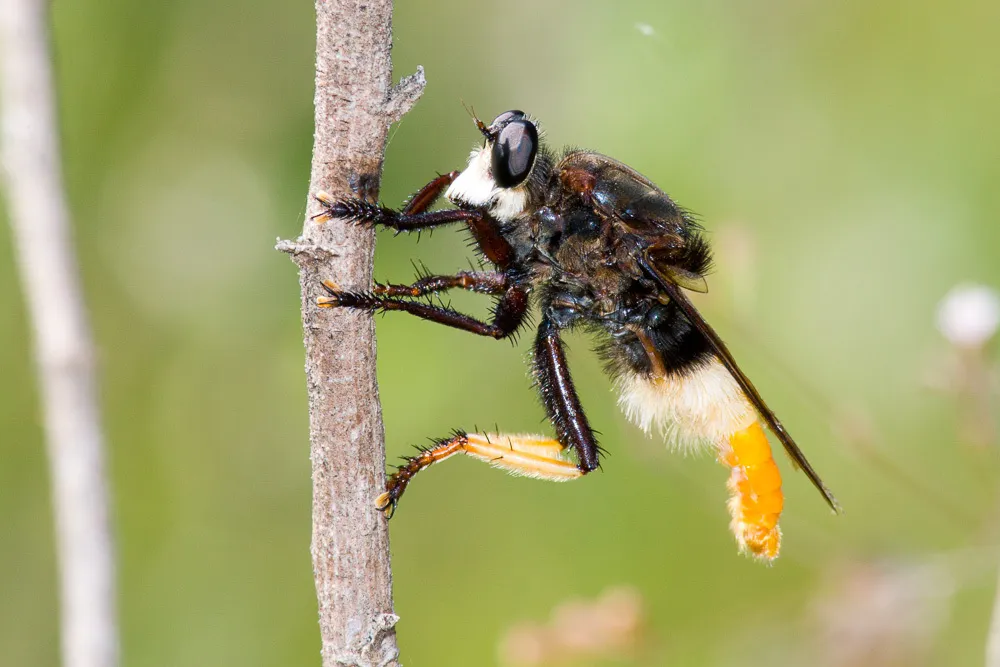
Photo credits: Contributed by Keith Bayless; Additional contributions by cotinis , Mike Quinn , John S. Ascher , v belov , Chris Cohen
Frequently Asked Questions About Northern Flare Fly
What is Northern Flare Fly?
Northern Flare Fly (Eccritosia zamon) is a species in the family Asilidae, within the order Diptera.
How big is Northern Flare Fly?
21-27 mm (Townsend, 1895)
How do you identify Northern Flare Fly?
| Feature | Description |
|---|---|
| Additional details | Appearance distinctive--see images. Quoting original description (Townsend, 1895): A stout species with large thorax. |
| Head | Head blackish, front with black hair; face more yellowish, with long pale yellow beard, extending on the cheeks. First antennal joint black; second and third brown, subequal, shorter than first, style longer than antennae. |
| Thorax | Thorax soft brownish black, with an indistinct pair of median vittae, having a narrow reddish line between them anteriorly which may extend to scutellum. A reddish line extending inward on suture from root of wings, and a line outside median vittae posteriorly. A whitish spot inside the humeri. Humeri, edges of thoracic dorsum, and the scutellum brown, the latter with bristly black hair, hind margins of thorax with black macrochaetae. First two abdominal segments blackish with blackish pile, the second usually with a yellow hind margin; rest of abdomen yellow, with yellow pile which is chiefly on third and fourth segments. Some yellow pile on hind margin of second segment in both sexes Terminal segments with a deeper yellow tinge. |
| Abdomen | Abdomen tapering in both sexes, more so in female, ovipositor rather small and spinose, hypopygium small. |
| Legs | Legs chestnut brown, with black hair and black macrochaetae, the hind tibiae conspicuously yellowish with yellow hair, the hind tarsi pale brownish. Pulvilli broadly yellowish on borders. |
| Wings | Wings subhyaline, very evenly tinged with smoky. |
Where is Northern Flare Fly found?
Range: AZ-TX to Panama ; BugGuide records from LA, FL.