
Dyer's Gall
Andricus infectorius
This record describes Andricus infectorius (species). Recorded family: Cynipidae. Recorded order: Hymenoptera.
Identification and Appearance
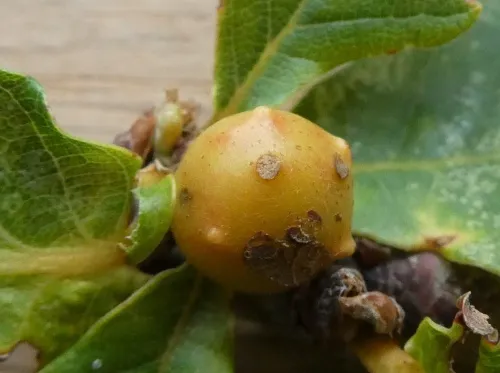
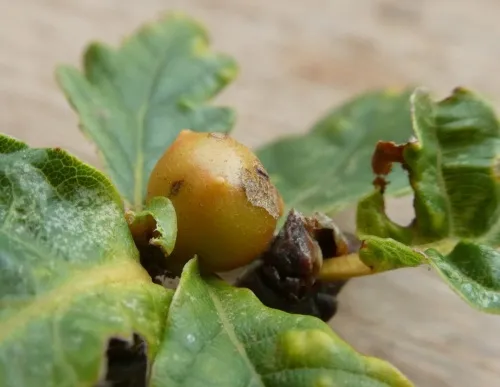
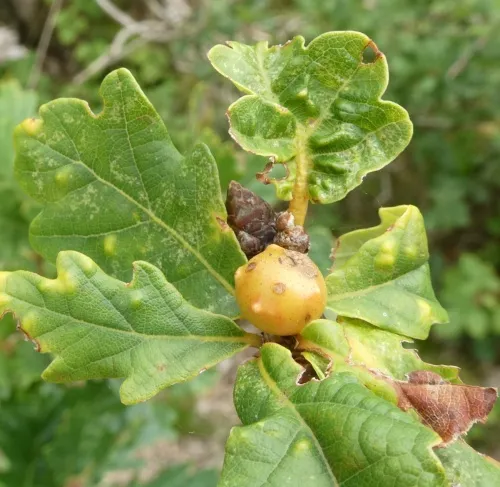
The agamic form is a medium-sized gall on oak buds. Rounded and may be nearly spherical, up to 15mm diameter, with a narrow attachment to a lateral or terminal bud on oak. Green then becoming reddish or orangey brown, often with light brown warty lumps, which sometimes create a 'crown'. The sexual generation forms small galls in Turkey Oak catkins, but has not yet been found in the UK. Andricus kollari is usually larger, but sizes are variable. The narrowing of the base to a narrow point of attachment appears to be a constant feature (ref. Redfern & Shirley, 2023) A photograph of the gall in situ on the oak twig. Note size of gall. It may be necessary to have this record verified by an expert in galls. Scattered records; first recorded from the UK in 2013. Widespread in the Mediterranean region, and may have been introduced in 18th/19th centuries to provide a source of tannin used in the dye industry and in ink production, and been unnoticed in the UK until recently. (ref. Leach, 2020) Rare in VC55; first found in 2018. All records to autumn 2023 are from Charnwood Forest. Redfern, M & Shirley, P. 2023 British Plant Galls (third edition). FSC Leach, C. 2020. Andricus infectorius (Hartig,1843): Biology, History & its occurrence in Britain. Cecidology 35: 22-26.) https://bladmineerders.nl/parasites/animalia/arthropoda/insecta/hymenoptera/apocrita/cynipoidea/cynipidae/cynipinae/cynipini/andricus/andricus-infectorius/ No additional images available for this species.
Classification
- Kingdom
- Animalia
- Phylum
- Arthropoda
- Class
- Insecta
- Order
- Hymenoptera
- Family
- Cynipidae
- Genus
- Andricus
Imported taxonomy record. Source availability varies; see the source references and editorial policy below.
Habitat and Range
Habitat
Oak trees
Seasonal Activity
Autumn
Additional species information
Recorded status
Scattered records; first recorded from the UK in 2013. Widespread in the Mediterranean region, and may have been introduced in 18th/19th centuries to provide a source of tannin used in the dye industry and in ink production, and been unnoticed in the UK until recently. (ref. Leach, 2020)
About Flies: the wider group
Order-level background for Hymenoptera, the group containing Andricus infectorius. Species-specific details appear above.
Group overview
Hymenoptera includes over 150,000 described species of ants, bees, wasps, and sawflies. Earth harbors approximately 20 quadrillion (20×10^15) ants, with a combined biomass of ~12 megatons of dry carbon - exceeding the combined biomass of all wild birds and mammals (PNAS, 2022).
Ecological role of the group
About 35% of the world's food crops depend on animal pollinators. The chocolate industry, valued at over $100 billion, depends on pollinating flies and midges. Ants are the dominant soil engineers in most terrestrial ecosystems, turning more soil than earthworms in many habitats.
Economic and practical significance of the group
Pollinators contribute $235-577 billion worth of annual global food production (FAO). In the U.S., bee pollination alone benefits crops valued at $18 billion annually, and honey bees are responsible for $5.4 billion in agricultural productivity. Between April 2023-2024, 55.1% of managed honey bee colonies were lost. The U.S. bee population dropped from 5 million to 2.5 million.
Recorded sources for this group: FAO, USDA, EPA, PNAS (2022), US Fish & Wildlife Service. Imported estimates may describe particular regions or reporting periods.
Photos of Dyer's Gall (3)
Frequently Asked Questions About Dyer's Gall
What is Dyer's Gall?
Dyer's Gall (Andricus infectorius) is a species in the family Cynipidae, within the order Hymenoptera.
Where is Dyer's Gall found?
Habitat: Oak trees
When is Dyer's Gall active?
Dyer's Gall: seasonal activity - Autumn.