
Six-banded Longhorn Beetle
Dryobius sexnotatus
This record describes Dryobius sexnotatus (species). Recorded family: Cerambycidae. Recorded order: Coleoptera.
Identification and Appearance
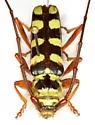
pattern distinctive: (recently collected in e. TX; state record) Uncommon/rare ; widely scattered, populations are sparse ; listed as rare or threatened by several states, e.g. considered a SGCN by AR, LA, and VA Dury noted that D. sexnotatus was once abundant but was even then becoming rare. Perry et al. noted a sharp decline in the collection since 1942.
Classification
- Kingdom
- Animalia
- Phylum
- Arthropoda
- Class
- Insecta
- Order
- Coleoptera (Beetles)
- Suborder
- Polyphaga
- Superfamily
- Chrysomeloidea
- Family
- Cerambycidae (Longhorn Beetles)
- Subfamily
- Cerambycinae
- Tribe
- Dryobiini
- Genus
- Dryobius
Imported taxonomy record. Source availability varies; see the source references and editorial policy below.
Habitat and Range
Habitat
Old growth hardwood forests; mostly in large, very old deteriorating sugar maple trees that have been wounded/scarred; adults hide under bark . In PA, all of the sugar maples observed were very old and at least 3 ft across. Most sites are located in stream valleys. (Perry et al. 1974)
Geographic Range
e US (TX-GA-PA-KS) - Map (Skillman 1993) ; >80% of specimens examined by Perry et al. were from the Ohio River Valley
Seasonal Activity
Flies early March to early September (most records Jun 15 to Jul 15) (Perry et al. 1974)
Diet and Behavior
Diet: Primary host: sugar maple ( Acer saccharum ) (larvae bore in living and dead trees); also basswood, beech, linden and rarely elm Can maintain itself on other hosts for a short period, but survival seems to depend on the availability of large, very old (overmature) sugar maple trees (Perry et al. 1974)
About Primitive Winged Insects: the wider group
Order-level background for Coleoptera, the group containing Dryobius sexnotatus. Species-specific details appear above.
Group overview
Coleoptera is the largest order of insects with over 400,000 described species, representing ~25% of all known animal species and ~40% of all insects. In the U.S. alone, nearly 30,000 beetle species have been identified.
Ecological role of the group
Beetles are prominent decomposers, especially in forests, breaking down dead wood and recycling nutrients. As predators, they reduce populations of pest insects. Many species are also important pollinators of flowering plants.
Economic and practical significance of the group
Beetles have major economic significance: leaf beetles (Chrysomelidae) and weevils (Curculionoidea) are among the most destructive agricultural pests globally, costing billions annually, while predatory species like ladybugs provide natural pest control.
Recorded sources for this group: Britannica, Smithsonian, NCSU Entomology. Imported estimates may describe particular regions or reporting periods.
Photos of Six-banded Longhorn Beetle (5)
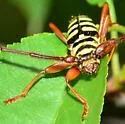
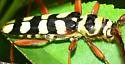
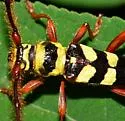
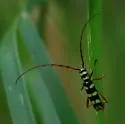
Photo credits: Contributed by Troy Bartlett; Additional contributions by Mike Quinn , v belov
Frequently Asked Questions About Six-banded Longhorn Beetle
What is Six-banded Longhorn Beetle?
Six-banded Longhorn Beetle (Dryobius sexnotatus) is a species in the family Cerambycidae, within the order Coleoptera.
How big is Six-banded Longhorn Beetle?
18-25 mm ( 3 )
How do you identify Six-banded Longhorn Beetle?
pattern distinctive: (recently collected in e. TX; state record)
Where is Six-banded Longhorn Beetle found?
| Feature | Details |
|---|---|
| Habitat | Old growth hardwood forests; mostly in large, very old deteriorating sugar maple trees that have been wounded/scarred; adults hide under bark . In PA, all of the sugar maples observed were very old and at least 3 ft across. Most sites are located in stream valleys. (Perry et al. 1974) |
| Range | e US (TX-GA-PA-KS) - Map (Skillman 1993) ; >80% of specimens examined by Perry et al. were from the Ohio River Valley |
What does Six-banded Longhorn Beetle eat?
The diet of the Six-banded Longhorn Beetle includes Primary host: sugar maple ( Acer saccharum ) (larvae bore in living and dead trees); also basswood, beech, linden and rarely elm Can maintain itself on other hosts for a short period, but survival seems to depend on the availability of large, very old (overmature) sugar maple trees (Perry et al. 1974).
When is Six-banded Longhorn Beetle active?
Six-banded Longhorn Beetle: seasonal activity - Flies early March to early September (most records Jun 15 to Jul 15) (Perry et al. 1974).