
Dolichopus tenuipes
This record describes Dolichopus tenuipes (species). Recorded family: Dolichopodidae. Recorded order: Diptera.
Identification and Appearance
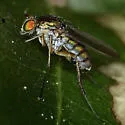
Dolichopus tenuipes has the fore tarsi in the male exceedingly elongated, and slender, with the last joint in the shape of a comparatively large, oval black disk... I observed in September the maneuvers of the male in courting the female. He would place himself directly in front of her, at a distance of about half an inch, with his face toward her. He would then rapidly vibrate his wings, holding them horizontally at right angles to the body; and at the same time would give these fore feet an up and down motion, raising them simultaneously to the level of the head and bring them down with a slight force upon the ground, the movement recurring in a measured way in about half a second. This he would continue for about 10 seconds; then, rising on the wing, he would swiftly make a small semicircle in the air and attempt to alight upon the female. In the large number of cases that I observed, he was always unsuccessful, the female hastily moving away a few inches, when the male would usually alight before her and repeat the movements. ... I saw the same maneuver repeated hundreds of times. -- J. M. Aldrich (1894 quoted in Van Duzee et al. 1922 )
Classification
- Kingdom
- Animalia
- Phylum
- Arthropoda
- Class
- Insecta
- Order
- Diptera (Flies)
- Superfamily
- Empidoidea
- Family
- Dolichopodidae (Longlegged Flies)
- Subfamily
- Dolichopodinae
- Genus
- Dolichopus
Imported taxonomy record. Source availability varies; see the source references and editorial policy below.
About Flies: the wider group
Order-level background for Diptera, the group containing Dolichopus tenuipes. Species-specific details appear above.
Group overview
Diptera includes over 150,000 described species of flies, mosquitoes, and midges. Mosquitoes are the deadliest animal on Earth (CDC). Malaria alone causes ~249 million cases and over 608,000 deaths annually, mostly children under 5 (WHO). Vector-borne diseases account for over 17% of all infectious diseases, causing 700,000+ deaths per year.
Ecological role of the group
Despite their disease impact, flies are critical decomposers and pollinators. Hoverflies alone pollinate hundreds of crop and wildflower species. Flies are also the primary food source for many birds, bats, and fish. Forensic entomology relies heavily on fly species for crime scene analysis.
Economic and practical significance of the group
In the U.S., vector-borne disease cases tripled between 2004-2016, with over 640,000 cases reported in that period (CDC). Tickborne diseases doubled from 22,000 to 48,000 annual reports. Globally, mosquito-borne diseases cost billions in healthcare and lost productivity.
Recorded sources for this group: WHO, CDC, PNAS. Imported estimates may describe particular regions or reporting periods.