
Dolichopus longimanus
This record describes Dolichopus longimanus (species). Recorded family: Dolichopodidae. Recorded order: Diptera.
Identification and Appearance
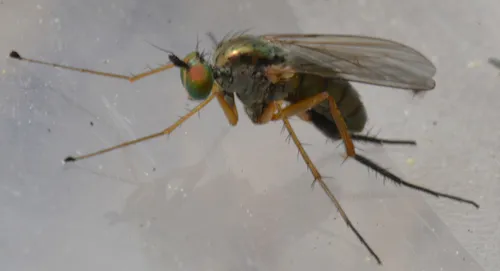
Dolichopus longimanus Loew is a species with much elongated front tarsi, the last joint being black and enlarged. I observed the courtship on the trunks of trees at Simpson Park, Big Stone City, South Dakota, in 1896, and although I have no notes I believe I can record the facts even yet. The male approaches the female directly from behind (below, as on vertical surfaces they always face upward); he walks on the tips of his toes with his front feet, assuming in consequence a reared-up attitude. As he comes to the female he advances his front tarsi on each side of her until their tips are even with her head, which is about as far as they can be extended. Then he deliberately raises the tarsi until the enlarged apical joint touches on each side the eye of the female, continuing the movement upward. But just as his tarsi touch her eyes, he advances his hypopygium and attempts to grasp the tip of her abdomen. She immediately dodges away, and the performance is repeated.
Classification
- Kingdom
- Animalia
- Phylum
- Arthropoda
- Class
- Insecta
- Order
- Diptera (Flies)
- Superfamily
- Empidoidea
- Family
- Dolichopodidae (Longlegged Flies)
- Subfamily
- Dolichopodinae
- Genus
- Dolichopus
Imported taxonomy record. Source availability varies; see the source references and editorial policy below.
Habitat and Range
Geographic Range
Widespread boreal and transition (Alaska to New Hampshire south to Colorado and Virginia)
Additional species information
Species notes from the sources
Etymology: Lognimanus means long hands. The male has very long fore tarsi.
About Flies: the wider group
Order-level background for Diptera, the group containing Dolichopus longimanus. Species-specific details appear above.
Group overview
Diptera includes over 150,000 described species of flies, mosquitoes, and midges. Mosquitoes are the deadliest animal on Earth (CDC). Malaria alone causes ~249 million cases and over 608,000 deaths annually, mostly children under 5 (WHO). Vector-borne diseases account for over 17% of all infectious diseases, causing 700,000+ deaths per year.
Ecological role of the group
Despite their disease impact, flies are critical decomposers and pollinators. Hoverflies alone pollinate hundreds of crop and wildflower species. Flies are also the primary food source for many birds, bats, and fish. Forensic entomology relies heavily on fly species for crime scene analysis.
Economic and practical significance of the group
In the U.S., vector-borne disease cases tripled between 2004-2016, with over 640,000 cases reported in that period (CDC). Tickborne diseases doubled from 22,000 to 48,000 annual reports. Globally, mosquito-borne diseases cost billions in healthcare and lost productivity.
Recorded sources for this group: WHO, CDC, PNAS. Imported estimates may describe particular regions or reporting periods.
Photos of Dolichopus longimanus (2)
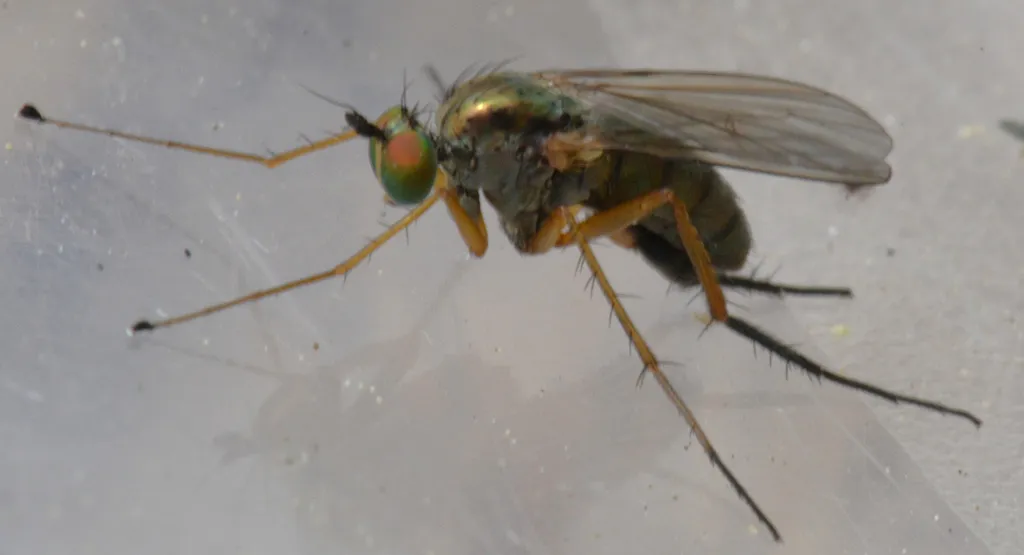
Photo credits: Contributed by John F. Carr