
Diviana eudoreella - Hodges#5929
Diviana eudoreella
This record describes Diviana eudoreella (species). Recorded family: Pyralidae. Recorded order: Lepidoptera.
Identification and Appearance
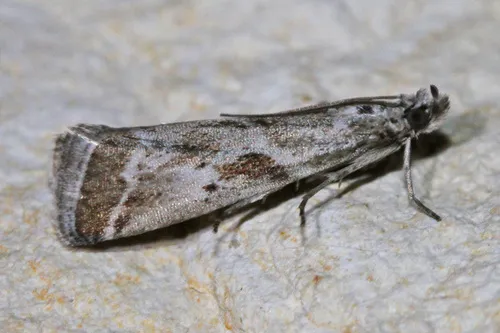
Heinrich revised description from PDF. Forewing blackish brown, the median area heavily dusted with white, giving it an ashy gray appearance; antemedial white line nearly straight, slanting outwardly from costa to inner margin, slightly notched at lower fold, bordered outwardly by a blackish line which expands to a triangular blotch at costa, a similar, somewhat smaller blotch bordering the fine at inner margin; subterminal white line parallel to termen, notched at vein 6 and at lower fold, towards costa bordered inwardly by a fuscous streak; discal dots at end of cell distinct, blackish ; entire outer area between subterminal line and termen blackish brown. Hind wing pale smoky fuscous, with a darker line along termen and some very faint dark shading on the veins. Alar expanse, 16-19 mm. Specimen determined by DNA analysis (BOLD). A personal observation: There is a very distinctive dark spot on the palps. A. Hendrickson
Classification
- Kingdom
- Animalia
- Phylum
- Arthropoda
- Class
- Insecta
- Order
- Lepidoptera (Butterflies and Moths)
- Superfamily
- Pyraloidea
- Family
- Pyralidae (Pyralid Moths)
- Subfamily
- Phycitinae
- Tribe
- Phycitini
- Genus
- Diviana
Imported taxonomy record. Source availability varies; see the source references and editorial policy below.
Habitat and Range
Geographic Range
Florida to Texas ( 4 ) . Moth Photographers Group map displays a few northern records.(?) ( 5 ) Holotype from "Florida".
About Butterflies and Moths: the wider group
Order-level background for Lepidoptera, the group containing Diviana eudoreella. Species-specific details appear above.
Group overview
Lepidoptera includes approximately 180,000 described species of butterflies and moths. Moths outnumber butterflies roughly 10:1. The monarch butterfly's eastern population has declined by more than 80% since the mid-1990s, and the western population by over 95% since the 1980s. The IUCN lists the migratory monarch as Vulnerable.
Ecological role of the group
Butterflies and moths are essential indicators of ecosystem health. As caterpillars, they are a primary food source for birds - a single nest of blue tit chicks requires ~10,000 caterpillars. Adult moths pollinate many night-blooming plants.
Economic and practical significance of the group
Lepidoptera are critical pollinators. In Europe, grassland butterfly species have declined by almost 50% since the early 1990s. In the UK, three-quarters of butterflies are in decline. In the U.S., five butterfly species have gone extinct since 1950, with 29 listed as endangered.
Recorded sources for this group: IUCN Red List, Xerces Society, USFWS, PNAS, WWF. Imported estimates may describe particular regions or reporting periods.
Photos of Diviana eudoreella - Hodges#5929 (2)
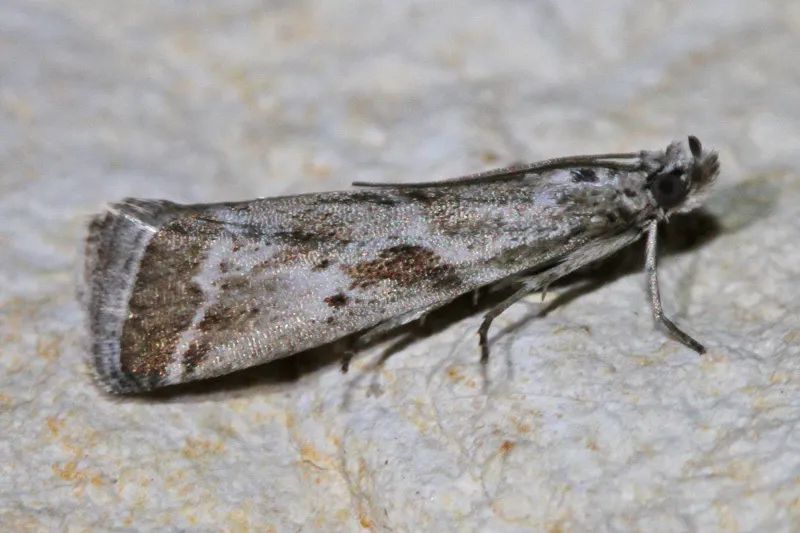
Photo credits: Contributed by Maury J. Heiman; Additional contributions by A. Hendrickson
Frequently Asked Questions About Diviana eudoreella - Hodges#5929
What is Diviana eudoreella - Hodges#5929?
Diviana eudoreella - Hodges#5929 (Diviana eudoreella) is a species in the family Pyralidae, within the order Lepidoptera.
How big is Diviana eudoreella - Hodges#5929?
Heinrich listed the wingspan 16-19 mm. Hulst listed a wingspan of 15 mm.
How do you identify Diviana eudoreella - Hodges#5929?
Heinrich revised description from PDF. Forewing blackish brown, the median area heavily dusted with white, giving it an ashy gray appearance; antemedial white line nearly straight, slanting outwardly from costa to inner margin, slightly notched at lower fold, bordered outwardly by a blackish line which expands to a triangular blotch at costa, a similar, somewhat smaller blotch bordering the fine at inner margin; subterminal white line parallel to termen, notched at vein 6 and at lower fold, towards costa bordered inwardly by a fuscous streak; discal dots at end of cell distinct, blackish ; entire outer area between subterminal line and termen blackish brown. Hind wing pale smoky fuscous, with a darker line along termen and some very faint dark shading on the veins. Alar expanse, 16-19 mm. Specimen determined by DNA analysis (BOLD).
Where is Diviana eudoreella - Hodges#5929 found?
Range: Florida to Texas ( 4 ) . Moth Photographers Group map displays a few northern records.(?) ( 5 ) Holotype from Florida.